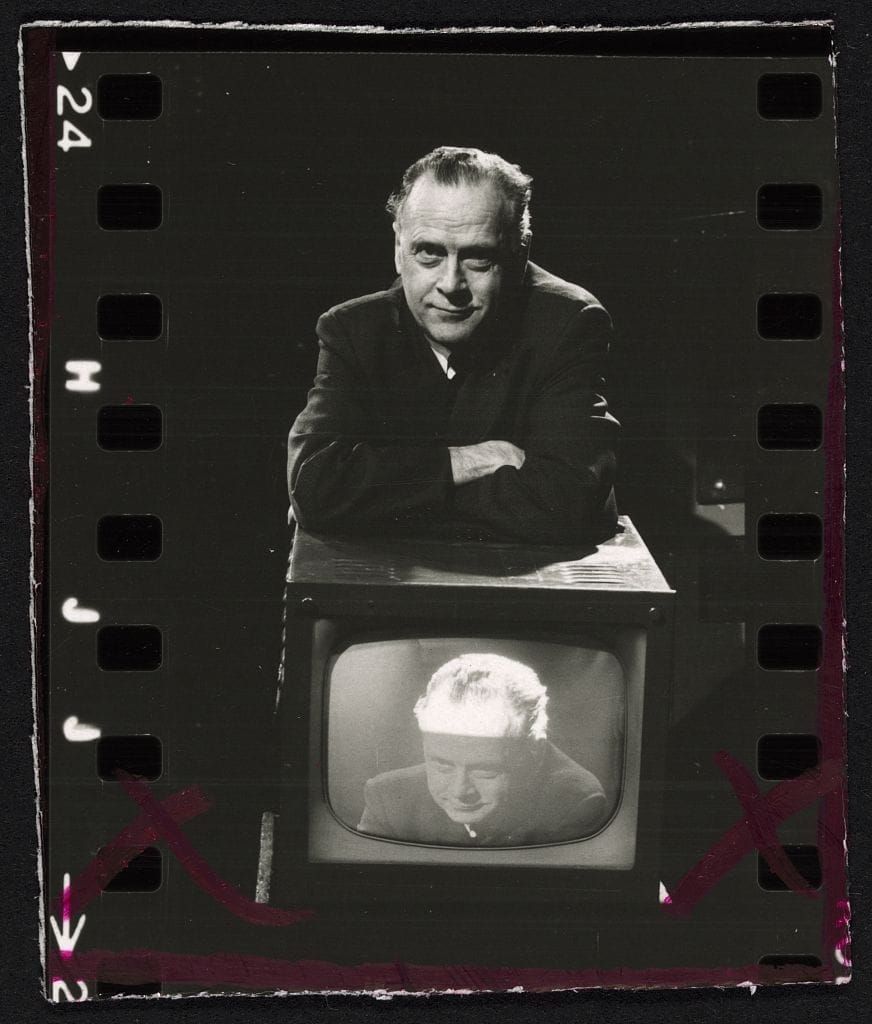
Marshall McLuhan's ideas were too advanced for the television age. In the era of social media and AI, they have become indispensable.
Editors’ Preface:
Marshall McLuhan’s mode of analysis was of such singular power and significance that the American novelist Tom Wolfe described him as the Western Hemisphere’s first and perhaps only “theorist of everything,” a peer to Darwin, Freud, and Marx. And where past theories of everything put forward natural selection, the unconscious, or class struggle as the driving forces of history, McLuhan elevated before a global audience, as no other thinker had before, the often unseen and unexamined power of media technologies, which he treated as extensions of the human body and mind. His genius, sparked in part under the inspiration of Harold Innis, was to look past the foreground of everyday communication and to see the background as itself an object worthy of purposeful study, thus his most famous aphorism, “the medium is the message.”
Yet McLuhan does not at all occupy a central place in contemporary debates on technology. Amid screen saturation and AI mania, he has been seemingly sidelined—particularly in his native Canada. Much work remains for those who wish to resuscitate his legacy just at a time when it is most needed, among a youth cohort raised in the full sweep of the digital deluge. But before that can even be attempted, we must first reacquaint ourselves with the details of his life and look more closely at how his work brilliantly prefigured our present, which will be the objective of this essay by Canadian media ecologist Andrey Mir. The following may be taken as an opening foray into what ought to be a sustained national conversation about understanding what our technologies are doing to us and what we can do to go beyond our generally indulgent and deferential attitudes toward them.
Marshall McLuhan is the best known Canadian thinker in the world. It would not be a stretch to add that he is the best known Canadian overall, at least beyond the ice rink.
Of course, we also have Leonard Cohen, Joni Mitchell, Drake, and Justin Bieber. Yet they rose to fame through American mass culture, which has boosted so many Canadian talents, if not all of them. But when it comes to distinctly Canadian intellectual brands, McLuhan, along with Harold Innis and perhaps insulin inventor Sir Frederick Banting, are the first names that come to mind. Just as with Wayne Gretzky on the ice, Marshall McLuhan stood out as unmistakably Canadian. You could say McLuhan was “elbows up” long before the phrase was in vogue, but his elbows were not up to oppose an external threat, American or otherwise. He needed no “significant other” to lean on or push against. He was significant enough on his own, and that makes him a role model, especially now, as Canada again searches for a national identity after Justin Trudeau’s “post‑national state” and Donald Trump’s “51st state.”
But it is not for fame that Marshall McLuhan should be appreciated. It is above all his intellectual legacy that calls for our attention. His ideas shaped the world’s understanding of media and continue to define how we make sense of the internet, social media, and now even artificial intelligence.
Marshall McLuhan was born on July 21, 1911, in Edmonton, Alberta, and raised in Winnipeg, Manitoba. His father, Herbert Ernest McLuhan, worked in real estate and insurance, and his mother, Elsie Naomi McLuhan (née Hall), was a schoolteacher who later became a “platform elocutionist,” an artist who toured with readings and performances. “She was well known and acclaimed in her time, and would read poetry and perform plays, playing all the characters herself,” writes Andrew McLuhan, Marshall’s grandson.
Elsie’s public readings and performances likely influenced Marshall’s way of speaking, writing, and thinking. He loved public speaking, often dictated his texts, and liked to sharpen ideas into aphorisms. Many of his insights came wrapped in striking metaphors, like his most famous one‑liner, “The medium is the message.” So, his mother’s elocution career can be seen as an early family lesson in how the form of communication affects perception.
Another formative lesson came at Cambridge University, where McLuhan studied literary criticism focused on how the form of poetry shapes what readers perceive. That close reading of poetic structures was a major step toward understanding how form itself becomes the message. As McLuhan wrote later, “I simply extend this kind of ‘language of forms’ analysis from poetry to the popular media.”
In the early 1950s, McLuhan taught the Culture and Communication seminars at the University of Toronto. His first book, The Mechanical Bride: Folklore of Industrial Man (1951), was built around a selection of newspaper clips and advertisements, each followed by a sharp, witty analysis of its effects, which was highly unusual at the time for media analysis, not to mention academic writing.
The Mechanical Bride made McLuhan known in advertising and media circles as the English professor who could decode mass culture. The Gutenberg Galaxy (1962) and Understanding Media (1964) turned him into the world’s media guru. He was invited everywhere, from leading universities and TV shows to his iconic cameo in Woody Allen’s 1977 film Annie Hall, where Allen suddenly pulls McLuhan out from behind a “curtain” to settle a dispute about McLuhan’s ideas in a cinema queue.
Marshall McLuhan died on December 31, 1980. The Centre for Culture and Technology, established by the University of Toronto in the 1960s to keep its megastar in town, has been on and off since then in terms of McLuhan-related activity. The Toronto School of Communication, never a formal community yet associated with a remarkable group of scholars including Harold Innis, Eric A. Havelock, Edmund Carpenter, Northrop Frye, and the towering figure of McLuhan himself, has continued to develop his legacy, led by his younger colleagues Derrick de Kerckhove and Robert K. Logan. The circle is narrow now, but for media and McLuhan studies, Toronto remains a focal point. Most importantly, McLuhan’s influence, in one way or another, permeates all contemporary communication schools and theories.
Most people know “The medium is the message,” and that’s usually where it ends. But McLuhan’s ideas deserve more than that. Perhaps too advanced for the TV era, his insights truly clicked into place with the emergence of digital media.
In the 1950s and 1960s, as TV reshaped society, most thinkers rushed to analyze cultural changes. McLuhan instead analyzed the media themselves, treating cultural shifts as media effects, regardless of content. Humanity stood on the brink of the space age, and while everyone was excited about traveling to the stars, McLuhan explored how light speed was already reshaping everyday life through electricity and electronic mass media. Instant connectivity synchronized the masses on an unprecedented scale, and that powered other media effects. But the idea of light speed affecting “the message” was hard to grasp, so some critics treated his ideas as cryptic prophecies.
McLuhan was simply ahead of his time. His insights into the side effects of instant connectivity and synchronization became obvious in the digital era. Prophecies turned into prognoses and diagnoses. No wonder that when the internet era began, Wired magazine named him its “patron saint” in 1993.
Today, most of us think in McLuhan’s terms without even realizing it. For example, it was hard to analyze the effects of television separately from the content of TV shows. But now nearly everyone sees that social media polarize users regardless of the specific content circulating there. It’s the algorithmic maximization of engagement, not the content, that drives polarization. That’s what “the medium is the message” means.
McLuhan’s analytical approach is particularly relevant as we move to the next medium that will likely change everything: AI. So, I have selected five of his ideas to help make sense of digital media and the emerging AI.
I. Media as Human Extensions
McLuhan used “media” broadly, to include any tools, technologies, or interfaces that mediate our interactions with environments. According to him, “All media are extensions of some human faculty — psychic or physical.”[1] He even put it in the title of his major work, Understanding Media: The Extensions of Man.
The idea was not new. Many thinkers realized that technology enhances human capacities, enabling us to reach further and faster than the body alone allows. Sigmund Freud wrote in his 1930 book Civilization and Its Discontents: “Man has, as it were, become a kind of prosthetic God. When he puts on all his auxiliary organs he is truly magnificent; but those organs have not grown on to him and they still give him much trouble at times.” McLuhan took this insight to the next level, turning it into the central concept for understanding media.
Some extensions are obvious: a hammer extends the fist, and a knife extends the teeth and nails. This means they enhance the functions of these organs, making humans “prosthetic gods” compared to animals. The same applies to cognitive faculties: writing is the extension of memory.
Other extensions require some imagination and abstract thinking. The machine gun extends the teeth and nails too, way beyond what a knife can do. Clothing extends the skin, but so does the fence, which shields humans from dangerous surroundings, just as the skin protects the body. And so do city walls and the city itself: they extend and thicken our skin, serving as extra layers between us and outside dangers.
Of course, this is not the only thing the city does, but this lens opens a new way to see how technologies work. Writing extends memory into an external device, but so do computers, the internet, and now AI. We keep most of our memory outside ourselves, which tremendously enhances our cognitive powers, completing the transformation into “prosthetic gods.”
Some abstract examples of extensions made by McLuhan himself sounded poetic in his time, but in the digital era they read like design descriptions. For example: “Language does for intelligence what the wheel does for the feet and the body. It enables them to move from thing to thing with greater ease and speed and ever less involvement.”[2] This is basically the core principle of the large language model (LLM), described sixty years before ChatGPT.
Grasping the concept of extension, you can’t help but apply it to different technologies and come up with strikingly McLuhanesque conclusions. Try it. For example, a rocket ship is obviously the ultimate extension of the foot, and the nuke is the ultimate extension of the fist. Is AI the ultimate extension of humankind? (The answer is “yes.”)
II. The Global Extension of the Central Nervous System
McLuhan wrote that electric wires extended human nerves beyond the body: “man succeeds in translating his central nervous system into electronic circuitry.”[3] That extension changed people and moved society from the era of mechanical tools into the electric era.
When the electric grid extends the “grid” of nerves and neurons into the outside world, humans can “experience” remote events instantly and personally. The telegraph started this by detaching communication from transportation, making electric messages instant. Radio and TV followed by adding live sound and moving images, letting millions “be there” at the scene, together and in real time. A distant revolution—or any other event—could now happen to vast audiences simultaneously the moment it was televised.
“What emerges is a total field of inclusive awareness. The old patterns of psychic and social adjustment become irrelevant,” wrote McLuhan.[4] He argued that electronic media gave humans a god-like ability of omnipresence in the form of a “disembodied spirit,” “the angelic discarnate man of the electric age who is always in the presence of all the other men in the world.”[5]
The telegraph, radio, and TV formed a clear progression: they extended the central nervous system into the world through wires, each step bringing communication closer to natural audiovisual perception. The internet went much further by turning passive witnesses into active participants. Electricity sped up communication; digital media sped up interaction. McLuhan’s idea of the electronic extension of the central nervous system fully unfolds only with digital media. Now we do not just observe remote events but interact instantly and remotely with the entire world. It is internet users who become fully fledged “disembodied spirits” and “angelic, discarnate people.” Because of this interactivity, momentous events around the world are not just televised for “empathic involvement” (another of McLuhan’s term) but trigger real empathic engagement and come to our homes, streets, and campuses.
Smartphones made online omnipresence portable—isn’t that a “god-like ability” on a new level? The wired has turned into wireless and become an even more powerful, more natural‑like extension of personal presence. The internet is a far better extension of nerves and neurons than television.
Yet even the internet did not reveal the full depth of McLuhan’s concept. It’s AI that now completes that logic. AI extends our nerves and neurons so effectively that it begins to replace them with its own processing capacities, rerouting our perception of the world directly into itself, perceiving the world for us and, increasingly, instead of us.
McLuhan knew nothing about the internet or AI, yet he identified these media effects that barely glimmered in electronic media, seen by almost no one except him. Here is my favorite quote, in which McLuhan thought he was describing electronic media, but in fact he described the digital era, prophesying—almost in passing—the emergence of AI:
After three thousand years of explosion, by means of fragmentary and mechanical technologies, the Western world is imploding. During the mechanical ages we had extended our bodies in space. Today, after more than a century of electric technology, we have extended our central nervous system itself in a global embrace, abolishing both space and time as far as our planet is concerned. Rapidly, we approach the final phase of the extensions of man — the technological simulation of consciousness [emphasis is mine. — A.M.], when the creative process of knowing will be collectively and corporately extended to the whole of human society, much as we have already extended our senses and our nerves by the various media.[6]
This is the one, highlighted: “We approach the final phase of the extensions of man — the technological simulation of consciousness…” Ten years ago, many would have read it as a prediction of the internet. Now, we can see that this passage, written in 1964, predicted AI.
III. Digital Tribalism in the Global Village
The electronic reach of our nerves and neurons now spans the globe, and it doesn’t just connect us: it synchronizes vast numbers of people at once. Never before have so many people been simultaneously absorbed in issues that have nothing to do with their daily lives. This unnatural involvement with distant events draws us into shared concerns, creating a sense of community more typical of a small village, but now on a global scale. That’s how McLuhan arrived at his ideas of the Global Village and “retribalization.”
But television only made people watch the same news together. Social media took it much further by exposing people not just to the same news but directly to one another. That is real village life on a global scale: everyone watching, judging, and reacting to everyone else in real time. McLuhan’s “Global Village,” which was only a metaphor in the TV era, has come to life in social media feeds. Read how McLuhan described life in the Global Village in the 1967 film This is Marshall McLuhan: The Medium is the Massage. It sounds a lot like social media:
The Global Village is at once as wide as the planet and as small as a little town where everybody is maliciously engaged and poking his nose in everybody else’s business. The Global Village is a world in which you don’t necessarily have harmony — you have extreme concerns with everybody else’s business and are much involved in everybody else’s life... It doesn’t necessarily mean harmony, peace and quiet, but it does mean huge involvement in everybody else’s affairs.[7]
In a 1977 interview on TVO, McLuhan dismisses romantic expectations about the Global Village expressed by his interlocutor, host Mike McManus:
McManus: But it seems, Dr. McLuhan, that this tribal world is not friendly.
McLuhan: Oh, no, tribal people… one of their main kinds of sport is a sort of butchering each other. It’s a full-time sport in tribal societies... The closer you get together the more you like each other? No, there is no evidence of that in any situation we’ve heard of. When people get close together, they get more and more savagely impassionate with each other.[8]
Electronic media removed space and time between people, exposing them to distant events simultaneously. But digital media are now exposing people to each other, removing not only physical but also social distance, making everyone just one click away from anyone else, regardless of geographical distance or social status. This hyperconnectivity creates a lot of disturbance. McLuhan drew attention to this problem sixty years ago.
IV. Digital Overload, Numbness, and Amputation
McLuhan argued that every service of a medium comes with a disservice. One major disservice of all new media is sensory and cognitive overload, which shocks our perception whenever a new medium extends our organs and senses beyond what we were used to handling.
Now imagine the shock when the central nervous system is extended to the entire planet. Imagine the shock when our whole persona is extended to all of humankind through social media. It is fortunate that we were at least partly prepared for this by television. If a person from pre-electrical times suddenly had to talk with countless distant others on social media, that person would likely mistake it for a supernatural event and react with shock and panic. Who are they? Where are they? How do they even know me? Have I died and started talking to ghosts?
Digital media extend our selves so powerfully that they create our doubles in shared virtual space. To illustrate this split between humans and their technological extensions, McLuhan used the myth of Narcissus. In the myth, Narcissus is cursed to fall in love with his own reflection, which he does not recognize as himself. McLuhan argued that humans are hypnotized by their reflections in technologies, and that this hypnosis, or “narcosis,” numbs their perception of everything else.
It was quite a metaphor then, hard to grasp. But look at our relationship with smartphones. Do we not stare at them just as Narcissus stared at his reflection in the pond? Is it not true that when we stare at screens, we cannot see anything around us and may not even recognize our own physical selves? Guess how McLuhan titled the chapter about Narcissus’ narcosis in Understanding Media (1964): “The Gadget Lover.”
McLuhan closely examined the mechanism of this technological numbness and came up with even deeper and more unsettling conclusions. By extending perception, any new medium supplies: 1) more stimuli and 2) more intense stimuli, leading to sensory and cognitive overload. He wrote: “In the physical stress of superstimulation of various kinds, the central nervous system acts to protect itself by a strategy of amputation or isolation of the offending organ, sense, or function.”[9]
He also used the notion of “self-amputation”: the nervous system “amputates” the organ or faculty that the medium has pushed beyond its natural limits. A simple example is memory: gadgets have vastly extended our capacity to store and process data outside the mind, but the overload of external information numbs our reliance on organic memory. “Use it or lose it”: our natural skills of memorization decline.
A more complex example is how social media affect our social life and relationships. For every one of us, social media have increased the number of “friends” enormously, yet this inflation of digital friendship erodes our ability to form and maintain real friendship. Moreover, when you can add friends with just a click, the “soft skills” needed to befriend strangers and build real-world relationships can become atrophied and, eventually, “self‑amputated.”
It won’t be an exaggeration to observe that this interplay of extension and amputation is turning into an existential threat for humankind in the age of AI. If AI extends human cognition, what does it numb and amputate? Our minds? Our personalities? Our humanity?
V. Surviving the Digital Maelstrom
McLuhan was perhaps the first to recognize that media are not just tools or technologies we create and use; media themselves create environments to which we must adapt. He wrote: “Any new technology, any extension or amplification of human faculties when given material embodiment, tends to create a new environment. This is as true of clothing as of speech, or script, or wheel.”
“Any understanding of social and cultural change is impossible without knowledge of the way media work as environments,” wrote McLuhan in 1967.[11] His environmental perspective on media helped his fellow media theorist Neil Postman introduce media ecology as a new discipline in 1968.[12] McLuhan and Postman are the two founding figures of media ecology. While other communication theories study what humans do with media, media ecology explores what media do to humans.
If media act as environments, what can we actually do about their power? The Persian king Xerxes ordered his soldiers to lash the sea when a storm destroyed his pontoon bridge, but the sea remained indifferent. At least Xerxes made it into history: the modern prosecutors of the mediatic seas may not even have that. As soon as you see media as environments, you become more circumspect about controlling them.
Personal withdrawal is no escape from media’s environmental force. When an opponent in a debate argued that he was not affected by television because he did not have a TV, McLuhan responded: “You merely suffer the consequences of TV without enjoying it.” You may not use smartphones, social media, or AI, but make no mistake: you are still affected by them.
McLuhan gave us a clue to what we can call environmental media literacy, as opposed to instrumental media literacy. In The Mechanical Bride (1951), he offered a metaphor for escape from a deadly environment, borrowed from Edgar Allan Poe’s short story “A Descent into the Maelstrom” (1841). In Poe’s tale, a fishing boat carrying three brothers was drawn into a mile‑wide maelstrom. One brother was swept away by the waves; another was paralyzed by horror. But the third watched the terrifying spectacle as a manifestation of God’s might and became fascinated by its structure. With awe and reverent curiosity, he watched the whirling walls and noticed that certain floating objects remained on the surface longer than others. He abandoned the boat and clung to a barrel. Eventually, the whirlpool subsided, and the sailor was rescued by another boat. As McLuhan explained,
Sailor saved himself by studying the action of the whirlpool and by co-operating with it. ... It was this amusement born of his rational detachment as a spectator of his own situation that gave him the thread which led him out of the Labyrinth.[14]
Prompted by McLuhan, media ecology relies on detached observation and pattern recognition. We need to appreciate the power of media as environments and soberly understand our limits, especially when media environments escalate into a maelstrom. Media literacy should be not digital but counter‑digital, and not instrumental but environmental. Awe, detachment, observation, awareness, and cooperation with the environment can help us form personal and, hopefully, collective strategies. “Is not the essence of education civil defense against media fallout?” asked McLuhan in 1962.
In a 1969 interview in Playboy, McLuhan said: “A recent cartoon portrayed a little boy telling his nonplused mother: ‘I’m going to be a computer when I grow up.’ Humor is often prophecy.” That seemed hilarious indeed at the time. Now humankind has a growing concern about how not to become a computer.
McLuhan’s ideas fit the digital age even better than the TV era. What seemed like a salon topic then has become vital now. Ignoring his legacy is like ignoring a cure during a pandemic of tribalism, postjournalism, polarization, and digital addiction. Just as Silicon Valley develops and exports all things digital, Canada could develop and export McLuhan as its “natural resource,” indispensable for building counter‑digital media literacy at home and abroad.
Notes
[1] Marshall McLuhan, and Quentin Fiore. (1967). The Medium Is the Massage: An Inventory of Effects. p. 26.
[2] Marshall McLuhan. (1964). Understanding Media, p. 78.
[3] Marshall McLuhan. (1967). The Medium is the Massage, p. 31.
[4] Marshall McLuhan. (1964). Understanding Media, p. 104.
[5] Marshall McLuhan. (1971, November 14). Interview with Father Patrick Peyton on TV show Family Theatre.
[6] Marshall McLuhan. (1964). Understanding Media, p. 3.
[7] An excerpt from the movie: This Is Marshall McLuhan: The Medium Is the Massage. (1967). Directed by Guy Fraumeni and Ernest Pintoff. 17:00.
[8] Marshall McLuhan in Conversation with Mike McManus. (1977). 1:22.
[9] Marshall McLuhan. (1994 [1964]). Understanding Media. p. 42.
[10] Marshall McLuhan. (1967). “The Relation of Environment to Anti-Environment,” in: Communication: The Human Dialogue, edited by Floyd Matson and Ashley Montagu, pp. 41–42.
[11] Marshall McLuhan and Quentin Fiore. (1967). The Medium Is the Massage: An Inventory of Effects. p. 26.
[12] Neil Postman. (1970). “The Reformed English Curriculum.” In: High School 1980: The Shape of the Future in American Secondary Education.
[13] W. H. Auden to Marshall McLuhan in a TV conversation in 1971: “I don’t have a TV and wouldn’t dream of owning one!” McLuhan: “You merely suffer the consequences of TV without enjoying it.” See: “Theatre and the Visual Arts: A panel discussion,” in: Robert O’Driscoll and Lorna Reynolds (Eds). (1972). Theatre and the Visual Arts. (Yeats Studies, series 2), pp. 127–38.
[14] Marshall McLuhan. (1951). The Mechanical Bride: Folklore of Industrial Man. p.v.
Andrey Mir is a Canadian media ecologist and journalist. After two decades in the press around the turn of the millennium, he spent another fifteen years exploring what media do to people, institutions, and society. He has developed concepts like postjournalism, digital orality, the digital reversal, and the Digital Rush, among others. He is the author of The Technological Imperative (2026), The Digital Reversal (2025), The Viral Inquisitor (2024), Digital Future in the Rearview Mirror (2024), Postjournalism and the Death of Newspapers (2020), and Human as Media (2014). Mir holds degrees in journalism, linguistics, communication, and culture. He lives in Toronto. Mir runs the blog Media Determinism. X/Twitter: @Andrey4Mir.