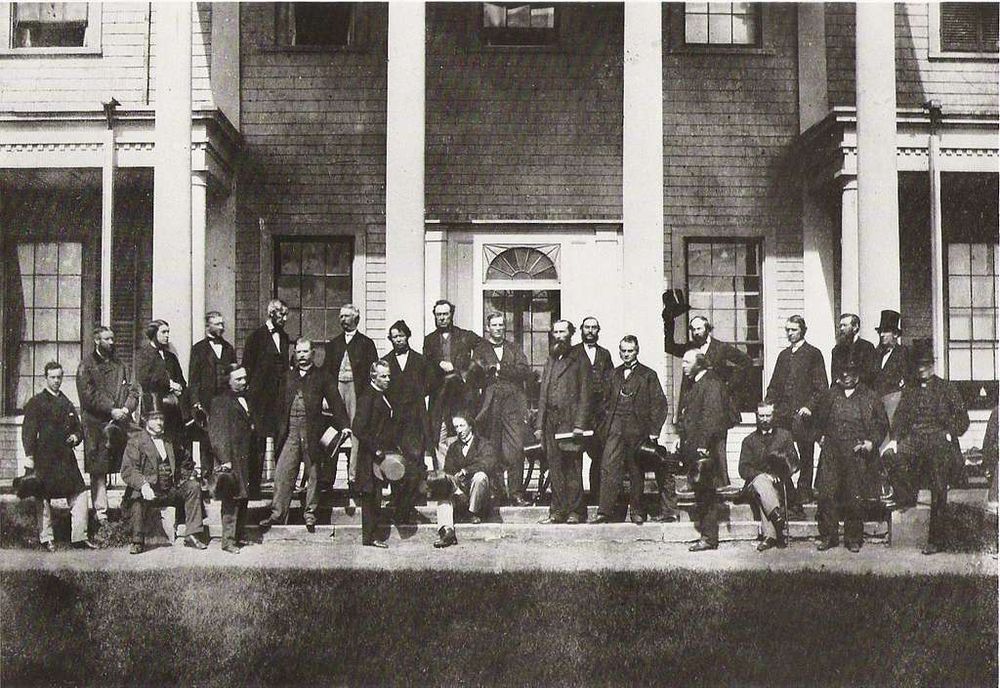
Canada's young generation has been denied a usable relationship with its own founding. Recovering the political economy of Confederation, honestly, without hagiography or prosecution, is the first step toward rebuilding it.
There is a particular kind of poverty that announces itself not through want but through surfeit. Canada in the mid-2020s is not short of opinions about its own past. It has, in abundance, the prosecutorial verdict, the rhetorical invocation, the algorithmic meme, and the great national shrug. What it conspicuously lacks is the one thing that any society navigating a genuine crisis of self-understanding requires: a usable relationship with its own history, one that neither worships nor repudiates but interrogates, recovers, and applies.
The present moment makes this lack newly urgent in ways that would have seemed implausible only a few years ago. The geopolitical pressures bearing down on Canada, in the form of a trade war prosecuted by its largest partner and neighbour, and the open suggestion from that same neighbour that Canadian sovereignty is a negotiable proposition, have done something unexpected to the terms of the domestic debate. They have made it necessary, in a way that comfortable decades of middle power complacency had not, to ask what Canada actually is, what it is for, and whether the ideas and impulses that animated its founding have anything to say to the generation that will determine its future. These are questions the country’s reigning intellectual tendencies are, for reasons that will be examined, spectacularly ill equipped to answer.
This essay is addressed primarily to young Canadians, the readers of this journal, not because the argument will be simplified for them (it will not) but because they have the most at stake in its conclusions. It is their generation that confronts, simultaneously, the most acute housing crisis in Canadian history, career ladders that have severed the connection between effort and security, and the sudden, vertiginous possibility that the geopolitical settlement their parents inherited, which had been synonymous with peace and prosperity, may not survive into the next decade.
More than abstract conditions, these are the facts that constitute the daily texture of a generation’s material life, and they make up, if anything can, a motive for historical recovery, and for taking seriously the possibility that the past contains not merely verdicts on the present but resources for it.
The essay will also engage primarily with the English-speaking historical discourse as the nuances and complexities of Quebec’s and French Canada’s relationship to history deserve their own distinct treatment that cannot be adequately captured here. (In any event, the sense of history that francophones carry, perhaps for obvious reasons, seems to be more robust, and certainly nowhere near as moribund and dysfunctional as that which prevails among their anglophone counterparts.)
The Confederation period, specifically, deserves attention and has, for reasons that will become clear, been systematically denied it. The figures who founded and enlarged the Canadian state between the 1860s and the turn of the twentieth century were neither the saints that a certain defensive patriotism requires nor the villains that a certain prosecutorial progressivism insists upon. They were, rather, something more interesting and more instructive: practical men of limited circumstances and large ambitions, operating under conditions of genuine uncertainty, who utilized power and improvisation in the service of a developmental project that had no guarantee of success and no obvious model to follow.
Their failures were real and, in some cases, catastrophic, particularly for the Indigenous peoples and other subaltern groups on whose exclusion and exploitation the project partly depended. These realities are not suppressed in what follows. But they are not permitted to exhaust the account, either, for the simple reason that an honest engagement with history requires holding its victories and its tragedies in the same frame, rather than allowing either to cancel the other.
What follows is an attempt at such a reckoning: a reading of Confederation that treats it as an example of political and economic statecraft worthy of study, criticism, and, where the lessons travel, application. It is written in the conviction that Canada’s young generation, denied so much of what their predecessors took for granted, has both the greatest need and, perhaps, the greatest aptitude for this kind of recovery.
The circumstances that produced Confederation were, in their essential character, not entirely unlike the circumstances that now confront them: a restless, talented, frustrated generation, trapped by structures they had not made and could not easily escape, looking for a way to set their ambitions loose on a world that had not yet made room for them.
The question this essay puts to its readers is whether the founding, honestly recovered, might yet help them build a Canada worth inheriting.
I. Historiographical Pathologies
We must begin by examining the dominant tendencies in Canadian historical perception—tendencies that span nearly the entire political spectrum and, for all their apparent differences, share complementary and overlapping blind spots.
The first is the institutionally dominant strain of progressive thought that anyone with an active interest in Canadian history cannot escape. Its origins lie in the post-1960s expansion of the franchise of historical recognition: the effort to recover the voices of the oppressed and marginalized represented a genuine and necessary correction. What has since supervened is something qualitatively different: a hyper-politics of identity in which race and gender have assumed the character of sacral categories, overriding in their totality and immune to interrogation; it is a view in which the past figures primarily as an inventory of traumas and grievances to be prosecuted, not a record of both human achievement and imperfection to be understood.
The practical expression of this disposition is by now familiar: the campaigns to rename institutions, the rewriting of curricula, the toppling of statues, the ritual of public self-flagellation in which symbolic atonement substitutes for political thought. In its genteel academic and media forms, this tendency rarely announces itself as the radicalism it is; rather, it presents as conscientious reckoning, its corrosive anti-institutional fervor concealed beneath the sedate vocabulary of equity and inclusion.
The contradictions internal to this position have for some time been visible to those disposed to look. Since 2025, they have become impossible to ignore. The U.S. trade war and the annexation threat have posed to Canadians a question that the progressive account of their national history cannot answer: what, precisely, is worth defending here? A country that has been taught to regard its founding as a crime, its institutions as vessels of oppression, and its historical figures as moral defendants awaiting sentence is inherently incapable of making the case for its own existence when that existence is, for the first time in living memory, contested from without. The logic of the position, pursued to its terminus, arrives at a curious destination: the concession, in effect, that the fiercest opponents of Canadian nationhood are fundamentally correct.
The second is the conventional conservative response, which has been, in its way, equally inadequate, though the inadequacy is less immediately visible because it wears the costume of historical reverence rather than historical repudiation. The figures and episodes of the Confederation era are invoked readily, but primarily only as symbolic resources for bolstering the partisan right’s pedigree and branding or for waging the battles of the culture wars: counters to be played against progressive iconoclasm rather than models to be seriously examined. The practical lessons of that era—what it actually required, in terms of executive power, elite coordination, economic coercion, and the heterodox institutional experimentation needed to turn a rough frontier into a self-governing dominion—are largely passed over in silence. This omission is not, of course, accidental.
Canadian conservatism, like much of the post-1980s Anglosphere right, has fused cultural and symbolic traditionalism with free market orthodoxy, a combination that has a pronounced institutional interest in forgetting how the Confederation-era Tory establishment actually operated: the closed patronage networks of political, financial, and imperial administrative elites (the “globalist elites” of their day), the ruthless deployment of state power in service of developmental ambition, the National Policy’s aggressive protectionism and strategic veto over the invisible hand.
A conservatism, if it can even be called that at this point, committed to unreconstructed market liberalism in substance and to “common sense and common people” populism in style cannot afford to look too closely at either Sir John A. Macdonald as a practitioner of political economy or to the self-interested, quasi-oligarchic Tory establishment that he led. It is safer, and considerably less demanding, to keep the first prime minister on a pedestal, his legacy to be honoured rhetorically but never tested against questions of real material or institutional significance.[1]
The third is the reactionary racialist tendency that has emerged at the fringes of online life, which represents, in one sense, the progressive view’s most faithful interlocutor and its most natural consequence. Where progressives have insisted that Canadian history is basically reducible to a never-ending story of racial hierarchy, the reactionary right has simply agreed and drawn the opposite, affirmative conclusion. The symbols that progressive iconoclasm has charged with the energy of transgression, i.e., statues of Macdonald, the Red Ensign, are eagerly appropriated not out of any serious engagement with the historical record but as props for the racket of racial egotism, which has contributed nothing of creative value to Canadian public life, only destructive rage and hatred.
The claim underlying this appropriation deserves to be stated plainly, because its absurdity is revealing: that the founding generation’s legacy belongs, by inheritance, to those who share their physical appearance, not to the actual doers and strivers in modern Canadian society who are practically closest to the nation-building spirit and who come in many races, colors, and creeds—but only to the people who have the same skin pigmentation as Macdonald or Lord Monck. It is the debased ethnic vanity that Schopenhauer once diagnosed: the refuge of those with nothing of their own to show. Their desperate insistence that “my ancestors” built the country betrays a premise that ultimately dooms them to the ash heap: that building the country was a static, primordial act that could only happen once rather than a continuous, upward, open-ended process that invites genius in every generation; such a view ensures that they are forever looking backward, imprisoned and blinded by the past rather than empowered by it.
The blame for creating the conditions in which such a movement could find purchase lies substantially with the radical progressive tendency, which surrendered Confederation’s achievement to blood-and-soil atavism by treating it as indefensible and irredeemable rather than complex. The twin nihilisms—the far-left’s repudiation of the past and the far-right’s vulgarization of it—are not opposites; they are, in effect, allies and collaborators, each supplying the other with the political oxygen it would otherwise lack.
Beyond these three active positions lies a fourth that is, in its way, more consequential than any of them: the simple absence of historical consciousness that characterizes the majority of Canadians who engage with their national past neither critically nor defensively but barely at all. Apathy and obliviousness amounts to a “non-view,” the void into which views, however deformed, rush to fill.
That these four views—the prosecutorial, the symbolic, the vulgar, and the indifferent—have come to constitute, with certain honourable exceptions [2], the whole of English Canada’s relationship to its founding history speaks to the poverty of our historical consciousness. It would be lamentable in the best of times, but now it is dangerous.
The concept of useful history, or the “usable past,” associated in the American tradition with Van Wyck Brooks and developed in more scholarly registers by historians such as Robert Kelly, begins from the proposition that a society’s relationship to its history need not be either reverential or merely antiquarian: that the past can be recovered not as a verdict on the present but as a resource for it, its episodes and figures examined for what they illuminate about the recurring challenges of political and economic life.
The great powers whose influence has periodically defined Canada’s circumstances have never had difficulty with this. Americans invoke their founders with a directness, selective and sometimes mythologized, but politically operative, that shapes live debates about constitutional order, fiscal policy, and the terms of national identity. The British have monarchs and prime ministers galore available as practical inspirations. The French periodically rediscover their revolutions, their ancien regime, their Gaullism, each retrieval calibrated to present necessity. China has constructed, from the Maoist and imperial past alike, a usable historical vocabulary that works to support its extraordinary national progress. Each of these examples of a usable past reaches well beyond academic or political elites into the broader culture. Canada has made no equivalent effort. Its past is either a crime scene or a curiosity, and in neither case a source of instruction.
That failure matters most for the Canadians who have the greatest stake in the future that history might help to build. Young Canadians inhabit an information environment that does not naturally incline toward the kind of sustained historical attention such a recovery requires: the algorithmic pull is toward the immediate, the affective, the seventy-second clip. But it is not the information environment that should make the case for historical recovery. It is the material circumstances.
A generation confronting the most acute housing crisis in Canadian history, precarious and unfair labour markets, stagnating wages, and the prospect of a geopolitical realignment that puts the terms of Canadian sovereignty itself in question: these are the conditions that make the past not merely interesting but urgent. For it was conditions recognizably similar—a peripheral polity of stunted ambitions, hemmed in by geography and great power indifference and avarice, its talented and restless class of leaders facing futures as cramped as the institutions they had inherited— that proved, in the 1860s, to be the forcing house of Confederation. In their own burning ambitions for wealth and fame, they discovered a reason to found a country.
II. Ambition against Adversity
The argument so far is essentially negative: a clearing operation, not yet a construction. What remains is the positive task: to recover from that history something genuinely usable, and to make the case that the Confederation episode, read honestly and without the distortions of either progressive prosecution or conservative hagiography, constitutes the most instructive episode in Canadian political history for the challenges now confronting the country. To do this requires beginning where the history actually begins: not with the statesmen but with the material circumstances that produced them.
The men who made Confederation were not, in the first instance, idealists. They were colonial politicians of the middling sort, mainly lawyers, merchants, railway promoters, and land speculators, whose material circumstances had been placed under sustained and, by the early 1860s, genuinely acute pressure by forces operating largely beyond their control. The old colonial commercial order on which their class had grown prosperous was coming apart at the seams. British imperial preference, which had for two generations guaranteed favourable access to the metropolitan market for the timber, wheat, and fish of British North America, had been dismantled in the free trade turn of the 1840s. The Reciprocity Treaty with the United States, which had partially compensated for imperial retreat by opening American markets to colonial goods, was becoming politically untenable by the early 1860s and would be terminated in 1866, a casualty of American resentment toward Britain, and the Union’s belief that London had shown undue sympathy to the rebelling South.
The Grand Trunk Railway, the prior decade’s most ambitious infrastructure project and the political class’s most consequential financial entanglement, was technically insolvent and consuming goodwill in the City of London at an alarming rate. The fiscal position of the Province of Canada was precarious. The constitutional deadlock produced by the union of the two Canadas, in which French and English legislative majorities effectively cancelled each other out on any question of significance, had reduced the colonial parliament to a condition of near paralysis. And hovering over all of it was the geopolitical shadow of the United States, a republic that had demonstrated, in four years of savage industrial warfare, both its capacity for organized violence on a mass scale and the appetite of its leading statesmen, particularly Secretary of State William Seward, for territorial expansion northward.
It is against this constellation of pressures, commercial, fiscal, constitutional, and strategic, that the decision to attempt Confederation must be understood. What the Fathers resolved to do, in response to a crisis they had not created but could not escape, was to reshape the material and institutional context of their own lives rather than submit to its constraints. This is not a small thing. Most political classes, confronted with the same set of deteriorating circumstances, would have managed the decline, sought accommodations, and deferred the reckoning. The colonial political class of British North America chose instead to build something new and great.
Canadian Tories of the pre-Confederation era, as Peter J. Smith has observed, wanted “a state they could control, one capable of providing political stability, promoting economic development and serving as an outlet for the ambitions of public men.”[3] The ambition was extraordinary given the materials available: a string of thinly populated, economically underdeveloped, constitutionally subordinate colonies strung along the northern edge of a continent dominated by a republic of thirty million that had just proved it could raise armies of half a million men.
What the Fathers built, or rather, what they designed and set in motion, was a developmental state, not a laissez-faire economic zone, but a proactive nation-building and market-shaping entity, capable of wielding real coercive power and political influence over economic affairs in ways that would unsettle contemporary ethical standards: a government with expansive fiscal resources and vigorous executive energy for enforcing Canadian claims across a territory stretching from the Atlantic to the Pacific, settling farms and towns and stimulating industries along the way. The first five of the seventy-two Quebec Resolutions declared, with notable directness, the delegates’ belief that the present and future prosperity of British North America would be promoted by a union of provinces under the Crown: the connection between constitutional form and commercial prosperity stated not as an afterthought but as the premise, one that linked the 1867 generation to their antecedents in the Family Compact and Château Clique.
Donald Creighton’s account of that tradition offers the most compressed and accurate summation of the outlook that produced 1867: the St. Lawrence commercial class, consisting of the mercantile adventurers who settled after 1763 and the Loyalist exiles who came after 1776, sharing “the commercial ambitions of the one and the political convictions of the other” as “two aspects of the same purposeful philosophy—the defence and extension of British interests in North America,” established a commercial system out of which emerged “the grandiose vision of an inland empire of trade and settlement” and the “fundamental political principle” of “unification and centralization of control.”[4]
What historian Andrew Smith, echoing Creighton’s British North America at Confederation, identifies as British support for the project captures its commercial logic and illuminates its imperial context.[5] At the helm were the colonial leaders on one side of the Atlantic and on the other a “tight nexus of private banks, the Treasury, the Colonial Office, and the Bank of England”; between themselves, they envisioned the prospective Canadian state as, in Creighton’s own formulation, “a great holding company in which could be amalgamated all those divided and vulnerable North American interests whose protection was a burden to the British state and whose financial weakness was a grievance of British capital.” “A great holding company”: the designation is at once irreverent and precise.
Far from being the child of romantic, or much less revolutionary, nationalism, Confederation was a financial and institutional vehicle for an interest-driven elite coalition, fit for maintaining and utilizing public credit, guaranteeing large investments, and sustaining a large tax base. It was imperfect in ways that stain its founding, yet remarkable in what it set in motion: the very conditions for Canadian development. The nascent dominion, self-governing but not yet sovereign, set the stage for the eventual growth and consolidation of a new continental realm and a bulwark against American absorption.
III. The Infrastructure of Nationhood
The railway, the great mega-project for which the empire’s capital had to be marshalled, was not incidental to the project; it was the material spine without which Confederation would have been meaningless. At the Charlottetown Conference, Alexander Galt, a leading advocate for federal union, successfully moved that the conference adopt a resolution favouring railway construction as the binding instrument of interprovincial commercial communication. The Maritime delegates made their meaning still more explicit: their participation in the union was conditional on the Intercolonial being built.
A country and a railway were being negotiated simultaneously, each dependent on the other, because the Fathers understood, with a clarity that their symbolic invokers in today’s conservative discourse usually lack, that national integration without modern physical infrastructure, and all the expense it entailed, was a mere concept without a concrete expression, and that the developmental ambitions of the new dominion demanded, as its first material fact, the laying of steel and roadbed from Halifax to the St. Lawrence.
In light of these monumental undertakings, Macdonald’s constitutional design thus had to be geared toward long-term developmental stability, i.e., the insulation of the federal executive from the democratic pressures that had helped paralyze the colonial legislatures, lest these or future projects be undermined by volatility; so this model concentrated the important prizes of political life—patronage, appointments, the power to disallow provincial legislation—in the hands of a strong, even overmighty, central government.
As Peter J. Smith argues, the constitutional design that emerged from Confederation was no accident of pragmatism but the deliberate expression of a "Court Party" ideology that placed the development of a capitalist economy at the centre of its ambitions and saw a strong central government as the most reliable means for achieving it. Macdonald himself stated with characteristic directness: “We must reverse this process by strengthening the General Government and conferring on the Provincial bodies only such powers as may be required for local purposes . . . . Thus, we shall have a strong and lasting government under which we can work out constitutional liberty as opposed to democracy.” The distinction between “constitutional liberty” and “democracy” was deliberate. Any thought of “popular sovereignty” did not even enter into it. Indeed, the developmental state required insulation from the democratic rabble, as the financial press of the era stated with rather more candor than the politicians themselves.
The point was made nakedly by the Canadian News, the house organ of the imperial investor community, which translated constitutional theory into the language of patrician alarm: “God forbid that, in the face of the melancholy example which is being held up before us, all power should be vested in the hoi polloi. We do not believe that vox populi is vox dei—rather vox diaboli.”
Centralization, in this view, was not simply an administrative convenience or a national necessity; it was a constitutional prophylactic against the agrarian radical, the activist taxpayer, the anti-subsidy reformer, the provincial electorate too near to its own purse. “Let there be a central and a permanent power,” the paper urged, “not subject to the whim of a mob which may be led away by a popular cry.” Confederation, so understood, was attractive to its advocates precisely because it promised to make British North America governable from above.
To realize their design, the Fathers had first to overcome each other. The sectional and partisan differences dividing the delegates at Charlottetown and Quebec were genuine and in several cases profound: French Catholic Quebec and Protestant Ontario had spent a decade in constitutional deadlock; Maritime politicians were suspicious of being absorbed into a larger polity they did not control; the financial interests backing Confederation were not always identical with the colonial governments nominally leading it. That they nevertheless produced, through three conferences across two years, a draft constitution that could be taken to London and embodied in statute is a testimony less to their idealism than to their shared recognition that the alternative—each colony managing its own decline independently—was worse for all of them than the risks of union.
It was the logic of the lifeboat, applied with unusual political sophistication. Andrew Smith’s assessment of the Fathers’ motivations is the right one to hold in view throughout: they were driven, as he puts it, by “a mixture of self-interest and genuine concern for the public good,” the mixture, and not some purer form of civic altruism, being what actually produced 1867.
The diplomacy required on both sides of the Atlantic was equally demanding. In London, the Fathers and their British financial allies in the City had to navigate a cabinet divided between the imperialism of the Duke of Newcastle, who understood that a confederated British North America served both the City of London’s investment interests and the empire's strategic requirements, and the fiscal retrenchment of Gladstone, who was determined to free the state from what he saw as the grip of colonial promoters and railway bondholders. The lobbying operation mounted through the British North American Association, drawing on the resources of Barings, Glyn Mills, and allied houses in the City, was decisive in shifting Colonial Office policy from indifference to active encouragement, producing Newcastle’s July 1862 circular inviting the colonies to discuss federation and setting the political process in motion that would culminate in the British North America Act of 1867 and the establishment of the Canadian state.
IV. Positive Externalities
The self-interest of specific Fathers was visible and demonstrable throughout this process. George-Étienne Cartier had since the 1850s been the well-paid solicitor of the British-financed Grand Trunk; Macdonald’s lucrative employment by the British-controlled Trust and Loan Company of Upper Canada, as Andrew Smith notes, “also needs to be taken into account when explaining his desire to preserve the constitutional link with the ‘old country’ (and its capital markets);” Charles Tupper had acquired a stake in coalfields along the projected Halifax-Quebec railway route and “loudly advocated British government assistance for the line.” None of this violated the standards of the era; conflict-of-interest legislation lay far in the future. But as the same source observes, “the strongly pro-imperial ideology articulated by most of the Fathers was entirely congruent with their own pecuniary interests.”
As is becoming clear, the self-interest at play here was not of the libertarian, Smithian, or Gladstonian variety, that of the independent rational actor in a competitive market place, who must apply himself with hard work and thrift while being subject to the incentives of the invisible hand, in a playing field defined by abstract “economic liberty”; rather, it was a kind of disposition for which the conventional ideological categories of our time are ill equipped to classify: that of a unified and assertive class interest, possessed of influence but by no means dominant, and yet able and willing nonetheless to project its particular demands and imperatives, through persistent lobbying, agitation, and force of will, to such a point where it determined the policy of the state and shaped the parameters of the market itself. It was, in other words, not the self-interest of the small shopkeeper or of the yeoman farmer, but that of the state-founder and empire-builder of the industrial age, eminently comfortable with seizing power and making it an instrument of their own collective material gain and social advancement.
The institutional expression of what the Fathers built was inseparable from the political economy Creighton traced through the full arc of the Conservative Party’s foundational decades. “Through Cartier, Galt, Ross, and others,” he wrote, “the party was linked with the fortunes of the Grand Trunk Railway in much the same way as the old Tories had been identified with the construction of the St. Lawrence canals.” The pattern would repeat with the Intercolonial and CPR: “both for good and ill, the party became linked with the Canadian Pacific in much the same way as it had been with the Grand Trunk and the St. Lawrence canals.” The phrase “for good and ill” is the essential qualification. Creighton was not whitewashing the patronage and coercion that attended these arrangements.
The anti-Confederate leader of the Quebec rouges, A.A. Dorion, observed that “the promise of these positions was publicly known to be ‘one of the reasons assigned for the great unanimity which prevailed in the [Quebec] Conference of 1864,’” a fact that makes the transactional character of the Fathers’ consensus explicit enough. But Creighton’s point was that the same institutional fusion that produced the corruption also produced the railway: that the post-Confederation state was, from the beginning, an insider’s state, built on cozy relationships between colonial politicians and powerful metropolitan elites whose capital networks were alone sufficient to fulfill Canada’s developmental needs, and that their achievements could not be divorced from the methods.
V. The Retrenchment Chorus
Indeed, the character of the opposition that formed against the Confederation project is worth pausing on, because it illuminates by contrast exactly what kind of political economy Macdonald was actually building. The anti-Confederate cause was not one thing: it drew on Maritime attachment to local self-government, Canadian East radical liberalism, and Protestant Ontario reform sentiment; but running through most of its expressions was a recognizable fiscal and economic logic that may fairly be described as the Gladstonian alternative to the Macdonaldian project: a politics of retrenchment, balanced budgets, hostility to public debt, and suspicion of the intimate relationship between the colonial state and London finance that the Grand Trunk embodied and Confederation threatened to enshrine at a constitutional level.
The clearest articulation of this alternative came from the Reform milieu associated with John Sandfield Macdonald’s Canada West ministry, George Brown’s Globe[6], and Luther Hamilton Holton, who served as finance minister under Ontario premier John Sandfield Macdonald. Their position, as Andrew Smith carefully establishes, was not republican anti-imperialism, which had largely died out as a major force after 1837. Rather, what they objected to was a specific colonial economic order built on borrowing, subsidy, and structural reliance on the City of London as the intermediary between Canadian ambition and British capital.
Brown’s Globe drew the distinction with some precision, distinguishing legitimate unaided British enterprise from the “subsidy-guzzling Grand Trunk,” a phrase that captures the whole critique in four words. Brown and Holton believed that Canada’s path to genuine economic independence ran through “retrenchment, balanced budgets, and the eventual repayment of the public debt,” not through the accumulation of railway guarantees and bonded obligations to Baring Brothers and Glyn Mills. They had absorbed enough of classical political economy to resemble, in their fiscal instincts, the Gladstonian liberals in London who were simultaneously fighting in the Westminster cabinet against Newcastle's colonial railway schemes. Robert Lowe, the British classical liberal ideologue, much preferred the Sandfield Macdonald governments to the “borrowing ministries” of Macdonald and Cartier.
In the parliamentary debates on the Quebec Resolutions, this fiscal conservatism found its most explicit individual voice in Benjamin Seymour, who attacked the Grand Trunk as a venture “planned by English capitalists” at the expense of Canadian taxpayers, and condemned both it and Confederation as incompatible with “retrenchment and financial reform.” Seymour's language is almost entirely that of taxpayer protection and anti-corporate-welfare, not small government in the modern ideological sense, but something recognizably ancestral to it: the demand that public finance be constrained so as to avoid corruption rather than function as a mechanism for socializing the losses of private investors who had made bad bets.
The Montreal radical liberal paper Le Pays struck similar notes in Canada East, blaming Grand Trunk influence, naming C.J. Brydges as the hidden hand behind Confederation, and warning that the new dominion would produce mounting debt and soaring taxation to enrich a clique of London bankers at the expense of ordinary Canadians. The Montreal Witness, more bluntly, declared that Confederation would put money into the pockets of “London bankers and speculators” connected to the Grand Trunk and the Hudson’s Bay Company, and that in return the British government had promised to put “all our prominent men into governorships or at least into a sort of order of nobility,” a formulation that acidly identified the patronage dimension of the whole arrangement.
What this opposition reveals, taken together, is that the conflict over Confederation was not primarily a conflict between nationhood and its absence. Many anti-Confederates were not opposed to union in principle and might have accepted a less imposing version of it. What they rejected was the model of nation-building that actually got the job done: Confederation bundled with railway guarantees, public debt obligations, the constitutional rescue of British investors’ stranded capital, and a centralized state designed, in Macdonald's own words, to uphold “constitutional liberty as opposed to democracy.”
They objected, in other words, not to the idea of building a country but to the vast concentrations of political power, financial capital, fiscal risk, and strategic coordination that the Macdonald Tories and their allies assumed were the natural and necessary tools needed to turn that country from an idea into a reality.
VI. A Most Useful Past
The Canada of 1867 that emerged from this process was imperfect in ways that demand acknowledgment rather than evasion. The dispossession of Indigenous peoples—systematic, violent in its consequences, and rationalized by a racial hierarchy that the founding generation did not question—is the deepest moral stain on the founding and cannot be dissolved by historical context however carefully assembled. The exclusion of women from political life, the unjust terms on which Chinese labour built the railway the National Policy required, the discriminatory restrictions that would accumulate in the decades following: these are not incidental features of the Canada of 1867; they were built into the design by men whose conception of the political community was as narrow as their material ambitions were large. None of this can be undone by celebrating the achievement, and none of it should be.
And yet the achievement was real, and its scale deserves honest recognition alongside its costs. A country was built, across distances that daunted experienced engineers, against geopolitical odds that would have discouraged less determined men, from institutional materials that were barely adequate to the task. The developmental state the Fathers designed, whatever its moral failures, bore the seeds of everything that followed: the agricultural settlement of the Prairies, the industrialization of the central provinces, the gradual expansion of democratic rights and social provision, the emergence of a prosperous, pluralistic, globally respected society that was, by any comparative measure, one of the more successful national projects of the modern era.
It is this founding episode, and specifically the audacious, context-altering disposition it embodied, that the present generation of young Canadians most urgently needs to recover and apply. The parallel is structural: the Millennial, Gen Z, and younger cohorts now attempting to establish their place in economic and civic life occupy a social position that rhymes, in uncomfortably precise ways, with the one inhabited by the pre-Confederation colonial political class: a generation whose legitimate aspirations toward a decent and prosperous life in an advanced society are being systematically denied by the accumulated weight and inertia of a system they did not build and cannot, within its existing terms, adequately reform.
Their economic well-being, their collective class prospects, and their most elementary material ambitions—to own a home, to find work commensurate with their education, to form families and communities, to believe that sustained effort will eventually produce long-term security—are under severe pressure from forces both internal and external. The external threat is visible and widely discussed: the American trade war, the annexationist threat, the geopolitical instability that has made Canada’s sovereign existence, for the first time in living memory, a genuinely contested proposition. But the external threat is not the primary origin of the crisis. A society that is regressing materially and losing institutional confidence will always be more vulnerable to foreign pressure than one that is not; the weakness that invites aggression is homemade.
And so, when it comes to the moment of institutional refoundation that must take place, Confederation should stand as an example, not because it was perfect, and not because its specific solutions translate directly into the twenty-first century, but because it alone provides the template for how such a moment would actually take place. This is emphatically not a call to revive the Victorian racial assumptions that progressives are keen to emphasize, nor the aesthetic fogeyism that some conservatives love to affect, any more than it is a call to return to Victorian locomotives and steamships as our primary modes of transport. It is a call to take this exemplary moment in Canadian history as a guide and inspiration for the challenges of today: to study, through positive but also negative lessons, what nation-building truly requires and what it might mean when set against different but rhyming contexts in the twenty-first century.
The through lines are visible across the historical distance. Strong national leadership and strategic vision, not reactive or merely managerial governance. Capital intensity and industrial discipline, not the passive accumulation of real estate asset values or get-rich-quick app schemes. The acceptance of complexity in economic statecraft, not one-dimensional policy cure-alls like tax cuts or basic income. A productive alliance between public initiative and private ambition, not a strict dichotomy between state activism and market fundamentalism. A sober appreciation for how new technologies will shape the markets and industries of the future at the material and structural levels as opposed to the faddish faith in the latest hype narratives. A capacity for cohesion and for building and maintaining coalitions instead of individual self-expression or reductive partisan tribalism as the template of public life. A willingness to engage seriously, patiently, and persistently with the institutions of state and civil society instead of the apathy, cynicism, and performative radicalisms that pass for youth political culture in modern Canada.[7]
Above all, there should be consistency and tenacity in carrying projects across the ordinary turbulence of everyday politics, not the abandonment of long-term commitments at the first sign of political headwind or culture war distraction. Obviously, the next generation of Canadian leaders should not share the degree of disdain for popular democracy that some of the era’s Tory oligarchs had, but we should also recognize that national goals must be able to survive the next electoral campaign, news cycle, or social media storm.
And where the Fathers neglected and excluded Indigenous peoples and prevented their full participation in the Confederation project, the next moment of Canadian reinvention must take Indigenous nations as equals and partners in a unified enterprise. This means going beyond both the crude prejudice of the past and the often superficial moralism of the present. It means applying to the situations faced by First Nations, Inuit, and Métis the same criteria of material development, genuine innovation, and the measurable improvement of ordinary lives that the essay applies to the rest of Canada—and raising Indigenous voices capable of speaking to and leading such a vision from within their own communities (a long-term goal of this journal), in genuine collaboration with the non-Indigenous majority, rather than in the managed relationship of dependency that both historical injustice and its current institutional remedies have too often reproduced.
In short: this is a call to recover the spirit and promise of Confederation, and the sense of historical mission embodied by its statesmen, warts and all.
VII. Regaining Consciousness
For that recovery, we will need guides. And here it is worth naming the historians whose writings on Canada’s formative epochs are indispensable for this purpose: Harold Innis, Donald Creighton, J.M.S. Careless, Frank Underhill, W.L. Morton, Arthur R.M. Lower, Pierre Berton, and P.B. Waite, among others. These writers did not agree with each other. Their differences were, in many cases, intense and philosophically fundamental: Creighton’s imperialism against Underhill’s continentalism, Lower’s liberal nationalism against the regionalism of Morton and Careless. Many of their views would be considered grossly outdated by contemporary standards, and a few would be considered worse. They wrote in stiff, erudite styles with exhaustive attention to detail that may baffle or bore the modern reader.
None of that disqualifies them. In the richness of their historical consciousness, in the seriousness with which they took the question of what Canada was and might become, and in the depth of their engagement with the material and institutional realities that produced the country, they remain the best starting point for any genuine rebirth of historical consciousness among young Canadians. The disagreements between them are not a defect but a model: they show what it looks like to take the founding seriously as a living question rather than a symbolic resource or a moral verdict. Young Canadians should not be afraid to reclaim their works, to read them with the nation-building lenses described in these pages, and to argue about them as fiercely as their authors argued about each other.
All this should be clear enough. But for the historical analogy to be complete, young Canadians have to extend their understanding beyond the Canada of 1867; they must grapple as well with the status quo they are to replace if they wish to build something new in its place: this is the nation the Boomers built, or rather remade, in their own image, the Canada of 1967. This will be the focus of Part II.
Notes
[1] It is also worth dispensing with a claim that recurs, with some regularity, in this discourse: that the Fathers are most usefully understood as classical liberals in the Lockean mould, men who built a nation on the foundations of natural rights, property, and limited government. The claim is not exactly false, but it is woefully deficient as a tool of historical understanding beyond the most surface-level examinations of the period. Lockean notions of property and the rights attaching to it were not the distinct possession of any faction in mid-nineteenth-century British North America; they were the common inheritance of nearly the whole political culture, the unexamined grammar in which Tory and Reformer alike conducted their disputes. Macdonald, Tupper, and Cartier subscribed to them. So did Brown and Mowat. So did the financiers and executives of the Grand Trunk and the Globe subscribers who fulminated against them.
To say that the Fathers were Lockean liberals, in other words, is to say that they were nineteenth-century British subjects: true, but explanatorily empty, since it cannot distinguish the centralizers from their opponents, the developmental statists from the retrenchment reformers, the architects of the industrial-railroad nexus from the men who wanted no part of it. The real and useful division did not lie in whether these men accepted the abstract premises of liberty and property, which none of them seriously contested, but in how starkly they differed over the practical expression of those premises in the actual conduct of government and the actual structure of the economy: over debt and subsidy, over the proper relationship between the state and private capital, over whether liberty was best secured by a strong central executive or by a jealously guarded local purse. It is this latter terrain, that of practice rather than profession, that any serious history of the Confederation era, and any usable lesson drawn from it, must actually inhabit.
[2] One honourable exception is none other than Prime Minister Mark Carney who has positively deployed Canadian history in multiple speeches since coming to office, even to the point of risking controversy, such as in his January 2026 Quebec City address; his view may be described as qualified reverence and is somewhat akin to the view of U.S. history commonly held by American liberals before the most recent bouts of academic radicalization, which is to say, affirmative of the nation’s legitimacy while being solemnly aware of the offences and imperfections that marred its history, and yet still appreciative, in a very broad sense, of the encouragement that history provides to the search for progress in our own time. This is a reasonable enough position and certainly an improvement on the dominant academic view, but it does not seem to have an institutional following capable of displacing the former; it is also, in any event, as this essay will show, still inadequate to the demands of the present crisis. Just as with the conventional conservative view, its engagement is necessarily limited and rhetorical.
[3] Peter J. Smith, “The Ideological Origins of Canadian Confederation,” in Canada’s Origins: Liberal, Tory, or Republican?, ed. Janet Ajzenstat and Peter J. Smith (Montreal: McGill–Queen’s University Press, 1995).
[4] D. G. Creighton, “Conservatism and National Unity,” in Roads to Confederation: The Making of Canada, 1867, vol. 1, ed. Jacqueline Kirkorian et al. (Toronto: University of Toronto Press, 2017), 251–53; the definitive account is Donald G. Creighton, The Commercial Empire of the St. Lawrence, 1760–1850 (Toronto: Ryerson Press; New Haven: Yale University Press, 1937), and The Road to Confederation: The Emergence of Canada, 1863–1867 (Toronto: Macmillan of Canada, 1964). See also: Donald Creighton, John A. Macdonald, 2 vols. (Toronto: Macmillan of Canada, 1952–55).
[5] Andrew Smith, British Businessmen and Canadian Confederation: Constitution-Making in an Era of Anglo-Globalization (Montreal and Kingston: McGill-Queen’s University Press, 2008), 10, 146; Donald G. Creighton, British North America at Confederation: A Study Prepared for the Royal Commission on Dominion-Provincial Relations (Ottawa: R. Duhamel, Queen’s Printer, 1963). The sources in notes 3–5 are essential for establishing the political economy premises of Confederation relayed in this essay.
[6] George Brown's place in the Confederation story is more complex than his role as Macdonald's chief antagonist might suggest. His decision in 1864 to enter the Great Coalition, setting aside a decade of bitter personal and political enmity with Macdonald in the interest of breaking the constitutional deadlock, was one of the most consequential acts of political selflessness in Canadian history, and Brown himself regarded it as such. His motives were genuine: representation by population, which had been his cause since the 1850s, could only be achieved through a broader federal union, and he was willing to subordinate his fiscal instincts and his suspicion of the Grand Trunk interest to that larger constitutional goal. That the union which emerged served Macdonald's developmental statism rather than Brown's Gladstonian liberalism is the central irony of his Confederation role, and one he appears to have understood clearly even as he accepted it. Careless's two-volume biography remains the definitive study and establishes Brown as a figure who deserves to be read on his own terms rather than simply as the foil whose cooperation Macdonald required and whose vision he ultimately eclipsed. See: J.M.S. Careless, Brown of the Globe, 2 vols. (Toronto: Macmillan of Canada, 1959–63). The accounts of Brown's and the other anti-Confederates' opposition politics in this section comes largely from Andrew Smith's history.
[7] These will be discussed in greater detail in Part II.
Michael Cuenco is co-founding editor of the 2067 Journal.