What men’s soccer tells us about the challenges of building institutions and national identity in Canada
I. A Better Kind of Defeat
On Saturday afternoon in Houston, Morocco knocked Canada out of the World Cup. The 3-0 scoreline was harsh – Canada was level at half time and, by most advanced metrics, the better team. But in a knockout game only the final result matters. Canada, like the other host nations Mexico and the United States, went out in the round of sixteen. And still, walking off the pitch, the players did not look like men who had failed at anything.
They were right not to. To see why, it helps to remember where the men’s program was not so long ago. In October 2012, in a qualifier for the 2014 World Cup, Honduras beat Canada 8-1, a result that knocked Canada out of contention and stands among the worst defeats in the team’s history. That was not the distant amateur past. Before this summer, Canada’s World Cup record was as follows: one appearance in the twentieth century, at Mexico in 1986, where the team lost all three games and scored no goals; and a return in 2022 with three more defeats and just a few world cup goals to show for it.
This summer was different. Over three weeks in June and July, Canada drew with Bosnia, beat Qatar 6-0, lost narrowly to Switzerland, and then beat South Africa on a stoppage-time goal from Stephen Eustáquio to win a knockout game at a World Cup for the first time in the country’s history. Nine goals, two wins, a place in the last sixteen. A genuine golden generation with some of Canada’s best players now playing and starting for some of the biggest teams in the world. Fourteen years after the humiliation in Honduras, this is different from the teams and failures of old.
The reaction at home matched the mood. Politicians of every stripe and level of government praised the team, and the players left the field to applause rather than sympathy. “We felt always the love back home from the Canadians,” Eustáquio told TSN moments after the final whistle. “I think we’re finally a soccer country, man, we need this support to go forward.” The audience numbers bore him out. The Qatar match on June 18th drew an average of 5.3 million viewers, the most for any World Cup group-stage match ever shown in Canada and the largest audience for a men’s national team game in the country’s television history. The South Africa game averaged 5.2 million and peaked at 8.2 million the moment Eustáquio’s free kick went in. Over the tournament as a whole, the broadcaster reckoned that some 26.1 million Canadians, roughly two in three people in the country, watched at least part of its coverage. A sport most Canadians had spent a century paying little attention to became, for three weeks, the thing the country was doing together.
All of this was taken, and sold, as a beginning: the moment Canada might finally build the soccer culture it has never had, on the back of a golden generation of players and a World Cup played partly at home. The team’s slogan for the tournament put it plainly: Our Game Now.
But, is it our game now?
A slogan is easy to print and hard to make true. For soccer to become Canada’s game in any real sense, the country would have to do two things it has generally failed to do. The first is to build the institutions the sport runs on, meaning professional leagues, clubs, stadiums, coaches, amateur pipelines and the training academies that develop players, and to keep them alive in a country where the winters are long, the cities are far apart, and the enormous American sports market next door makes it easier to plug into someone else’s structures than to build your own. The second is a matter of identity: to make Canadians care about the game as something of their own, rather than as something they follow on behalf of the countries they or their parents and grandparents came from. The first problem is about what can be built here, beside the United States. The second is about where people’s loyalties actually lie, and whether a country made up of people from everywhere else can get them to attach that loyalty to Canada. These two basic things apply as much to building Canada as they do to building the beautiful game in Canada – soccer represents a microchosm of this bigger question.
II. Claimed on Arrival
Soccer is not a foreign sport in Canada. It has been played here almost as long as the country has existed, and it is now the most played sport in the country: Canada Soccer counts close to a million registered players nationwide, against roughly 600,000 in hockey, a gap that surprises people who assume hockey is simply what Canadians play. This should not be a surprise at all, because Canada was built in large part by immigrants from soccer-playing countries: the English and Scots who spread the game around the world in the nineteenth century, the Italians and Portuguese and Germans and Croatians who arrived after the Second World War, and the Caribbean, Latin American, West African and South Asian newcomers of the past fifty years. If immigration alone could make a country good at soccer, Canada would have been good at it long ago.
It was not, and the reason is the same one that runs through the rest of this story. For most of the past century, soccer in Canada organised itself around ethnic communities rather than the country as a whole. The important clubs in postwar Toronto were teams like Toronto Italia, Toronto Metros-Croatia, the Serbian White Eagles, Toronto Ukrainia and First Portuguese, and they were not only sports teams. They were community institutions, places where an immigrant group gathered on a weekend, spoke its language, and argued the politics of the country it had left. These clubs recruited from their own communities, played in the style of the old country, and carried its rivalries onto the field. The matches between Toronto Croatia and the Serbian White Eagles were less ordinary fixtures than a continuation of Balkan hostilities by other means, and could turn nasty in ways that had nothing to do with the game and everything to do with events back in Yugoslavia.
There was nothing sinister in this. It was a natural and human thing, the way a scattered people holds itself together while it finds its feet in a new and often cold country, and much of the real passion in Canadian soccer came from exactly this attachment. But it meant the game arrived already claimed. An immigrant who loved soccer loved it as a Portuguese or an Italian or a Croatian, and that love tied him to the country he had left rather than the one he had joined. Canadian soccer became not one national game but a dozen imported ones played side by side, each pointing back across the ocean, none really pointing at Canada.
The clearest illustration is also the era’s one great success. In 1976, Toronto Metros-Croatia won the championship of the North American Soccer League, then the top professional league on the continent, becoming the first Canadian club to win it. The victory was understood, by the team and its supporters, as a triumph for Croatia rather than for Canada or even Toronto, and the league found this embarrassing. It wanted soccer to look like a mainstream North American sport, not a collection of immigrant clubs flying the flags of other countries, and so its executives pressed the American broadcaster, CBS, to refer to the club on air only as “Toronto,” and had the stadium announcer in Seattle do the same, dropping the “Croatia” for a continental audience. Hours after the final whistle, the general manager of the New York Cosmos, the league’s marquee club, formally proposed banning “ethnic names” from the league altogether. The motion failed. What made the whole thing sharper still was that the club had won on the goals of Eusébio, the ageing Portuguese forward who was one of the greatest players in the history of the game, signed for a single season because the club could not afford to keep him. A Portuguese legend, playing for a Croatian club, representing a Canadian city, in an American league that wished his club had a less foreign name: the whole predicament in one image. The game was here, and at moments it was magnificent, but it belonged to everyone except, quite, Canada.
You could see the same thing this summer in its own ways. Fans filled the streets of Toronto and Vancouver, but many of them filled the streets for Portugal and Ghana and Croatia and Egypt as much as for Canada, wearing the shirts of the countries they had come from. Had Canada’s opening game been against Italy rather than Bosnia, who would most of the crowd in a Toronto stadium have been cheering for, Canada or Italy?
III. A Century of False Starts
For most of a century, Canada produced a great many players and built almost nothing to keep them at home, or to make the game its own.
The best recent sign that this is changing is a goal scored in a snowstorm. In November of last year, the final of the Canadian Premier League, the country’s new domestic professional league, was played in Ottawa during a blizzard that dropped twenty centimetres of snow on the field and forced the ground crew to shovel the lines clear between stoppages, with players joining and helping with snow removal. In those conditions a forward named David Rodríguez scored with an overhead bicycle kick that was quickly called the “icicle kick” and the clip of it travelled, by the league’s own count, to some 786 million people in 173 countries. The BBC replayed it; Marsch said friends in Europe messaged him about it. The goal went around the world precisely because it looked so unmistakably and gloriously Canadian, the snow coming down sideways as the ball went in. For perhaps the first time ever, a domestic Canadian game briefly appeared on the global radar.
A domestic league helps develops players at home and gives them a home to play and grow, instead of relying on exporting teenagers and hoping they come good, and gives a country clubs of its own that people can follow in an ordinary week rather than once every four years. Building one here has proven hard, because the history of professional soccer in Canada is a history of leagues that failed. The semi-professional National Soccer League, founded in 1926, was built out of many of the same ethnic clubs, and so kept soccer a matter of immigrant communities rather than the country. Several Canadian teams played in the American-run North American Soccer League in the 1970s and early 1980s, and the Whitecaps won it in 1979, but when that league collapsed the Canadian clubs went down with it. The one real attempt at a national league of Canada’s own before now, also called the Canadian Soccer League, ran from 1987 to 1992 across six provinces and was built specifically to break with the ethnic-club model; it folded after five years, and its strongest clubs crossed into the American system. For twenty-seven years after that, until the Canadian Premier League kicked off in 2019, Canada had no national professional league at all. For a century the Canadian professional game, when it existed, was divided along ethnic lines, absorbed into the American game, or unable to pay its way.
The physical infrastructure was, and is, just as thin, which in a country with long and harsh winters is a real constraint. Soccer missed the great wave of public sports construction in the 1960s and 1970s, the centennial-era boom that gave hockey its thousands of publicly funded arenas, so the sport that most needs indoor space through a Canadian winter is the one that never got it. Big cities have added millions of people over the past decade and only a handful of new municipal fields, few with the artificial turf or domes that allows winter play, while a club wanting indoor time on a winter evening pays a steep rate to rent part of the few domes that exist. The country grew a large population that loved the game and then, for fifty years, mostly declined to build it anywhere decent to play or watch.
So the talent left, and much of it, once abroad, stopped playing for Canada at all. A gifted young Canadian had two realistic options, to give up the game or to leave, and those who left often ended up representing the countries that had actually developed them. Owen Hargreaves, born in Calgary, joined Bayern Munich at sixteen and won forty-two caps for England. Asmir Begovic, who fled the wars in the former Yugoslavia and grew up in Edmonton, stood in net for Canada’s youth teams and then chose Bosnia. Jonathan de Guzman from Scarborough, whose brother Julian is one Canada’s great players, ended up playing for the Netherlands. It is easy to judge them for the looseness of their loyalties, and switching countries has become common in international soccer, but these were young men who looked at what their own country had built to carry their ambition, found very little, and went where the game was taken seriously. A country that builds no institutions does not keep its talent, and it does not make a sport its own. Institutions are not decoration on national life; they are much of what a nation is. For a hundred years, in this sport, Canada mostly chose not to build them.
IV. The Branch Plant and the School
When Canada finally started building, in the last two decades, it went down two different roads at once, and the tension between them runs through everything that follows and has before. One road runs through the United States: joining the big American league, taking its money and its higher standard of play, and accepting that the whole enterprise is run on American terms. The other is the slower, more difficult and poorer work of building a league of Canada’s own. The country has tried to travel both at the same time and both come with benefits and perils.
The American road came first. Toronto FC joined Major League Soccer, the top league in the United States and Canada, in 2007, followed by Vancouver and Montreal (these were older teams playing in lower leagues in the American soccer pyramid), and for the first time in decades Canadian cities had teams in the strongest league on the continent. The bargain MLS offered was the one the United States always offers Canada: a bigger market, more money, and a higher standard, in exchange for playing by American rules, in American dollars, for American purposes. And those terms work quietly against the Canadian game. For most of the league’s history a Canadian at an American club counted as a foreign player, taking up one of a small ration of international roster spots, which gave American teams a reason to sign an American over a Canadian of equal ability. Wages are paid in US dollars while the three Canadian clubs earn in a dollar worth about seventy cents of it, the same currency drag that has squeezed Canadian teams in every cross-border league.
The deeper cost is that tying the top of the Canadian game to an American league leaves it at that league’s mercy, and Vancouver shows where that can lead. The Whitecaps have just had one of the best seasons any Canadian club has managed in MLS (Toronto FC has won the MLS Cup): a club-record points haul, a fourth straight Canadian Championship, and a run to two continental and league finals, knocking Lionel Messi’s Inter Miami out of the CONCACAF Champions Cup 5-1 on aggregate along the way. And it may be one of the club’s last in Vancouver: a Las Vegas billionaire has bid to buy the team and move it south, and the owners say they have approached more than a hundred local buyers without finding one willing to keep it in the city. In a league run for American purposes there is nothing to stop a Canadian club being sold across the border. Montreal is squeezed differently by the same structure: with MLS moving to a winter schedule later this decade and its stadium unfit for a Canadian February, the club is arranging to play its coldest games in the cavernous Olympic Stadium instead. Even the league’s calendar, set in the United States, bends to a Canadian climate it does not otherwise have to think about.
And yet the same American league that treats Canadians as foreigners has done more than anything else to produce the current Canadian team. Of the twenty-six players Marsch took to this World Cup, 11 players spent time at a Canadian MLS academy, and 10 more played for an MLS club. Many either developed in the academies the clubs run for young players, were scouted through America’s collegiate sport system, or established as professionals in the league. Alphonso Davies, the best of them, came through the Whitecaps’ youth academy before moving to Bayern Munich in Germany.
And the very rule that makes a Canadian a foreigner on an American roster is also the rule that helped build the national team: a change in 2016 let any Canadian who came up through an MLS academy or an approved Canadian youth club count as a domestic player rather than an international one, even on American rosters, which gave clubs a reason to develop Canadians, and Canada Soccer credits the change directly with the rise of the national team. So MLS both holds the Canadian club game down in some ways, but also supplies the Canadian national team, which is exactly what makes it so hard to walk away from. The American league is a branch plant that also, as it happens, runs the best school.
More of that school is now being built at home, and for once with public money. In May the federal government committed $9.8 million toward a national training centre for Canada Soccer, described as the main lasting legacy of hosting the World Cup. It is one building, a modest start rather than a transformation, but it is the sort of thing a country does when it has decided a sport is worth keeping.
The other road, the Canadian one discussed above in which the “icicle kick” took place, is the Canadian Premier League, founded in 2019, which is in almost every way the opposite of MLS. It has eight clubs, where its founders hope eventually for sixteen, and has already lost some: a club in Edmonton folded in 2023, one in Winnipeg went dark after last season, though a new Quebec club joined this year. It is limited by professional standards, with a minimum salary of thirty thousand dollars and a whole club’s player budget a little over a million. It is easy to dismiss or sneer at a league like this, and some do, but the sneers miss the point. The league is only six years old, and it spent its first seasons contending with a pandemic that shut down live sport almost as soon as it had started. It needs time more than anything, and the hope is that the interest the World Cup generated gives it room to grow into a real domestic league, one that develops Canadian players and builds the small, local loyalties a sport needs to put down roots. There are early signs of it: Forge FC, in Hamilton, has become the league’s dominant club, and Atlético Ottawa went unbeaten at home in 2025 and won its first title in the same snowy final that produced the bicycle kick, drawing loud crowds to its downtown stadium, with one Hamilton match last year drawing a league-record 17,971. The new Quebec team, Supra FC, who have committed to only signing and playing Quebec players, is modelled on famous clubs like Athletic Bilbao is the Basque region of Spain, who famously only play Basque players. These are not Juventus or Benfica, the century-old clubs that anchor the game in Italy and Portugal, but they are the beginnings of clubs that belong to Canadian cities and can help establish small but committed local fan bases.
The difficulty the Canadian Premier League faces is not really a soccer problem, and it is not unique to soccer. It is the standing problem of every attempt to build a domestic Canadian institution beside the United States, and it is why Canadian professional sport keeps ending up run through American leagues. A homegrown league will always be smaller and poorer than the American alternative right next to it, which is why the easy choice is always to integrate: take the higher standard and the bigger money across the border and accept a junior place in someone else’s structure.
This is the choice George Grant described more than half a century ago, and you need not share his pessimism to recognise it on a soccer field. A country can fold itself into the larger American system and live as a branch plant, comfortable and well-supplied but dependent, its best people foreigners in a league it does not control and its teams sold south when the economics favour it. Or it can build the smaller, poorer, more fragile thing of its own and keep it. We probably ultimately need both. But the reason to never give up on the harder road is that only a domestic league can make the sport Canadian, developing Canadian players and Canadian loyalties rather than renting both from a league headquartered elsewhere. The World Cup, and the slogan draped across it, put the question directly: is the country serious about building its own game, or only sentimental about the idea?
V. The Prior Attachment
Suppose Canada built all of it: a domestic league that thrived, a way to keep its clubs, the stadiums and training centres and indoor fields. A harder problem would remain, the one the old ethnic clubs pointed to all along.
Hockey could carry Canadian identity for a century because almost no other country cared about it; caring about hockey was itself a way of being Canadian. Soccer cannot work that way, because it is the world’s game, the one nearly every country already loves. Almost everyone who immigrates to Canada arrives already supporting a club and a national team, loyalties usually inherited from a father and not open to revision. Hockey asked immigrants to take up an attachment they did not bring; soccer asks them to move one they already hold, more strongly than almost anything they carried across the ocean, and an attachment like that does not shift because a marketing campaign wants it to. The passion is already here, in enormous quantity. It simply points somewhere else.
This is why the institutions matter, and why the World Cup cannot be allowed to be just a good month that fades. A Canadian soccer loyalty cannot be inherited, because there is almost nothing yet to inherit; it has to be built slowly, around clubs and a national team that people come to feel are their own. None of this requires anyone to give up the loyalties they already have. The Italian-Canadian grandfather does not have to stop supporting Italy, and no one should feel less himself for wearing Portugal’s colours during a Toronto summer. What Canada needs is a soccer identity and institutions of its own alongside those older loyalties, so the game does not simply remain an imported sport played on Canadian soil that has lately started producing good players.
There are small signs it is beginning to happen. During the tournament, in the heavily Italian stretch of Toronto around College Street, a neighbourhood that empties into the streets whenever Italy plays, fans lined up to trade their Italian jerseys for Canadian ones and get behind the national team. It is a modest thing, and Italy’s absence from this World Cup made it easier, but it is the exact transfer of loyalty the whole project depends on. Because the old pattern is stubborn. Italy, a four-time world champion and the team that has moved College Street to joy and grief for sixty years, failed to qualify for this World Cup at all, beaten in a playoff by Bosnia, its third straight failure to reach the tournament. A great many Italian-Canadians therefore spent this World Cup, held in their own country, with no Italy to follow, and the real question is whether that freed-up loyalty attached itself to the Canadian team playing an hour down the road, or simply went dormant for another four years. The federation is betting it moves. The history of these loyalties suggests they rarely move so much as fade slowly across generations, replaced, if they are replaced at all, by something built new.
VI. Nationality, Made Portable
The way loyalties are shifting and in flux is not only a Canadian story. This was the most international World Cup ever played, in a specific sense: the link between a country and the players in its shirt has never been looser. Of the 1,248 players at the tournament, 289 were born in a country other than the one they represented, nearly a quarter, and the highest share ever recorded; twenty years ago, at the 2006 World Cup, it was under 9 percent. Only eight of the forty-eight teams were made up entirely of home-born players. Curaçao, a Caribbean island of roughly 150,000 people, reached the tournament with a squad almost all born in the Netherlands, its former colonial power. Much of this traces to one change: in 2021 FIFA, the sport’s world governing body, made it far easier for a player to switch national teams, as long as he had played only a few times for the first and never at a major tournament.
That change has turned national teams into something closer to a choice than an inheritance, and countries now scout their diasporas for talent. Morocco, the team that knocked Canada out, is the clearest case: nearly three-quarters of its squad was born abroad, mostly developed in the academies of France, Spain, and the Netherlands, and it was this that carried Morocco to the semi-finals in 2022, the best result any African team has managed. Its goalkeeper, one of the best in the world, is Yassine Bounou, was born in Montreal. The tournament’s surprise, Cape Verde, a group of West African islands of half a million people, reached its first World Cup and drew with Spain before losing to Argentina, with a squad drawn largely from its European diaspora, one player reportedly first contacted through a message on LinkedIn.
For Canada this cuts both ways, and it has lately begun to cut in Canada’s favour. The same rules that once drained the country of players like Hargreaves and Begovic now let it recruit players the old system would have lost. Marcelo Flores, born in Ontario to a Mexican father, had already played three times for Mexico and might once have been gone for good, but under the newer rules he switched to Canada earlier this year. The same with the defender Alfie Jones, an English player who was on the Canada squad for the World Cup. Eustáquio, the captain who declared Canada a soccer country at last, was born in Canada to Portuguese parents and could have played for Portugal. The movement that hollowed out the Canadian game for a century now runs in both directions. But it is a fragile kind of advantage, because it depends on Canada continuing to look like a place a talented young player with a choice would want to represent, which depends, once again, on building something worth belonging to.
VII. The Suburban Answer
If there is an answer to all of this, it is being put together in the suburbs, and it looks nothing like what the people who usually speak for Canadian culture would have designed.
Something like a quarter of Canada’s World Cup squad came from Brampton, a city of fewer than 800,000 people just outside Toronto. The usual explanation, that this reflects Canadian diversity, is true in a way that explains nothing, because Brampton has been among the most diverse cities in the country for thirty years and produced almost no professional players for most of them. Diversity was never the active ingredient. What changed is that a critical mass of second-generation kids, raised in homes where soccer mattered enormously, finally met just enough structure, a nearby Toronto FC academy, decent local clubs, the beginnings of a real pathway, to turn inherited passion into a profession. Cyle Larin, Tajon Buchanan, Jonathan Osorio and Atiba Hutchinson, who captained the side at the last World Cup, all came off the same patchwork of suburban fields, where the cheapness of the game, a ball and some grass, let the children of families living close to the line play a sport that hockey, with its thousands in ice time and equipment, had priced them out of.
There is something genuinely new in these players. They are not the immigrant grandfather whose heart stayed in the old country, and they did not assimilate in the older way, by trading soccer for hockey. They took the game they inherited from their parents and aimed it at Canada. When Canada beat Jamaica to reach the last World Cup, Brampton did not celebrate the way College Street celebrates an Italian win, as a loyalty pointing across the sea, but as a place cheering for a team that was its own. When the run ended against Morocco this summer, the crowd in Brampton’s Garden Square took the loss the way you take a defeat that belongs to you. If soccer really does become Canada’s game, it will become it through places like Brampton, which means the Canadian game will belong to a country visibly different from the one that played those ethnic-club matches a century ago. That is not a loss to mourn or a change to resist; it is simply what has happened to the country, and soccer may prove one of its truest measures, a national game assembled out of the children of the most recent arrivals. A pipeline is not yet a culture, and one suburb does not answer a national question; the attachment that makes a grandfather weep at a result takes generations Canada has not yet had. But if the country’s soccer loyalties are ever built at any scale, it will very much reflect a new Canada that looks different from the country a century ago.
VIII. The Homemade Question
Canada’s World Cup is over, and whatever it gave the country, it did not settle the underlying question so much as open it. A nation assembled out of other nations, living next to a giant that makes dependence easier than self-reliance, got a brief look at what it might feel like to have a game, and the institutions and loyalties behind it, that were genuinely its own. Whether that becomes permanent is now a choice rather than an accident. To make it “our game now” in more than a slogan, Canada would have to do the slow, unglamorous work it has always found hardest: build the leagues and stadiums and academies and keep them alive, and grow, over years, an attachment that cannot be bought or imported or summoned in a single summer.
The problem, in the end, is not really about soccer. The difficulty of building a lasting institution beside the United States is the difficulty of Canadian broadcasting, of Canadian publishing, of much of Canadian economic life: the larger market is always right there, always cheaper to join than to resist. And the difficulty of getting people to love a Canadian thing as their own, in a country built out of everyone else’s, is the oldest question of Canadian nationhood, older than soccer and sure to outlast it. The team that lost in Houston went further than any Canadian team before it, and did so largely at the edges of institutions that were missing, indifferent, or on their way out the door. Whether the country now builds what would let the next team go further, and whether Canadians come to feel a Canadian result in the gut the way an Italian-Canadian on College Street feels an Italian one, is the question the whole thing turns on. One summer, however good, was never going to answer it. But it helped make the answer worth wanting.
Ben Woodfinden is co-founding editor of the 2067 Journal. He is a writer and PhD candidate in Political Science at McGill University, where his research focuses on constitutional theory and executive power in Westminster systems. He has published on George Grant and writes widely about constitutional politics, Canadian politics, and conservatism. He is a Fellow at the Research Group on Constitutional Studies, a columnist at the National Post, and his work has appeared in The Hub and other publications. He is Senior Advisor at Meredith Boessenkool & Phillips, a policy advisory firm, and previously served as Director of Communications in the Office of the Leader of the Official Opposition.
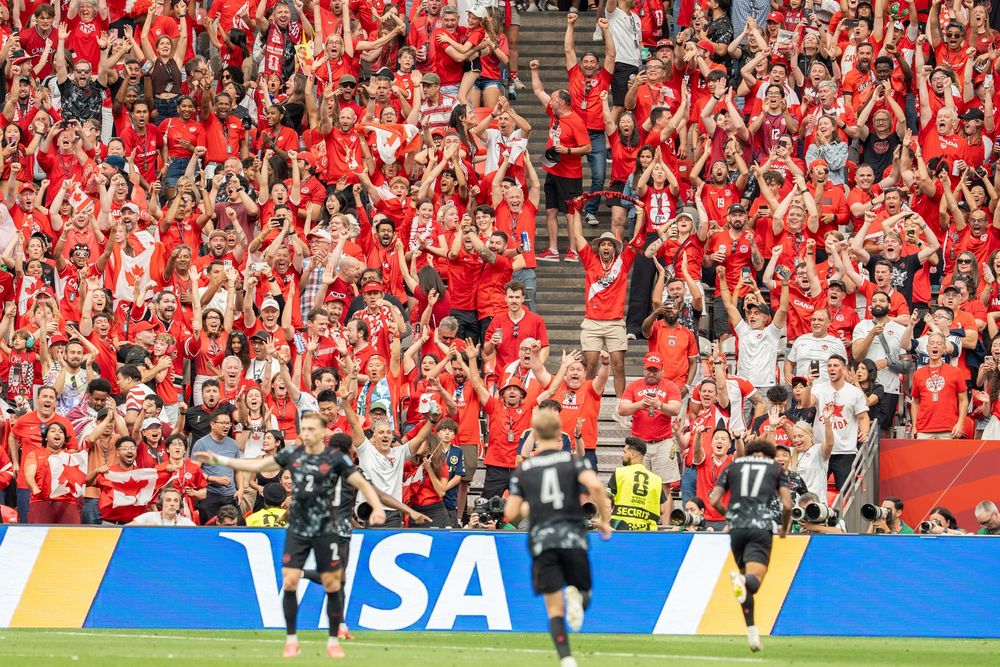
Article photo: Canada v Qatar on 18 June 2026 at the 2026 FIFA World Cup" by Bryan Berlin / WikiPortraits is licensed under CC BY-SA 4.0.