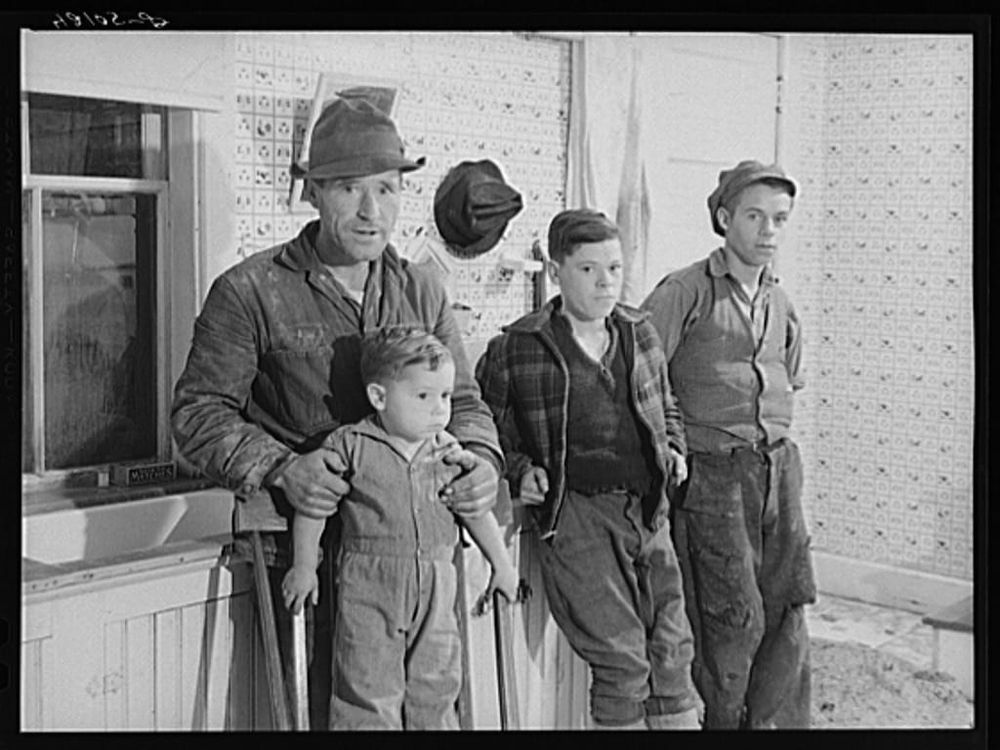
Working-class politics wasn’t built by policy — it was built in halls, taverns, and union locals that mostly no longer exist.
Since 2016, there has been a great deal of material written about populism in the West, particularly of the right-wing variety that is intimately connected to white working-class voters. Brexit, Trump, and many other movements are claimed to have arisen from working-class anger about declining living standards in deindustrialized regions like the American Rustbelt, Northern England, or the auto manufacturing towns of the Golden Horseshoe.
This populism has not gone away, and in fact seems to have strengthened since Trump was reelected in 2024. In the 2025 Canadian federal election, Conservative Party leader Pierre Poilievre promised “boots not suits” to increase trades training and projects to attract working-class voters. While the incumbent Liberals managed a reelection miracle in response to Trump’s musings about annexing Canada as a 51st state, the labour-aligned New Democratic Party (NDP) was nearly obliterated, with the Conservatives capturing many of their long-held working-class constituencies in Ontario and British Columbia.
There is of course a relationship between industrial closure and populism, but it is a much more complex one about how class and cultural identity intersect, and there is no straight line from deindustrialization to workers voting conservative. Yet despite the centrality of workers to left-wing politics in the twentieth century, they were never a monolithic bloc of voters in Canada, and the NDP competed for their votes with the Liberals and Tories throughout the period. This seemingly muddled sense of political class awareness should not be particularly surprising, as historian Craig Heron notes in Lunch-Bucket Lives, his history of early twentieth-century working-class life in Hamilton, Ontario: “Workers tended to work out this class awareness, at least in part, through their social networks of family and kin, workmates, neighbours, and others they met through sports, church, lodge meetings, union activities, and politics.”
In other words, workers did not so much become politicized to class, as socialized into it, and this was key to developing a working-class political sociability; this insight is among the most prominent blind spots among those trying to rebuild a viable class consciousness in the twenty-first century. It is not a lack of partisan or ideological education about this or that issue so much as the disappearance of the social embeddedness that made working-class identities an organic reality and a live variable in the political struggles of the last century. Often, this embeddedness boiled down to something as simple as the fact of the regular, physical proximity between workers in shared spaces—working-class bars, union halls, labour temples, leisure centres, and the workplace itself—and allowed for the casual sharing of views, grievances, and aspirations, which then served as the foundation for solidarity and fellow feeling among workers.
However, there has been a long-term decline in the availability of these spaces and the sociability they engendered, which Robert Putnam demonstrated in his landmark 2000 book Bowling Alone. People spend less time participating in social activities with others, as evidenced by the shift away from bowling teams to throwing solo that Putnam found in the 1990s. A recent retrospective of the book by Anton Jäger claims this has gotten even worse, particularly for working-class sociability, which Putnam did not even touch on, as in a “book of more than five hundred pages, there was no index entry for ‘deindustrialization,’” or “the aggressive drop in union strength at the close of the century.” Nonetheless, Jäger still finds much value in Putnam’s thesis for thinking about working-class politics across the West, as new conditions of precarity combined with atomization have replaced the mass-based milieu of the past.
What I am attempting here is to focus on historical working-class sociability in Canada, and consider its transformation in the past few decades, not just through the decline of the labour movement but also through the contractions of the spaces for worker socialization that came along with it. Unions provide crucial institutions for workers to develop a collective sense of themselves as political actors who could make and win demands to improve their lives. And it is the socializing function of unions and union-adjacent spaces that served as a precondition for any working-class politics worthy of the name.
This dynamic is visible in the historical development of the labour movement. By the mid-nineteenth century, a distinctive Canadian labour movement began to emerge and steadily grew. Unions formed in the coalfields of Cape Breton Island and in Montreal textile mills, and many other places besides. And they regularly went on strike to fight for wage increases, better working conditions, or just basic recognition of their right to organize at all. At times, such as in 1919 following the First World War, these strikes crested in immense waves that terrified employers and governments who responded with repression and reform. Yet still the power of the organized Canadian working class grew, and their unions became accepted economic and political actors in this country, enshrined in a large body of labour law that conceded to as well as contained them. A prime example of this is the Rand Formula, which was a 1946 Supreme Court ruling that required all workers covered by a collective agreement to pay union dues, automatically deducted from pay cheques, which cemented unions in the country.
To accomplish these feats, workers needed to cultivate strong collective solidarity to win. Strikes are very risky endeavours and require everyone to stick together or be individually cut down by the bosses. Of course, many things militated against solidarity and divided people. Ethnicity, religion, gender, locality, trade, and more claimed the loyalty of workers and were used by employers to split up labour resistance. However, these social bonds could also be forged into working-class solidarities.
In her book on the Ukrainian Canadian Left, historian Rhonda L. Hinther chronicles an example of this, where an ethnic community created physical spaces to organize themselves, building a network of Ukrainian labour temples across the country. Not only were they political spaces, but labour temples were vital social spaces that hosted dances, community meals, and musical performances. Whole communities and successive generations found meaning and formed identities through this infrastructure: young people found partners, families came together to celebrate births and mourn deaths, mutual assistance was exchanged, and cultural memories were sustained. The Canadian labour movement more broadly had similar spaces in the form of union halls. This physical infrastructure had been invaluable to the purposes unions were formed to fulfill—and much of it is unfortunately gone now. In many cases, the structures still survive as curious civic relics, now hollowed out of a living communal presence.
Unions provide a larger social infrastructure that empowers workers to act collectively, and this social infrastructure requires a good amount of working-class sociability to function, not just consisting of openness to conversation. Simply making appeals to improved wages and working conditions was and is insufficient to mobilize people against their employers. The late Jane McAlevey, the American theorist of union organizing, argued that the most successful period of union drives in the mid-twentieth century relied on “methods [that] were deeply embedded in, and reliant on, an understanding of workers in relationship to the communities in which they lived.”
Family, religious groups, sports teams, hobby clubs, etc. all were folded into union organizing campaigns to create immensely strong organic social bonds that made the union an integral part of the community. Where that has happened with regularity and intensity, such as in the coal mining towns of the Crowsnest Pass, which straddles the Alberta-British Columbia border, unions “were the organizational centres of an alternate vision of community, [...] a vision that stressed equality rather than hierarchy, solidarity rather than self-interest and democracy rather than corporate oligarchy.” It is certainly a left-wing vision, but it is also, more broadly, a vision of society where people have deep commitment to and reliance on each other, and one that should interest any Canadian with communitarian instincts, whatever their political orientation.
In the past forty years, this social infrastructure has declined along with the North American labour movement. As of 2024, union density, that is the percentage of the workforce covered by a collective agreement, has shrunk from its peak decades ago. In Canada, union density fell from a record high of 37.6 percent in 1981 to 30.4 percent today, with much of the decline happening since 1997. For the United States, the collapse in union membership has been much more dramatic, with only 9.9 percent of workers organized, down from 20.1 percent in 1983; it was likely around one-third in the 1960s, although comparative records do not exist. Falling union density correlates strongly with stagnating real wages, increased inequality, precarious employment, and worse health outcomes. The empirical evidence overwhelmingly points to unions providing an economic regulating function that protected workers’ interests and helped to secure decent wages and safe working conditions, but with the decline in union density, those things have eroded away.
The reasons for this are multifaceted. The nature of the workplace has changed significantly, moving away from industrial mass employment to much more fragmented service sector jobsites. Deindustrialization and offshoring eliminated much of the traditional heavy industries such as steel, automobiles, and goods manufacturing that were the historical pillars of organized labour. Canada is now primarily a white-collar service economy, bifurcated into relatively well-paid skilled professionals and low-wage, low-skill positions. The former are more likely to be unionized, especially if they are in the public sector, the growth of which has masked the much steeper decline in private sector unionization rates, where workers are only a fifth as likely to be covered by a collective agreement. (The condition of precarity and stagnant salaries are also catching up with white-collar workers, a trend that began well before the present expansion in AI capabilities and which is only likely to accelerate in the years ahead.)
Unifor, Canada’s largest private sector union, was once the Canadian Auto Workers, but since merging with the Communications, Energy, and Paperworkers Union in 2013, it has branched out well beyond industrial work. But at 320,000 members, it is dwarfed by the country’s largest union, the Canadian Union of Public Employees with 800,000 members.
These structural factors have been accompanied by a decades-long offensive by employers and governments on the labour movement. In recent years, Canadian governments have routinely intervened in labour disputes on the side of employers. The federal government has ordered transport unions back to work so often that their private employers no longer bargain in good faith and simply await the more favourable state-mandated arbitration settlement. In 2024, the two big railways, Canadian National and Canadian Pacific Kansas City, pushed the national logistics network to the brink of crisis so the federal government would squash the strike, using the constitutionally dubious Section 107 of the Canada Labour Code. Again in 2025, the federal government used it against Air Canada flight attendants, who this time ignored it at risk of fines and jail. In the case of the Alberta teachers’ strike, the provincial government chose an even more extreme option of pre-emptively invoking the notwithstanding clause of the Canadian Constitution to impose a settlement and override any civil rights legal challenges.
Overall, these things have weakened the Canadian labour movement, if not to the same degree as south of the border. The decline of unions was not a voluntary phenomenon like the decline of many other institutions of sociability like social clubs and churches. Union locals primarily go extinct when workplaces like factories or mines close down, and the members lose their jobs. Work is where most of us spend an enormous amount of our lives, second only to home. And we do this daily with other people we interact with to accomplish the tasks we are paid for.
Despite decades of neoliberal ideological hegemony preaching the virtues of total individualism, human beings cannot be reduced to self-sufficient economic units hustling their personal brands all day long. The historical experience of labour unions offers a countermodel that remains strikingly resonant today; these institutions have acted as a strong facilitator of sustained social engagement between coworkers both on and off the job, extending beyond the workplaces to the third spaces that once littered the social fabric across countless Canadian cities and towns. Unions today still perform this function, if in diminished capacity.
In his latest book, Richard Seymour argues that the rise of contemporary populism has much to do with the isolating effects of contemporary life. Anonymously posting online has not brought us closer together but pushed us apart into a fevered stew of alienation. Internet forums can instead encourage anti-communities that foster negative solidarities of shared hatreds, which poisonously mimic the normal desire to socially connect with other people.
Yet we do not entirely live online and still have to go out into the world, at the very least to work a job to survive. However, long before the internet, the workplace was the classic space of alienation, and that has not changed, because employers have little incentive to socialize workers any more than necessary to do the job. Unions have long contested that work should not be alienating, and that is a role they still play. While unions certainly are political institutions, they are first a place where workers develop sociability between themselves and their broader communities, a necessary precondition for doing any politics at all.
What do these insights about working-class solidarity mean for those working to revive worker solidarity and consciousness going forward? Quite simply, it will not be enough to devise policies to help workers—though this is, of course, necessary work—nor will it suffice to try to capture the attention of working-class voters through viral memes and content production, which is the extent of some political parties’ engagement strategies. Rather, serious efforts must be made to rediscover and resuscitate spaces for workers to see and interact with each other at an embodied, physical level and with enough frequency for interactions to be more than fleeting. This holds true for workplaces and communities with surviving or residual union presences but is even more urgently needed in locales where such structures do not exist.
The challenge is that any such effort will have to operate with the aforementioned fragmented nature of today’s economy and culture, which seems almost tailor-made to prevent the formation of social identities larger than the lone individual: neither Uber drivers nor work-from-home clerical employees will have natural places to meet their peers; young and precarious workers who feel overburdened by “the grind” often feel like they do not have the time or the right to socialize freely. Certainly, the financial costs of going out have become prohibitive to many at a time of price inflation and bifurcation within the food and beverage sector. And then there is the seemingly inescapable pull of digital stimulation and distraction, which has more than anything sapped the basic attentional and interpersonal capacities of citizens. I do not pretend to have all the answers for how to overcome these obstacles, but identifying them clearly is as good a place as any to begin the difficult but necessary task of reconstituting the working-class social world.
Indeed, the example provided by the founding generations of the labour movement in Canada, composed of often dirt-poor, illiterate, or newly arrived immigrant workers and farmers with very little by way of economic or social capital, should be instructive and inspiring. If the factory workers of Ontario, the farmers of the prairie West, the loggers of British Columbia, the miners of Quebec and Atlantic Canada, and so forth were able to come together and create new forms of integrative associations to combat alienation and oppression in a world with Dickensian levels of deprivation and despair, so too should modern Canadians be able to begin that work again.
William Gillies is an independent scholar and recipient of the 2022 Deindustrialization and the Politics of our Time (DePOT) Masters’ Fellowship at Concordia University. William is a founding member, researcher, and writer for the award-winning Alberta Advantage podcast which produces episodes on current political events and working-class history. His primary historical research interests are labour, regional economic development, fossil-fuel capitalism, and state industrial policy. William currently splits his time between Calgary and Tumbler Ridge, where he works in a coal mine. He has also written for Jacobin.