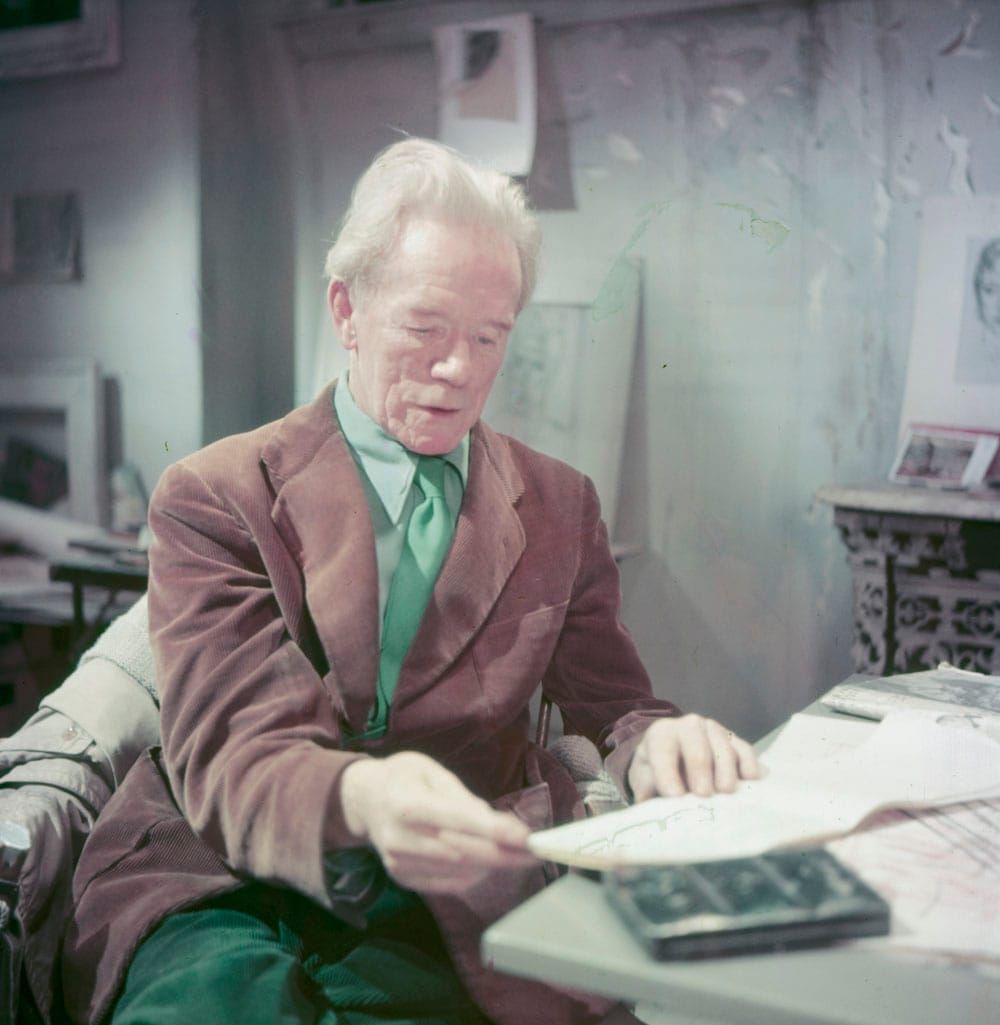
It is no longer fair to say that the only thing to do on weekends in Vancouver is to go out of it for a hike. All the same, you could do worse than to take the Varley Trail, which runs up the boulder-strewn Lynn Creek in North Vancouver. Where Dempsey Road gives way to the trailhead, you will pass a rambling Edwardian house, weather-beaten, even shabby, despite being valued at two million dollars when it was up for sale lately (because this is Vancouver). It was here that the painter Frederick Varley holed up after leaving his wife in the mid-1930s. From here, you can reach Rice Lake, the subject of some of his most rapturous paintings. Varley’s feverishly creative decade in Vancouver (1926–35) is little commemorated today, even though he was one of the canonical Group of Seven. There is not much apart from a plaque at Rice Lake, a few canvases in local galleries (often in storage), and the naming of the trail in 1998. A lot of his works ended up in Markham, Ontario, a bedroom community outside Toronto, where a museum named for him opened as late as 1997.
Varley’s obscurity is surprising, given how formative the landscape painting of his day was to the “wildercentric” definitions Canadians still tend to offer of themselves, in which bracing encounters with a uniquely harsh landscape generate a national identity. Whenever anxieties arise about an assault on their sovereignty by the United States, Canadians have also groped after a distinctively national culture, often without thinking hard about how they might support its production. These two impulses coalesce in the sedate cult of the doomed Tom Thomson and of the Group of Seven as pioneers who freed Canada from foreign influence in the realm of the arts and revealed a creative identity worth cherishing. The McMichael Museum in Kleinburg, Ontario, is their temple and mausoleum: its founder even arranged for the interment of six of the seven painters in its pastoral grounds, which are admittedly now hemmed in by suburban subdivisions. But the fixation goes wider: there are blockbuster touring shows; guidebooks to the wild corners of eastern Canada that they painted; Christmas cards and other gallery gift shop tchotchkes.
I. The Weight of Wilderness
Mechanical reproduction spread the Group’s imagery so widely, leaving such a deep mark in the Canadian psyche that academics and critics have subsequently tried (in vain) to demonstrate that the pristine wildernesses they painted never existed. Their treks into the Canadian Shield and later to remote Skeena in British Columbia relied on the loan of carriages from railway companies who hoped to boost tourism. Members of the Group did not privately believe they were treading where no one had ever set foot. They quartered themselves in defunct logging villages and relished hacked about landscapes. Though they were happy to play along with old frontiersman imagery and talk about their “red blood” and “virility,” they never claimed that theirs was a naïve response to what lay before them. Working in commercial studios had versed them in post-Impressionism and Japanese printmaking techniques. Their philistine critics had a point when they attacked them for turning out crude posters of nature.
Lawren Harris, who had an easier passage in life than Varley and ended his days in a Vancouver mansion, exemplified this complexity. The fortune his family had amassed selling tractors allowed him to devote his life to painting. He was no simple woodsman: trained in Berlin, he approached his native scenery with eyes trained on the work of Norwegian snow painters. He was deeply into Theosophy, whose esoteric understanding of the natural world as an emanation of inner spiritual energies refined his sense of artistic perception. Yet he burdened the Group with a mythology that still affects how we regard this country. He turned Theosophy’s placeless spirituality into a spot on the map: the “living whiteness” to be found at the “top of the Continent” of North America. The closeness of Canadians to this “source of spiritual flow” distinguished them from the teeming millions of materialistic Americans.[i] Canadian artists were thus called to refine their awareness as a Nordic civilization and to channel cleansing blasts of Arctic air south.
All this talk of elevating whiteness and a “great North” that was as numinous as it was empty fudged cultural and racial terms and skipped over the presence and impact of First Nations. But the problems with Harris’s vision go deeper than a now crass sociobiology. He misread his society. To the frustration of the federal authorities, most newcomers to early twentieth-century Canada gravitated not to its desolate frontiers but to the booming cities. They wanted to traffic with each other, not to commune with the trees. This preference pained the Group’s members. Varley’s friend Arthur Lismer, who had preceded him in coming to Canada, sorrowed over “our polluted cities, our mechanical fashion of living, our ugly squalid architecture.”[ii] Harris had initially conceded that the action was in the cities: his early paintings depict houses in sketchy Toronto neighbourhoods and in the hardscrabble towns of Atlantic Canada. Yet even his Toronto is spookily depopulated, resembling the national parks in being a waste space in which lonely artists wander, capturing shapes that set their soul aquiver. By the late 1920s, he was heading to the Rockies to capture the inhuman whiteness of its snowy peaks in paintings as sublime as they are chilly.
Harris’s misanthropic chauvinism lingered in Canadian thought long after he fled to the United States with his best friend’s wife and gave up landscape for abstraction. In 1946, Percy Wyndham Lewis, a self-hating Canadian who loathed Toronto, introduced the Group to British readers by observing that the “pull of nature” on Canada would exceed the lure of urban life because Anglo-Saxons had a “great affinity with primitive nature.” Canada was an “agricultural and raw material nation” that was “everywhere on the frontiers of the wilderness.”[iii] In the 50s, Northrop Frye enlisted Harris and Thomson in his account of the struggle to apprehend the “immense searching distance” of Canada. The settlers and statesmen of the young Dominion pushed roads then railways westward: they had “advanced geometrically” across the landscape, building towns and cities that were “an arrogant abstraction, the conquest of nature by an intelligence that does not love it.”[iv]
By the middle of the twentieth century, Canada was already among the respectable and mature middle powers of the world. Yet to Frye, its aesthetic understanding of itself appeared to be still nascent and colonial; it had excelled only in the “inarticulate parts of communication, railways and bridges and canals and highways”.[v] In the visual arts, efforts to solve the “riddle of unvisualized land” seemed to have only just begun with Thomson and the Group of Seven. He admired their “feeling for strained distance”: the way in which their eyes, like those of the fur-trading voyageurs before them, were always scanning for the horizon in this formless landscape.[vi]
Working out where we really are is a challenge, at once aesthetic and ethical, no less vital today than it was when Frye wrote. Yet the terms in which he couched it were both mystical and parochial. Did the horizon really operate so differently here that it requires the origination of unique creative forms? When we pretend that the mission of Canada’s artists is to express the need of its citizens to respond to their environment, we end up gesturing at the wilds, a reservoir of meaning largely unvisited by most Canadians outside of the odd Canada Day camping trip. These fond visions muddle public policy too. The enthusiasm of Mark Carney’s government for oil and gas projects sits oddly with its pledge to spend millions of dollars protecting the wildernesses it claims that Canadians love. The Prime Minister can come to Vancouver to announce an LNG plant and the expansion of a port terminal from behind a lectern emblazoned with the slogan, “Protecting our Oceans.” It is as if orcas, salmon, and Douglas fir trees existed in a Platonic realm of Canadianness, where they can be depicted by visionary artists or invoked by politicians, but where they will be unaffected by a warming climate or by rapacious resource industries. These totemic flora and fauna will linger on at the picturesque margins of human activity so that Canadians can get an occasional lift from contemplating them.
II. Peripheral Visions
What we might call “Group of Seven Syndrome,” or the conviction that the role of culture here is to express our encounters with pristine landscapes or at least our memories of them, is a serious condition. And it has made it difficult to grasp what our country is and diverted the question of how to promote the arts into protectionist musings on how to safeguard Canadian content. How then could it be cured?
One way in which our tastemakers have dealt with tough legacies from the past is to deaccession them. For instance, they have honed this capacity for amnesia in political history, disappearing founders whose actions and attitudes have not kept up with revisions to public doctrine. The process has been more spasmodic than systematic: Vancouver renamed Cecil Rhodes School in 1977, but you can send your child to General Gordon Elementary or live on Rhodes Street. The same bureaucratic, patchy censoriousness now affects artists: a plaque still commemorates Alice Munro outside the Kitsilano branch of the Vancouver Public Library in which she worked, but her name vanished from prizes when news of her complicity in the abuse of her daughter broke. Curators of galleries can consign supposedly outdated works to the storeroom: a Globe and Mail columnist noted lately that the abundant wall space now given to Indigenous art comes at the expense of colonial schools of art that are no longer on public display.
Yet neither scholarly critique nor the episodic deaccessioning of art works seem likely to shift the visual grammar of nationhood any time soon. “Landscape is all that is national yet,” Harris quipped in 1914. “Her people and her cities are not characteristic.”[vii] That still seems to hold true in 2026, on the evidence of everything from postage stamps to car advertisements. But what if instead of uncritically consuming, or prissily blenching at, formative movements in Canadian culture, we returned to take a harder look at them? We might look at their failures and their dead ends as well as their iconic works and achievements. Doing so might help to generate a more realistic sense of how culture could thrive in Canada, provided we can cultivate a certain deliberate irresponsibility toward the moral agendas and political programmes of the moment, whether the national “virility” pursued by members of the Group or the Elbows Up patriotism of our own day.
Varley’s messy stint in Vancouver is a case in point. Although he joined in the 1920 Toronto exhibition that gave the Group their moniker, his origins made him immune to the chest-beating in which some of his friends indulged. He had the signal advantage many Canadian artists and thinkers have enjoyed of not being from here. He was from the grimy English town of Sheffield and emigrated in 1912 only after he had failed to make it in London; he aimed to make a living and good art, rather than to ennoble a nation. He naturally gravitated to Toronto. After falling in with other painters in commercial studios, he trekked out of town with them to pursue truth to nature, though he didn’t relish life in a tent. Stormy Weather: Georgian Bay (1920), in which a gnarled tree pushes back against fierce winds, was snapped up by the National Gallery and is still often a handy thumbnail for the Group’s lonely genius. But it was atypical of him. Varley might have conceded that Canada was “an outdoor country,” but he preferred doing portraits of Toronto’s burgeoning intelligentsia, whose purposeful faces shine out from impasto blocks of rich, dark colours.[viii]
His excellence as a portraitist had for a time led Varley to the Western Front. Like Wyndham Lewis, he joined Lord Beaverbrook’s Canadian War Memorial Fund during the First World War. This was an imperial rather than a national project, which celebrated Canada’s contribution to the British effort, rather than encouraging Canadian artists as such. Most of its first recruits were British. The big canvasses that Varley produced after he got to France in the last days of the war now look somewhat portentous. But when he reluctantly returned to Toronto, he took home the realization that industrial society could maul environments as efficiently as it killed people. Nature did not exist outside its disintegrative power. When Varley painted Rice Lake and Lynn Valley, he showed tangled slopes pocked with second growth timber and stumps that recall the brutalized soils of Flanders. Critics would dismiss these landscapes as “messes.”
The School of Design and Applied Arts that tempted the middle-aged Varley west in 1926 was a modest affair housed on top of the Vancouver School Board’s offices but was part of Vancouver’s hesitant pitch at big city status. Vancouver epitomized Canada’s unease at urbanity. It owed its prosperity and even its name to the Canadian Pacific trains that chugged across the continent from Montreal before reaching the western terminus of a vast global network of railways and steamships. Its downtown housed a floating population of loggers and salmon canners who helped foreign corporations to strip the seas and Crown lands of their bounty. But its streetcar suburbs were home to a rising middle class who plumed themselves on their Englishness, their cottagey houses, and their love of the woods. These worthies had insisted that Stanley Park should be a chunk of wilderness, albeit one emptied of a Squamish village, rather than an Americanized pleasure ground, complete with a baseball stadium. The local journalists who catered to their tastes attacked the Group of Seven as “freakists.”[ix]
Varley refused to conform to this respectable love of manicured wilderness. He set up in a shack-like home on Jericho Beach. After the eviction of the Irish squatter who had given Jerry’s Cove its name, this logged shoreline to the northwest of the city became a pleasure ground for its residents, a place to bathe and play tennis. The selling point of Varley’s house was its proximity to the elements: a deck gave onto the sea, backed by the mountains on the north shore of the Burrard Inlet. Varley often painted these splendid vistas but in a way that evoked the artist’s own consciousness. His roiling, inky strokes seemed to represent the Pacific Ocean as the outflow of an inland sea, the mauves and greens of the water at dawn or dusk harmonizing with the pure white of the mountain tops. He often framed that view through open windows, playing further with the notions of inner and outer.
Where Harris saw himself as “Nordic,” Varley’s aesthetic models for evoking the “wonder” of his surroundings were refreshingly cosmopolitan. He gravitated to the “Chinese of the eleventh and twelfth century,” whose prints of mist-wreathed mountains had “interpreted the spirit of such a country” as theirs.[x] Varley’s biographer, Maria Tippett, noted how he borrowed features from Eastern artistic traditions, such as the vertical ordering of a landscape or the removal of a middle ground, to make the land his own. The photographer Harold Mortimer-Lamb, another restless Englishman who had become a mining journalist before turning his hand to collecting East Asian art, encouraged these orientalizing tendencies. They thought of Vancouver not as the Western outcrop of a monolithic British Canada but as a tectonic zone where the plates of different civilizational sensibilities ground against each other. Mortimer-Lamb, Varley, and their allies challenged the Vancouver Art Gallery’s import of stodgy British paintings. After Varley had quit the School of Design in protest of budget cuts and set up a breakaway British Columbian College of Art in a former car showroom, it became a centre for such ambitions. Varley invited Japanese consular officials to talk about how to “open Oriental branches” within it and hoped that half the College’s students might be local Chinese or Japanese people.[xi]
While he mounted these challenges to the North American variant of little England-ism, Varley was on the skids. He fled from his wife and children to rented rooms and eventually to Lynn Valley, where he settled in the house on Dempsey Road, living off kippers and fried onions. He was often so cash-strapped that he lunched off the free crackers and ketchup at the White Lunch diner downtown. He started an affair with Vera Weatherbie, a talented pupil whom he credited with his own breakthroughs. Lynn Valley put him on the rim of urban life: he was at the end of a trolley line, so that after a day’s teaching and a boozy night downtown, he was only a ferry over the inlet and a tram ride from the forest. The commute produced Night Ferry (1937), a hymn to urban modernity he later painted in sleepy Ottawa. Excited by a friend’s talk of New York City, he inflated Vancouver’s then modest skyline into something akin to the pocket mini-Manhattan that it is today. Skyscrapers trail their lights like “peacock feathers” across the ferry’s wake.[xii]
III. Paradise Lost and Painted
Official Canada, which has passed smoothly from Presbyterian moralism to the neoliberal ethic of self-optimization, often forgets that insight can come from personal chaos. Holed up in the woods, Varley reflected that settlers like him were “little bits of mind” who had yet to connect with their surroundings. The meaning of that environment could not be picked up from the ground but had to be supplied from within. Varley’s wonderful paintings of Rice Lake and Lynn Valley made of the trees what he had found in the sea: the organic expression of his inner states.
A believer in what he took to be a Buddhist doctrine of “colour vibrations,” he achieved rich and dark harmonies of forest greens, the colour of spiritual enlightenment. Dhârâna (1932) is a touching, if stagey, expression of this faith. Vera sits at dawn on the porch of a fire watcher’s hut they frequented. The sky’s violet and the mountain’s green harmonize with her green dress and become emanations of her evident rapture, her body’s upright but flowing pose emulating the lines of cabin and peak. The title, a garbled reference to Buddhist teaching, matters less than the painting’s statement that what we find in exterior views comes from ourselves: not just from ourselves but from others. It was his sexual and creative entanglement with Vera that turned these woods into a brittle, temporary heaven. He later confided to her that it “permeated everything we saw…we lived splendidly with no limitations to dreams.”[xiii] His plaintive eroticism is far from the lonely virility popularly associated with the Group: nature exists not beyond but within our turbulent intimacy with others.
These days, the Vancouver Art Gallery advertises the therapeutic benefits of its contents, suggesting that an hour with Emily Carr’s treescapes is as good for you as a forest bathing session. Yet Varley’s Mirror of Thought (1937) suggests that when we are down and heartbroken, nature just amplifies our desolation. The artist’s gaunt, dejected face, lit fag dangling from his lip, hovers in a mirror hanging from his studio window. Beyond its panes is the road toward Mount Seymour, which is rendered with dark but lambent strokes that recall the haunted landscapes of Edvard Munch. A courting couple on the path are a piercing reminder of the love from which Varley feels shut out. The mirror hangs at the point where four bars of the window meet. He is being crucified: a self-pitying parallel but one with artistic pedigree; the Renaissance artist Albrecht Dürer had modelled his self-portrait on Jesus.
Mirror of Thought records Varley’s expulsion from paradise. Like many an artist before and since, he was reduced to raging at the “indolent and sleepy natives” of Vancouver whose getting and spending had no time for his “prophetic utterances.”[xiv] In 1935, everything went wrong. By the time he handed Mirror of Thought over to Vera, he had broken up with her: she fled to Yokohama then wounded him deeply by marrying Mortimer-Lamb. The impact of the Great Depression meant that local businessmen were unwilling or unable to stump up the sums that could have kept his college alive. Cultural patronage in Canada was as exiguous as it was conservative. The only way that friends could think to help the sunken Varley was by commissioning a portrait of H.S. Southam, the Christian Scientist who chaired the National Gallery’s trustees.
Varley loathed official Ottawa. But when he flitted back to Vancouver, it was to find that his wife had used a legacy to buy the Lynn Valley house: a gesture he resented as the final destruction of his independence. He spent his remaining decades in a morose hunt for employment and housing. He moved in and out of lodgings in Toronto and Ontario, romancing his landladies in lieu of paying rent. He taught painting in the Ontarian countryside, where the overlit expanses did not suit a sensibility formed on cloud-capped peaks. He tried to do for the Second World War what his earlier work had done for the First but could not repeat his past successes. Before Varley died in 1969, he had nonetheless become a national treasure. The National Film Board’s short film of 1953 celebrated him as a corduroyed bohemian, with a sonorous if obscure message for the world. Its portrait of Varley as a grand if now toothless lion of the canvas concentrated on the war paintings, brushing out his years of wonder and enlightenment in the oriental West.
An artist is a “bloody fool,” Varley once said. There is a lesson for us in his self-destructive contrariness as policymakers and the chattering classes agonize about what Canadian culture can contribute to defending the nation-state. The provocations of the Trump administration have naturally made us only too eager to strengthen or remake national identity. We want to be one people behind our ramparts; commentators have responded by resuscitating old ideas about Canadians as a people welded together by rocky wilds or harsh weather. While it is vital to find some civic common denominators, we should not slide back into Group of Seven Syndrome and ask artists to be solemn apostles of a grand patriotic narrative. Many of them come from elsewhere, either geographically or philosophically, and work aslant from what we suppose our national virtues and traits to be. Varley painted Vancouver superbly because he was poor but free, with no need to look over his shoulder for the approval of King and Country.
Varley’s house at Jericho Beach has gone but the mountains haven’t moved. You still hear the plock of prosperous Vancouverites hitting tennis balls. Much has changed though. When I swim there in the summer, the beach now resounds to the tinny beat of Bluetooth speakers. Varley’s morose light is no more: as in a Fred Herzog photograph, the synthetic hues of sportswear and the primary colour paint jobs of the tankers in the inlet bleach out under a strong sun. Zola said of an impressionist artwork that it was “a corner of nature seen through a temperament.”[xv] Varley’s seas and woods have vanished with his sulphurous, idiosyncratic temper, and that is no bad thing. We should leave the defence of trade and sovereignty to the politicians and ask of artists that they give us visions of ourselves that are as various as we are—and which recognize, as Varley did, that we carry the flux and heartache of modern life with us when we hit the trail.
Notes
[i] James King, Inward Journey: The Life of Lawren Harris (Toronto, Ont: Thomas Allen Publishers, 2012), p. 153.
[ii] Quoted in Charles Hill, The Group of Seven: Art for a Nation (Toronto, Ont: McClelland and Stewart, 2007).
[iii] Percy Wyndham Lewis, “Canadian Nature and its Painters”, The Listener, 36 (1946), pp. 267-268.
[iv] Northrop Frye, The Bush Garden: Essays on the Canadian Imagination (1971; Toronto, Ont: Anansi, 1995), p. 226.
[v] Frye, Bush Garden, p. 224.
[vi] Frye, Bush Garden, pp. 203, 10.
[vii] Hill, The Group of Seven, p. 20.
[viii] Tippett, Stormy Weather: F.H. Varley, a Biography (Toronto, Ont: McClelland and Stewart, 1998), p. 71.
[ix] Hill, The Group of Seven, p. 236.
[x] Christopher Varley, ed., F.H. Varley: A Centennial Exhibition (Edmonton, Alta: Edmonton Art Gallery, 1981), p. 110.
[xi] Tippett, Varley, p. 198.
[xii] Tippett, Varley, p. 232.
[xiii] Varley, Varley, p. 100.
[xiv] Varley, Varley, p. 126.
[xv] Quoted in John Berger, “The Moment of Cubism,” in Selected Essays, ed. Geoff Dyer (New York: Vintage Books, 2001), p. 83.
Michael Ledger-Lomas is a historian and writer who lives in Vancouver, British Columbia. His most recent book is Queen Victoria: This Thorny Crown.
Photo by Gar Lunney / Library and Archives Canada, licensed under Creative Commons Attribution 2.0 Generic license.