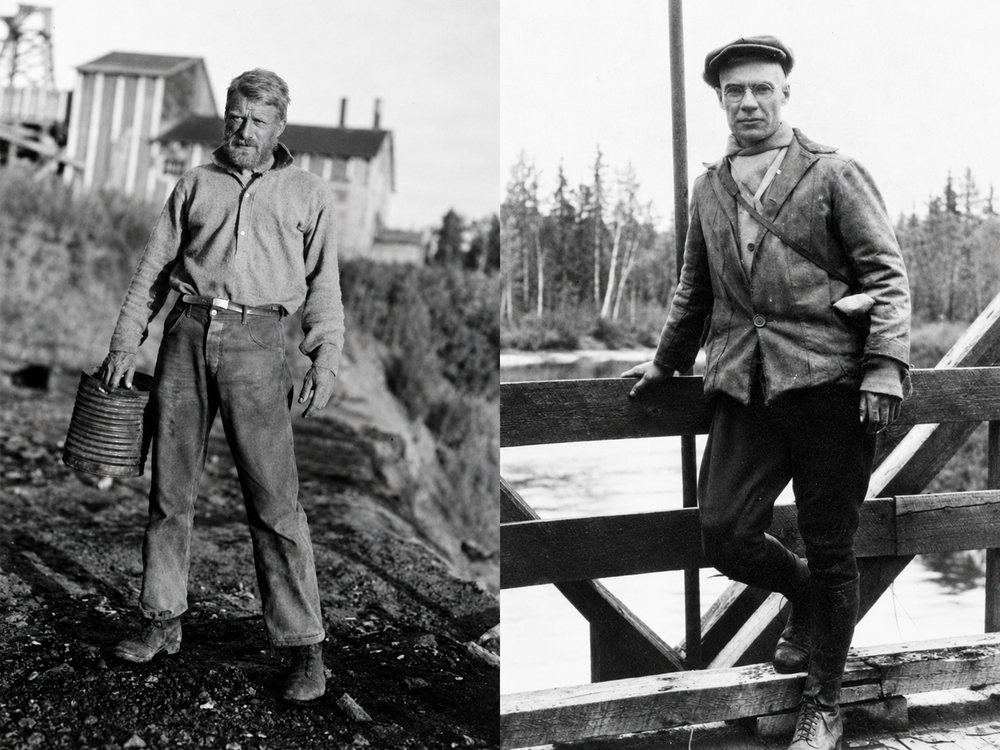
Left: S.C. Ells, Canada. Dept. of Mines and Technical Surveys/Library and Archives Canada, PA-014454. Right: Karl Clark, University of Alberta Archives, 78-114-11.
While separation from Canada is the hot button political issue in Alberta today, it is worth noting that, a century ago, an entirely different form of separation preoccupied the province: the separation of crude oil from the bituminous sands alongside the Athabasca River. The Alberta oil sands, in the northeast of Alberta, Canada, comprise the world’s fourth largest proven reserve of oil. The oil sands contain three oil fields: the Cold Lake oil sands, the Peace River oil sands, and the Athabasca oil sands, the most commonly referenced, as it is by far the largest, located on the Athabasca River north of Fort McMurray.
In its natural state, oil sand is a black, sticky substance, of which bitumen, the component refined into crude oil, makes up only 10 percent. The bulk of the material is sand, water, and other miscellaneous mineral content. While there are great quantities of oil encased in the oil sands, the task of separating it from the sands has proved immensely difficult. Combined with the region’s punishing geography—thick muskeg, biting winters, and great distance from major markets—the oil sands represented a mere potentiality for much of the twentieth century. After decades of surveys and experimentation from the 1910s onward, it wasn’t until 1967 that Great Canadian Oil Sands Ltd. opened the first commercial bitumen separation plant in the oil sands.
Why did it take so long for a commercial oil sands operation to get underway? How did the immense industrial projects in northern Alberta get their start? As a worker in the oil sands, I fell down the rabbit hole. In my free time, I began poring over historical oil sands reports, tracking down obscure books from town to northern town, and combing through documents in the University of Alberta Archives and the Provincial Archives of Alberta.
At the heart of the story were two rivals from out east who vied to be the first to tap the oil from the sands. Most historians today hail Dr. Karl A. Clark as “father of the oil sands.” Clark was a scientist from Georgetown, Ontario, lured to the University of Alberta expressly to solve the oil sands riddle and coax forth the sweet bounty. He was a well-liked, even-tempered, methodical researcher. His rival, often given second billing now, was the opposite: an ill-tempered but ardent mining engineer named Sidney Clarke Ells, who hailed from Amherst, Nova Scotia. He may have been too independent and irascible even by Alberta’s standards. Ells spent less time behind a desk or in a white lab coat and more time slogging through dense forest and following unruly rivers. Which of these two men truly deserved the title “father of the oil sands”?
Finding out required going back to the beginning.
I. The Oil Sand Puzzle
In 1913, a letter landed on the desk of Sidney Ells, the newly hired assistant to the Director of Mines in Ottawa. The letter was from the Alberta MLA for Athabasca, J.L. Côté, inquiring about the economic potential of the bituminous sands in the province’s far north. Indigenous groups had long known about the oil sands, using it to mend and waterproof their canoes. But the region’s inhabitants, native and settler alike, had little idea of the industrial and commercial uses of the natural resource.
Ells scoured the musty files of the Mines Branch but found virtually no analysis of the oil sands, except an unscientific report from 1883 by Yukon surveyor William Ogilvie. What caught Ells’s attention was Ogilvie's notes about a “float” on the Athabasca River, near Fort McMurray, containing twelve and a half percent bitumen. Ells became passionate about the oil sands, first proposing, and then insisting, that he be allowed to travel to Fort McMurray and do a proper survey. His superior, Eugene Haanel, Director of Mines, refused to allow Ells to go until the persistent surveyor threatened to quit. As luck had it, Ells possessed all the necessary credentials. He’d worked in the coal fields of Atlantic Canada as a miner and later as a surveyor, including in the oil shales of Nova Scotia and New Brunswick.
Ells launched his expedition with a rudimentary scow, a freight canoe, three white colleagues, and a crew of a dozen Indigenous men. They travelled the Athabasca River, over rapids and along portages, through bug-infested wilderness and muskeg, for almost four hundred kilometres, going with the current and reaching their destination in nine days.
Fort McMurray was then a mere fur trading town, with only a few log cabins, a dilapidated inn, and, in summertime, a handful of teepees. The surrounding land was naught but untamed wilderness. The real work began more than one hundred and fifty kilometres north of Fort McMurray, where Ells’s team took samples from minor tributaries connected to the Athabasca.
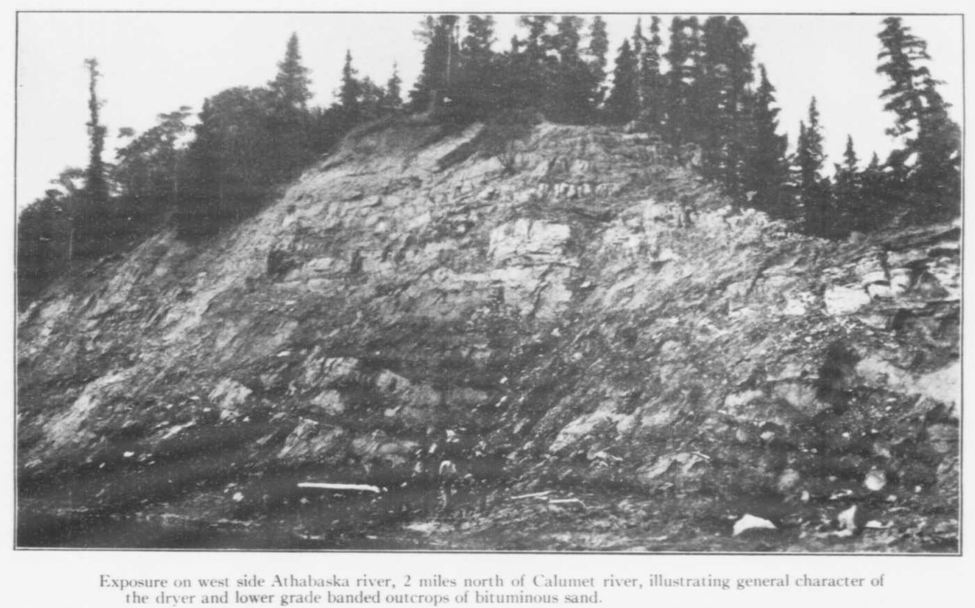
Photo of cutbanks from Ells, S.C., “Preliminary Report on the Bituminous Sands of Northern Alberta” (1914), Canada Mines Branch report no. 281, Government Printing Bureau, Ottawa.
Riverbanks provided the best terrain to see outcroppings of oil sand deposits. Overland, these deposits were covered by thick overburden and required drilling to access, which was more labour-intensive and costly. Ells created the first geological and topographical maps of the uncharted area, providing a guide for future oil sand development. His findings indicated promising deposits of oil sand on the banks of the various waterways.
The expedition met with snow and frosty north winds on the return journey in late September. Travelling against the current while carrying over two hundred oil sands samples weighing nine tonnes, plus equipment, the load was far too heavy to row. So, the team of a dozen Indigenous men, of whom only one spoke English, had to pull the scow and freight canoe from shore with ropes, trampling through rock and bog. Three times, as Ells notes in his memoirs, did his Indigenous companions desert him into the bush, at which point Ells and his white companions bluffed that they were able to run the line themselves, and lured the men back to the riverbanks with the wafting aroma of tea. The one Ells called “bacon face” proved to be the most obstinate of all, instigating these defections.
Only fourteen years had passed since the adhesion of the Fort McMurray region to Treaty 8, and the Indigenous economy of the Athabasca region was already being drawn more tightly into the expanding wage and commercial economy of the Canadian state. Hunting and trapping remained important, but increasingly they existed alongside seasonal work in freighting, guiding, river transport, and resource exploration. For able-bodied men accustomed to the river, tracking offered cash wages, though few could have regarded the work itself as desirable. One imagines that, when better-paying or less punishing alternatives were available, hauling a loaded scow upstream ranked low among them. Ells paid the men their wages and supplied tobacco and moccasins, expenses he later complained that the Mines Branch had left him to cover himself.
The journey was a rousing success, culminating in Ells’s “Preliminary Report on the Bituminous Sands of Northern Alberta” (1914), which he wrote upon his return to Ottawa. The report indicated many promising oil sand deposits which later became commercially significant. A site called Bitumount on the east side of the Athabasca, identified by Ells as the most promising deposit, became the site of the first semi-commercial oil sands separation plant in 1930. In 2018, Suncor opened a mine at Fort Hills, a few kilometres away, which is now one of the largest oil sands sites in operation, producing 200,000 barrels a day. Another high-potential site mapped by Ells was at the mouth of Steepbank River, where Suncor’s Millennium mine began operations in 2001. Ells also indicated significant deposits on the northwest bank of the Moose River, where CNRL (Canadian Natural Resources Ltd.) began its Horizon oil sands project in 2009.
Ells’s initial research with oil sand samples was for making road pavement, as the gooey, black substance resembles tar, hence the “tar sands” nickname. But Ells was always aware the real potential lay in separating the bitumen for refining into oil. It is difficult to extricate bitumen from oil sands, however, given that the bitumen forms a thin film around an envelope of water which encases a particle of sand in turn: it does not separate from the water easily, like conventional crude oil would be expected to. A commercial separation method would be necessary if the oil sands were to be a viable source of crude oil. If Ells could crack the problem, as he intended, the consequences would be immense: Canada, which then produced only a fraction of the oil it consumed, could become a great petroleum producer—or even an exporter.
Ells travelled through the United States to witness the use of bituminous sands in road paving and afterwards took a leading role in paving a stretch of road in Edmonton using oil sands. In typical, headstrong fashion, he travelled there against his supervisor Eugene Haanel’s orders. The bituminous sands proved to be a satisfactory asphalt, but the cost of transportation of the sands from the far north made it uneconomic. In 1916, the Mellon Institute of Industrial Research in Pittsburgh, Pennsylvania, offered Ells a fellowship and use of its laboratory to conduct deeper research into oil sand separation. Haanel refused to allow him leave, but again, Ells defied his boss, this time going over his head and appealing to the Minister of Mines in Ottawa. Haanel was overruled.
At the Mellon Institute, Ells first investigated the use of solvents alone in separating the bitumen, but that approach proved messy and expensive, while using heat alone to effect separation had a high percentage of waste. He conducted various experiments, including fractional distillation, with some success. Ells then turned to conducting the first experiments with hot water separation to remove bitumen from the sand, and water encasing it. Ells made an experimental separation tank of his own design, added water to a sample of bituminous sand, heated the mix, and skimmed the frothed bitumen off the top—for when heated to two hundred and twelve degrees Fahrenheit, bitumen would cleanly rise above the water. It was the prototype for the method that his future rival Karl Clark would further develop, which would eventually become the breakthrough for oil sand production.
His fellowship over, Ells returned to Canada, where he was then recognized as the country’s leading expert on oil sands. He was offered a position with the University of Alberta, which wanted to concentrate the oil sand research in one place, rather than have it divided between Ottawa and Edmonton. For some reason, not found in known documents or his private papers, he turned the offer down. Instead, he enlisted in 1917 to serve overseas with a battalion of combat engineers in the Great War. While away, others began to talk. His notes from his 1913 expedition were less than professional, and his irascibility had made the wrong impression with important people in the field. When Ells returned, it must have galled him to see another man, ten years his junior, rising to usurp his role as the de facto authority on the field he had pioneered. That man was Karl Adolph Clark.
II. A Young Rival Rises
Clark was still a relatively new hire at the Geological Survey of Canada in Ottawa when Haanel tasked him with conducting a critical review of Ells’s notes from his 1913 expedition. Ells was still overseas. Clark’s daughter, Mary Sheppard Clark, wrote in Oil Sands Scientist: The Letters of Karl A. Clark, 1920–1949 (1989), that her father “was very uneasy about the assignment. After all, he was relatively new in the department and was being asked to judge the work of an older member of staff who was not able to defend himself.”
Reservations aside, Clark panned Ells’s work, which was hardly surprising. Any cursory glance at the document would confirm that it was incomplete and disorganized. That said, Ells had always considered it a first draft, owing to his having less than four weeks to write it. In fact, he explicitly stated in the document that he intended to revise it into a proper report. Clark called Ells’s work “a hopeless mess,” “unbalanced and incoherent,” and “unfit for publication.” Ells either neglected to include key information or withheld it for some reason, Clark said.
In 1919, with Ells fallen out of favour both professionally and on a personal level, the University of Alberta hired Clark, who had a PhD in chemistry, to lead the province’s oil sands development. Clark, his wife, and infant daughter arrived in Edmonton on September 1, 1920. Ells suspected a conspiracy against him but blamed no one more than Clark and his verdict on his draft report on the bituminous sands. Ells also claimed, not without warrant, that Clark had copied his work without citation.
The misgivings Ells harboured hardly made him any easier to work with. “There is a good deal of uncertainty about both his temper and his qualifications,” wrote University of Alberta president Henry Marshall Tory, explaining his hiring decision to A.B. MaCallum, the head of the federal Scientific Advisory Council, who was, on the contrary, an advocate of Ells. “I found no one in Ottawa who knew him intimately who expressed a really favourable judgement,” Tory continued. MaCallum maintained that Ells’s knowledge of the sands was unmatched, but Tory’s choice of Clark to spearhead oil sands research rested as much upon character as expertise.
And so, Clark, a “quiet self-effacing intellectual,” in his daughter's words, quickly became a poster child for oil sands research, whose authority on the matter came to rival that of Ells. Clark’s oil sands research was two-pronged: to find a way to use oil sands for both pavement and for oil production. He started out trying emulsions to release the bitumen but eventually pivoted to hot water flotation cells, as Ells had done. Clark’s discovery of sodium silicate as a solvent to aid the separation of bitumen was a novel technique that is still used today. Also, like Ells, Clark ventured many times along the Athabasca River to dig out and haul back tonnes of dark, viscous samples on a tracking scow. He was a hardy outdoorsman, as well as a diligent scientist, who listed canoeing as one of his greatest loves. His good-natured demeanor didn’t make waves the way Ells did.
But Clark proved on occasion that Ells’s suspicion of conspiracy was not totally unfounded. In a telling moment, a 1921 memorandum from Clark omits any mention of the fact that it was Ells who first proved that flotation cells enabled separation. Instead, Clark claimed that he was the first—a bald lie, given that he himself had reviewed Ells’s notes detailing the original experiments. This pattern would repeat itself time and again over the next four decades: neither Ells nor Clark would acknowledge the work of the other, or even the person, even though they were Canada’s two leading oil sands researchers.
With Ells remaining in the federal Mines Branch and Clark leading the University of Alberta’s research, their rivalry added a very personal element to difficult federal-provincial relations. Those relations were already touchy owing to Ottawa still holding resource rights in the prairie provinces, something it wouldn't relinquish until 1930, twenty-five years after Alberta and Saskatchewan joined Confederation and sixty years after Manitoba’s entry.
While better collaboration between the two orders of government could have sped up research, the oil sands still got a boost from the strong economy of the Roaring Twenties. The world had an increasingly voracious appetite for “black gold.” New technologies, not least of which the automobile, were becoming affordable, thanks to the invention of the assembly line by Ransom Olds in 1902 and the unveiling of the Model T Ford in 1908. Military equipment such as tanks also drove oil prices and kept them high.
Meanwhile, Canadian sources for conventional crude oil—the liquid kind that bubbled to the surface and didn’t need separating—had just about run out. The Turner Valley oil field, southwest of Calgary, Canada’s largest oil field at the time, was winding down. Accordingly, federal and provincial governments practically threw money at oil sand research. Plus, the Alberta Great Waterways Railway had extended to just east of Fort McMurray in 1922, allowing for easy transportation of oil sands. Ells and Clark no longer needed to bear the arduous journey via tracking scow to procure samples for research.
The federal government’s effort, led by Ells, focused on geological and topographical surveys north of Fort McMurray and techniques for quarrying the sands. Alberta, guided by Clark, was occupied with separating bitumen from the sands to make crude oil. Separation had been proven but not on a commercial scale. By focusing on different but complementary things, Ells and Clark found an unsteady and informal agreement.
Ells continued to find enemies, however. A respected scientist in Edmonton, whose name was kept anonymous, had written a damning letter about Ells to federal Minister of Mines Sir James Lougheed, prompting Lougheed to cancel Ells’s field work for 1921. The minister later realized his error and apologized, but it set Ells back a year. In 1922, another mysterious letter, which Ells believed was from the same scientist, caused the Service Club in Edmonton to cancel a speaking engagement by Ells.
In 1923, Clark, with assistant Sidney Martin Blair, built the first oil sands separation plant in the University of Alberta basement, below the college’s power plant. It wasn't an ideal location, as oil sand had to be shovelled in through the window, and tailings had to be drained through a sump pump and lifted out in buckets. But it was a start. Bitumen frothed to the top as they had hoped and then flowed through an outlet pipe. It processed half a tonne of oil sand per hour.
The following year, Clark built a new plant in the Dunvegan Rail Yards on the outskirts of Edmonton, so that bituminous sands could be accessed straight off the rails. It was a much larger plant than its basement version and could process five hundred tonnes in a season.
But Ells criticized the location, saying the plant should have been built amid the oil sands themselves, and he was right. Ells knew oil sands didn’t travel well. Freshly quarried oil sand separated remarkably better than weathered oil sand transported over long distances. Clark admitted as much after disappointing results at Dunvegan, lamenting the “inconsistency of shipping bituminous sand before separating it.” Bituminous sand loaded on flat cars, exposed to drying conditions and shipped hundreds of kilometres, “presents an altered problem in separation.”
Meanwhile, Ells wrote the first comprehensive report on the oil sands in 1926, his “Report on the Bituminous Sands of Northern Alberta,” a sourcebook for potential commercial interests. It detailed the character of the sands, included topographical surveys, the best well-drilling samples, the best-known deposit sites, progress with bitumen separation, and experiments with using bitumen for paving. Ells even gives Clark a few mentions, albeit cursory ones.
Clark and Blair published their own report a year later that dealt more with separation and economic prospects: “The Bituminous Sands of Alberta (1927).” The flurry of research and writing which both men undertook in this period laid the foundation for commercial development of the sands. As the great potential of the resource slowly dawned on the nation, it was only a matter of time before daring entrepreneurs finally stepped in and turned the tap on the fount of black gold in northern Alberta.
III. The Entrepreneurial Turn
In 1929, in a rare show of unity, the Government of Alberta and the federal Mines Branch agreed to work together on the first oil sand separation plant north of Fort McMurray, on the shore of the Clearwater River. Despite a formal agreement between Edmonton and Ottawa, Ells planned to construct the northern separation plant without any input whatsoever from his rival Clark.
Instead of using the model Clark had developed at his Dunvegan plant, Ells intended to use a hot water separation method pioneered by J.M. McClave of Denver. McClave had patents for viable hot water separation techniques but, like Clark, had no experience operating them on a commercial scale. “There did not seem to be any intention of recognizing us at all in the plan,” an affronted Clark wrote in his field diary, on May 26, 1929.
Intervention came in the form of Henry Marshall Tory, formerly the president of the University of Alberta, now president of the National Research Council in Ottawa, the body that would oversee development of the Clearwater Plant. Duties were divided: Ells and the federal Mines Branch would run the quarry, while Clark and the Research Council of Alberta would be in charge of the separation plant.
Yet, federal-provincial cooperation was significant. It showed that Ottawa would still invest in the province’s oil sands development, even though the transfer of all mineral rights to Alberta under the Natural Resources Transfer Act was imminent (passed in 1930). The act allowed Alberta to collect royalties from its natural resources instead of the federal government.
The governments opted to disassemble Clark’s Dunvegan plant and reassemble it, with modifications, on the banks of the Clearwater River. Meanwhile, Ells was responsible for expanding an existing quarry. When Clark suggested Ells might use the latest technology, i.e. steam shovels, Clark might as well have been shouting into a windstorm. If it was advice from Clark, it fell on deaf ears with Ells, and workers stuck with the traditional point, pick, and shovel.
After a busy season, with the Dunvegan plant undergoing its move to Clearwater, Ells and Clark’s site soon looked like a small town. It started production in a late and lovely fall, on October 30, 1929, then stopped for the winter a few days later. Its grand opening fell under a gloomy pall, however, coming just days after Black Thursday, October 24, 1929, the first day of panic selling that led to the unprecedented Wall Street Crash and the start of the Great Depression. The free-spending days were coming to an end. Edmonton and Ottawa continued to push ahead with the oil sands operations, but finances quickly tightened.
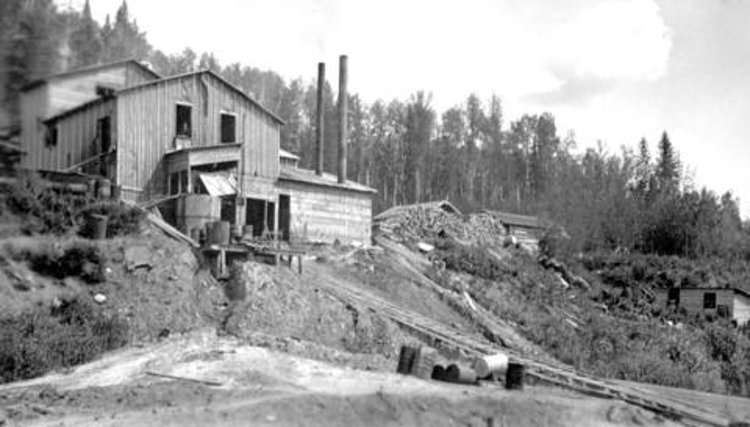
Clearwater River separation plant, Provincial Archives of Alberta, A3536.
When the Clearwater plant began operating again in spring, there was no ignoring the economic conditions. Banks were failing and jobs were disappearing. The price of oil plunged, and governments and companies slashed budgets. The joint venture on the Clearwater River was shuttered after just one year of operation, at the end of 1930.
However, despite the economic crash and against prohibitive odds, two entrepreneurs soon emerged who would change oil sands history, rising from the ashes of the Clearwater plant, but not without detours through scandal, incompetence, and government mismanagement. The first was Robert Fitzsimmons, a businessman from Prince Edward Island who had moved to the United States and had commercial real estate dealings as far away as Spokane, Washington. With no background in the oil industry, Fitzsimmons purchased the Alcan Oil Company in 1925, rechristened it International Bitumen Co. (IBC) in 1927, and moved to northern Alberta.
Fitzsimmons followed a hunch that the oil in the oil sands bubbled up from below and started drilling beneath the oil sands as one would for conventional oil. He eventually abandoned that approach, and after carefully observing the work of Clark and Ells, built a crude replica of their Clearwater separation plant on an industrial site he named Bitumount, on the east shore of the Athabasca River, ninety kilometres north of Fort McMurray. Construction began in 1930, and by 1932, Bitumount was operating with moderate success. Fitzsimmons became the first entrepreneur to produce bitumen and even built a small refinery to make various fuels.
But it was not enough to recoup his $200,000 investment. In need of funds, the plant closed from 1932 to 1936 while Fitzsimmons toured the United States and Great Britain to attract capital, selling stock in the venture. He returned and got the plant running again in 1936, but the equipment hadn’t aged well, and poor separation resulted. Fitzsimmons tried to rebuild the plant in 1937. Meanwhile, pay cheques to many staff members were missed.
Clark wasn't impressed with Fitzsimmons’s technical or business acumen. Financial problems saw employees go unpaid, workers and management alike quit, and at least one person sued Fitzsimmons for lost wages. When his company was declared insolvent in 1938, Fitzsimmons blamed his employees. To people on the outside, the problem was evidently gross mismanagement by Fitzsimmons and poor equipment. Yet, as the first semi-commercial oil sands separation plant, Bitumount blazed a path for others to follow.
The second notable entrepreneur in the northern Albertan oil sands was Denver oil man Maxwell Ball and his assistant, petroleum engineer J.M. McClave, who had previous dealings with Ells. They didn’t venture in blind as Fitzsimmons did. Ball, a mining engineer himself, had studied the plant at Clearwater and initially proposed buying the plant, but chose to build his own instead. Ball named the new company Abasand Oils Ltd. Abasand proved much more consequential than Fitzsimmons’s IBC. Both Clark and Ells were impressed by Ball’s technical knowledge and business prowess.
Ball built his separation plant, plus a refinery, on leased land, the Horse River Reserve, which was still owned by the federal government under a clause in the Natural Resources Transfer Act of 1930, much to the dismay of Albertans. Ball and McClave completed construction on their separation plant at the end of 1936.
1937 proved to be a setback, however. The sand from the quarry was incredibly abrasive and continually clogged and broke machinery. A new method was required that involved blasting the sand with explosives, and an overhaul of the plant was undertaken to accommodate the rough and coarse sand of the Horse River Reserve.
By 1940, Abasand was finally separating bitumen and refining it into useful fuels. Ball found a market for the gasoline with mining companies on the north shore of Lake Athabasca. In 1941, two hundred barrels of gasoline per day were floated by barge down the Athabasca River to mines in northern Saskatchewan. Abasand produced 41,265 gallons of gasoline, 70,700 gallons of diesel oil, and 137,550 gallons of fuel oil that year. Yet it was still regarded as poor quality gasoline. It was putrid as well, leading to the product from the plant being nicknamed “abascent” by nonplussed locals.
IV. The Shadow of Abasand
With oil prices soaring due to the start of the Second World War in September 1939, and with Canada desperately needing domestic oil reserves to fuel its war effort, Abasand was finally making a return. More eyes turned to the potential of the oil sands. “Those tar sands contain enough oil to lick Hitler, Japan, and Italy,” noted one magazine.
Then, at the end of 1941, just as the future of Abasand seemed hopeful, a fire destroyed much of the plant. With the Horse River Reserve still being federal jurisdiction, the political football of oil sands development was tossed Ottawa’s way. Receiving it was none other than Clarence Decatur Howe, Ottawa’s Minister of Munitions, nicknamed the “Minister of Everything.” C.D. Howe was the most important man in government, second only to Prime Minister William Lyon Mackenzie King. His role was overseeing the procurement of critical resources, from oil to bombs, for Canada's war effort—in effect, creating a wartime economy from scratch.
Ball had first discussed nationalizing the Abasand plant with Ottawa in 1940. Howe voiced his confidence in Abasand’s viability and announced the federal government was taking control. Howe’s ruthless competence and sound judgement can hardly be overstated. Indeed, few politicians deserve more credit for Canada’s successful war effort. But even a man like Howe, with a reputation for getting things done in Ottawa, wasn’t immune to scandal and mishap.
The federal government took title to the plant on February 18, 1942. It appropriated $500,000 to rebuild the plant but paid no compensation to Ball. Howe hired Consolidated Mining and Smelting (CM&S) and appointed an Eastern oil man, Earl Smith from Petrolia, Ontario, to oversee operations. Ells, Clark, and Ball were all left out.
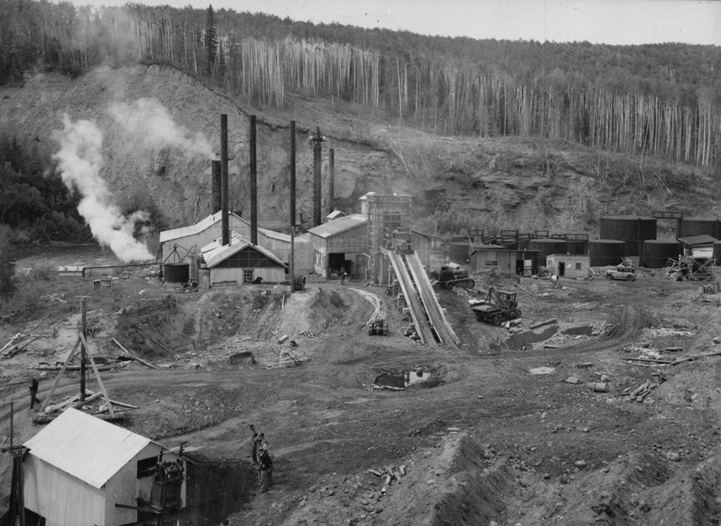
Abasand, Library and Archives Canada, PA-017285.
Sourcing talent from outside, rather than utilizing the expertise of those familiar with the oil sands, would become a pattern and a mistake by Howe. Smith’s background was in the conventional oil fields of southern Ontario. He was completely ignorant about the oil sands. “We all know how much oil sands there are around Petrolia,” a sarcastic John MacNicol, Conservative MP for Toronto-Davenport, quipped in the House of Commons. The results were predictable. While Howe had great aspirations for the plant, anticipating that Abasand could also produce asphalt for the Alaska Highway, then under construction by the United States, such hopes proved overly sanguine.
What followed was gross mismanagement and incompetence, observed by all who were involved with the misbegotten operation. Earl Smith got the old plant working again intermittently, producing eleven thousand barrels of oil after the plant was acquired in 1942, according to Howe. CM&S then recommended it be enlarged. Instead, for reasons not clear, Ottawa ordered it demolished and a new plant built. Again, Howe ignored experts like Ells and Clark who had spent their careers developing the oil sands and the bitumen separation process.
Instead, he hired a firm out of Toronto called General Engineering. Disorganization plagued its operations. Its biggest mistake was a decision to use cold water separation instead of hot water to save energy, which proved vastly inferior. There is a lack of documentation during General Engineering’s time at Abasand, and the secrecy doubtless owes to poor results. Workers on site served up lurid tales of mismanagement and incompetence. The stories reached William Fallow, Alberta’s Minister of Public Works, who relayed the stories of construction follies to the Alberta legislature. He declaimed, “Buildings were started and then torn down or moved to temporary foundations, and finally they started putting the buildings on skids instead of foundations so that they could move them around with tractors to suit everybody's convenience.” That was only the beginning. “Trenches were dug for sewer and waterlines and the waterlines (were) laid and backfilled without testing pipes for leaks. Later, when the water was turned on, the lines leaked so badly that the trenches had to be reopened and the lines taken up,” Fallow continued.
Howe was facing immense scrutiny from the Opposition in the House of Commons over his handling of Abasand and Ottawa’s ballooning investment. Ball and Fitzsimmons managed to operate separation plants on shoestring budgets and even turned a small profit, while Howe’s plant, after spending nearly $2 million, struggled to produce any oil at all. By 1944, Howe was backtracking, saying the plant was purely an experimental effort and that profit was not an indicator of its success. In fairness, Abasand did demonstrate bitumen could be produced for $2.64 a barrel, a profitable figure except for prohibitive transportation costs.
Even so, it might be seen as an act of cosmic mercy that on June 16, 1945, a spark from a welding operation ignited an oil-soaked wall and touched off a billowing blaze. The waterline connecting the river to a fire hose at the plant didn’t work that day, and Abasand was razed to the ground once more.
Abasand was dead. Shortly after, Ells, having reached age sixty-five, announced his retirement. With him went the role of the federal government in oil sands development, while the Alberta government quickly assumed the sole mantle. The Abasand experience was a valuable lesson in the role of government in industry. Government could forge ahead where private enterprise feared to tread, given that it was not beholden to profit incentives. But for that same reason, government pet projects can reach extraordinary heights of profligacy, as Howe’s actions in the oil sands attest. While Ottawa’s efforts came at great expense, they did move oil sands development closer to the goal line by demonstrating that profit was more tangible than ever.
Not long after the fall of Abasand, the Alberta government poured its efforts into Bitumount, long dormant, where Fitzsimmons had last produced oil a decade earlier. The province wanted to prove it could do better than the feds, while at the same time demonstrating its authority over natural resources. It didn’t have to go far to find its champion—indeed, Champion was his very name. Lloyd Champion, a Montreal financier, had bought what remained of Fitzsimmons’s insolvent IBC, which still held the lease to the Bitumount site. Champion renamed the company Oil Sands Ltd. With a provincial cheque for $250,000, Champion began a joint private-public enterprise. The plant wasn't completed until 1947 and operated intermittently until 1949. There were many technical issues still to be worked out along the way, but the separation method perfected by Karl Clark proved a resounding success.
Yet, it still wasn't smooth sailing. In early 1947, a gusher of oil was struck at Leduc, Alberta, the largest conventional oil reserve discovered in Canada up to then. Other oil fields were discovered nearby, and Canada’s oil supply was no longer so precarious. Leduc set development of the oil sands back by fifteen years in terms of the urgency, market signals, and funding. Oil prices predictably fell, and so did returns, ultimately leading to the demise of oil extraction at Bitumount.
Bitumount, however, demonstrated more concretely that the oil sands could be commercially viable. Based upon data from the second iteration of Bitumount, Sidney Blair (Clark’s onetime research assistant and longtime friend) declared in his landmark oil sands report of 1950 that the mining, separation, refinement and transportation of crude oil from the Athabasca oil sands could be undertaken for $3.10 per barrel and earn a profit in the right market.
The work of public institutions was now finished. With Ells having retired in 1945, Clark followed, also at age sixty-five, in 1954. The time had come to pass the torch to private enterprise.
Great Canadian Oil Sands Ltd. (GCOS), a company backed by Texas-based Sun Oil, entered discussions with the province of Alberta in 1954, but it took another decade for plant construction to begin. A lease was secured beside Ruth Lake, north of Fort McMurray, on a parcel of land advocated many years earlier by Ells. Prolonged negotiations ensued. Plant construction began in 1964. Clark and Ells were both brought on in advisory roles. In 1967, GCOS became the first company to produce crude oil commercially from the oil sands. In 1979, Sun Oil became Suncor.
Despite ultimately achieving their goals, Ells and Clark never reconciled. Ernest Dobson, a Sun Oil executive, said the company quickly realized that it was best not to have Ells and Clark on site as consultants at the same time. “Ells, a geologist, would have ideas on processing the sand; Clark, an expert on process, had his own concepts of the geology, and the two fought bitterly,” he was quoted as saying in The Abasand Fiasco: The Rise and Fall of a Brave Pioneer Oil Sands Extraction Plant (1980) by Darlene Comfort.
V. Two Legends and Their Legacies
Sidney Ells was in the audience listening to speeches at the grand opening of GCOS’s production plant in 1967, but Karl Clark was not, having succumbed to cancer a year earlier. Ells died in 1971 but not before writing a memoir of his exploits, Recollections of the Development of the Athabasca Oil Sands (1962), and compiling a collection of memoranda and photographs. He even published a collection of Robert Service-esque poems and stories in the style of Jack London that take place on the Canadian frontier. One can tell from Ells’s lurid yet clunky prose and poetry that he had lived every word he wrote.
Neither Ells nor Clark ever acknolwedged the merits or contribution of the other. In his memoir, Ells credits a host of individuals for developing the oil sands, but Clark is absent from the list. Similarly, Clark never admitted Ells was the first to separate oil sand using flotation cells. Today, Clark’s papers are at the Provincial Archives of Alberta in Edmonton. Ells’ papers are in Library and Archives Canada in Ottawa.
Who, then, is the “father of the oil sands”? Is it Ells, the irascible surveyor? Or Clark, the “quiet and self-effacing intellectual”? Max Ball was the first to give Ells that title. But today, museums and government promote Clark more prominently and downplay Ells’s achievements. Perhaps it is easier for Alberta to credit Clark, an adopted Albertan, than to admit that Ells, a federal civil servant, made the greater contribution.
But Ells was the first to scope out the region’s resources methodically and the first to separate bitumen from sand using hot water. If “father” is considered as a progenitor, then the case for Ells becomes clear. One may wonder how much more Ells might have contributed. Clark made no less a contribution, but he borrowed and perfected the techniques used by others, including Ells.
Commemorations of the legacies of Karl Clark and Sidney Ells are scant in Alberta. But today, the success and prominence of commercial oil sands operations stand as a testament to their achievements. Canada is the fourth-largest oil-producing nation on earth. In 2025, the oil sands produced about 3.5 million barrels per day, accounting for roughly 57 per cent of Canada’s total oil production when natural-gas liquids and condensates are included. With the overwhelming majority of Canada’s proven oil reserves now concentrated in the oil sands, extraction continues to expand.
But this inspiring story is not without a touch of melancholy. Clark, who once adored the pristine wilderness of the Athabasca region while canoeing the region’s many tributaries, confessed late in life that he couldn’t bear the sight of the ravaged industrial landscape. Indeed, as the industry expanded, Indigenous peoples were increasingly displaced from ancestral lands, while many communities came under mounting pressure to relocate in the face of successive waves of oil workers. The Indigenous community of Fort McKay, near the epicentre of extraction, has had chronic concerns over drinking water quality and environmental contamination since the beginning of commercial oil production. The story of the oil sands is thus also a reminder that progress is rarely costless: the same transformation that unlocked extraordinary wealth and possibility imposed burdens on landscapes and communities that did not share equally in its rewards.
Still, the achievements of Clark and Ells deserve a place in the annals of Canadian history, for, through intellect and sheer force of will, these men contributed to the creation of the largest industrial project on earth in the inhospitable and remote boreal forest. For those who care to look, a few landmarks honour Ells and Clark. There is the Ells River, north of Fort McMurray, named for the obstreperous explorer, while Dr. K.A. Clark Elementary School sits on the town’s main drag, named after the assiduous scientist. Indeed, Ells Crescent and Clark Crescent, in a residential neighbourhood of Fort McMurray, sit side by side—the two men inextricably intertwined in legacy, as in life.
Ethan Isaac Redekop is a writer, oil sands worker, and candidate of the Master's of Public Policy program at the University of Toronto's Munk School of Global Affairs and Public Policy.