Thirty years ago, Silicon Valley invoked McLuhan while ignoring everything he actually argued. Michael Cuenco on how the "Californian Ideology" buried the one Canadian thinker who predicted our current wreckage, and why Canada may be positioned to revive his method for the AI age.
Marshall McLuhan spent his career arguing against one of the most durable assumptions of the modern Western mind: that the expansion of communication technology and the expansion of human understanding are the same process. He was no Luddite who wished to stand athwart technological progress; rather, he stood against the refusal to think seriously about what technology does to the people who use it, about what it extends in human capacity and what it amputates. By the time of his death in 1980, that refusal, even among those who claimed to be guided by his ideas, had already begun to win, establishing the very terms for public discourse in the digital age.
Indeed, what emerged in the wake of McLuhan’s intellectual stardom in the late twentieth century was nothing less than an inversion of his insights, fostering a narrative of Whiggish faith in the inviolability of technology and of the individuals who made it; their values became society’s values, our new common sense, and even now, when a reaction has set in against their hegemony, their influence over our lives has, despite so many twisted revelations and controversies, seemed immovable.
It would be too easy to say something like “If only we had listened,” or “If only McLuhan had lived a bit longer. . . .” But even if McLuhan had lived to be a hundred and witnessed the wonders of Facebook, YouTube, and Twitter as they existed in the middle of 2011 (though the centenarian, mercifully, would not have seen TikTok or AI chatbot girlfriends), we likely wouldn’t have listened, or we might have listened, even reverently, but without taking anything seriously enough to change our conduct (this is, in fact, what happened when McLuhan was alive and famous through the 1960s and ‘70s); this is because the forces fuelling technological saturation were never limited to mere ignorance or indifference on the part of consumers and policymakers; every interlocking facet of our institutional culture—economic, political, ideological, psychological—would have come together to push us in the same direction anyway.
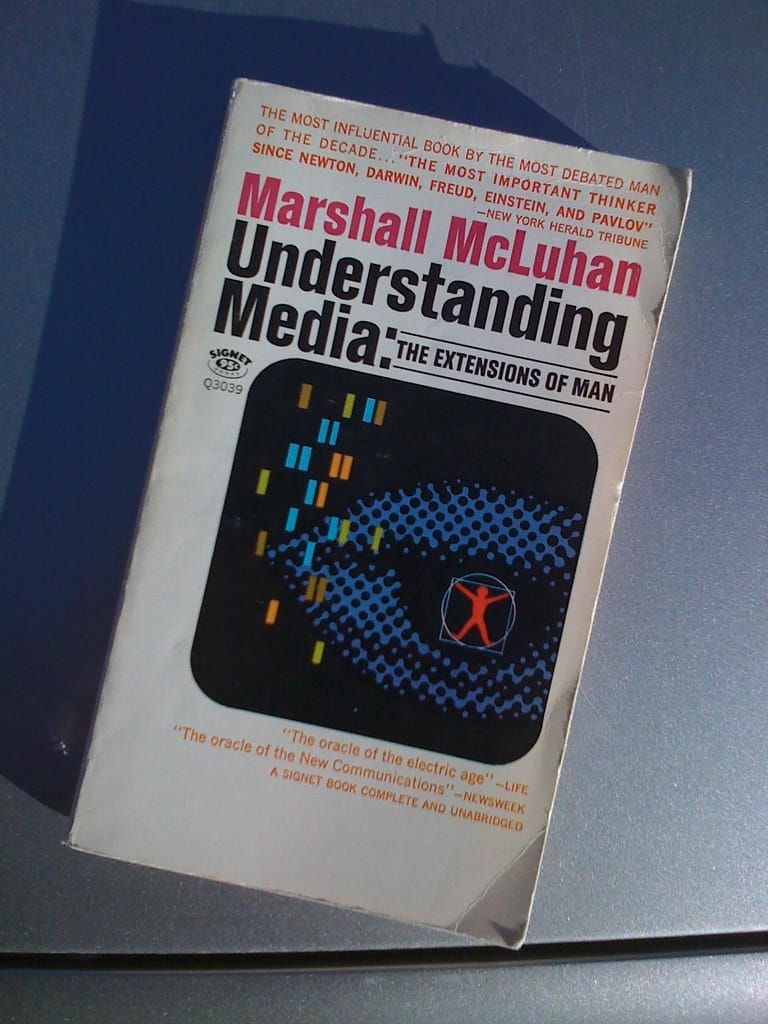
As McLuhan put it, somewhat harshly in Understanding Media (1964):
The effects of technology do not occur at the level of opinions or concepts, but alter sense ratios or patterns of perception steadily and without any resistance. . . .
Once a new technology comes into a social milieu it cannot cease to permeate that milieu until every institution is saturated. . . .
[T]he technological extension of our central nervous system that we call the electric media began more than a century ago, subliminally. Subliminal have been the effects. Subliminal they remain. . . . At no period in human culture have men understood the psychic mechanisms involved in [that era’s] invention and technology.[1]
On a different occasion, he observed that “We look at the present through a rearview mirror.” In other words, we now understand the excesses of the last three decades, encompassing the rise of the internet and social media, only because the immersive period of consciousness-expansion they represented has itself passed into the rearview mirror. And a new period with a new central technological fact is dawning, one whose effects are already inundating us but whose contours we cannot yet grasp. So, are we doomed to make the same (or perhaps different) mistakes with artificial intelligence?
McLuhan, of course, prescribes no set of regulations or prohibitions; instead, what he can give us is the inspiration for a certain frame of mind and an aptitude for open-ended inquiry (what he called "probing") with respect to media and the mental environments it created, which were often unseen. Thus, what we are looking for is not a policy—that can come later—but a new balance on which to recalibrate our sense ratios as we confront a more potent phase of the same continuous electronic revolution that McLuhan had set himself to diagnosing. But first, we must retrace the steps and missteps our society took at the last great turn.
I. A New Faith
By the 1990s, McLuhan’s ideas were already retreating into the footnotes of media studies curricula while the practical business of building the digital world proceeded at a feverish pace, propelled by what the British social critics Richard Barbrook and Andy Cameron, writing in 1996, diagnosed as "The Californian Ideology": a “new faith” arising from what they described as “a bizarre fusion of the cultural bohemianism of San Francisco with the hi-tech industries of Silicon Valley.” This faith fused the social liberalism of the New Left with the economic individualism of the New Right, producing a creed in which technological progress and human liberation were assumed to be a single force, advancing together on an inevitable arc toward a more open, more connected, and more enlightened world. At its centre, Barbrook and Cameron observed, was a particular misreading of McLuhan: the “restyled McLuhanites” of Silicon Valley “vigorously argue[d] that big government should stay off the backs of resourceful entrepreneurs who are the only people cool and courageous enough to take risks.”
The “electronic agora,” a vision of networked democracy inspired by McLuhan’s thinking and premised on the possibility that new media might create spaces of genuine civic participation, was appropriated and privatized, stripped of its critical dimension and repackaged as a justification for a regime of aggressive deregulation and institutionalized deference to the ascendant tech sector.
The vision spread rapidly beyond the Valley into political culture. Into the new millennium, as the Californian Ideology reached full bloom, Mark Zuckerberg declared that “Facebook was not originally created to be a company. It was built to accomplish a social mission—to make the world more open and connected.” By giving people “the power to share,” Zuckerberg argued, “we're making the world more transparent.” These went way beyond idle marketing slogans; his words were sincere expressions of a worldview in which connectivity was inherently civilizational and messianic, in which the act of linking people together was self-evidently good because understanding and concord would naturally follow. (Had McLuhan been around, he might have cautioned, as he did in 1977: “The closer you get together, the more you like each other?. . . . There’s no evidence of that in any situation we’ve ever heard of. When people get closer together, they get more and more savage and impatient with each other.”)
When Facebook hit one billion users in 2012, Zuckerberg described it as “amazing, humbling, and by far the thing I am most proud of in my life.” The scale was the achievement. What the scale was doing to the quality of human attention, relationship, and political life, the instincts it was magnifying and the ones it was making obsolete, was not, at this stage, a question the ideology’s advocates had any way to ask.
Governments absorbed the same faith with equal enthusiasm and effectively rolled over to ensure that no great regulatory hurdles would hinder Silicon Valley’s crusade to remake global society in its image. In her landmark 2010 speech on internet freedom, U.S. Secretary of State Hillary Clinton pledged American support for a world with “one internet, one global community, and a common body of knowledge that benefits and unites us all.” Internet freedom, she argued, was as fundamental as free speech itself: the “freedom to connect” was the new frontier of universal human rights, and the open web was its guarantor. When the Arab Spring erupted across the Middle East in 2010 and 2011, the Obama administration and its allies greeted it with barely contained exhilaration. The digital tools that activists were using to organize, the social media giants, Twitter and Facebook most of all (whose founders were feted at the White House), and the nascent smartphone that made those platforms so portable and ever-present, seemed to be vindicating everything the Californian Ideology had promised. On our television and cellphone screens, we could see that these technologies were emancipating people from despotism. The medium and the message were, at last, one and the same.
This was the environment in which McLuhan's ideas could find no purchase. A sustained McLuhanite sensibility, one that persistently probed new media environments and asked what effects they were producing on the people who inhabited them, would have been, in the intellectual climate of the 1990s and 2000s, a form of heresy. The question “what is this doing to us?” was antithetical to an ideology whose foundational premise was that the appropriate human response to new technology was gratitude and adoption. Even the idea of regulation was treated as a harbinger of censorship and tyranny; skepticism was treated as quaint, if not ignorant, nostalgia. The laissez-faire approach gave every new platform, device, and app the benefit of the doubt every single time, and in doing so foreclosed the kind of environmental analysis, the “civil defense,” in McLuhan's own phrase, that might have produced a more careful, considered, and humanly scaled relationship between society and the systems it was building.
II. Californian Spring
The reckoning arrived in the latter half of the 2010s, with a suddenness that itself testified to how completely the ideology had neutralized dissent. We began to notice things we hadn't had before: polarization as a matter of course; radicalization as the rule rather than the exception, the systematic warping of democratic and deliberative processes; the industrial production not just of disinformation, which has always existed, but of the epistemic numbness that makes even transparent and uncontroversial information practically illegible to large swathes of the population. These were not the accidents or unforeseen externalities of a few bad actors but the predictable, and in many cases intentional, outputs of technological environments optimized for endless engagement rather than understanding, for emotional activation rather than considered response.
Even Zuckerberg eventually acknowledged it, though only under pressure, conceding in 2018 that his company had been “overly idealistic and focused on more of the good parts of what connecting people and giving people a voice can bring.” Clinton herself lost her chance at becoming the first female U.S. president, in a razor-thin election outcome, due in part to forces unleashed by the very same technologies she had praised so uncritically only a few years before, their disruptive power turned in that instance not against Middle Eastern peripheries but against the American metropole itself. The admission was honest as far as it went. Yet what it could not quite say was that the idealism had not been a regrettable excess but a structural feature, that the ideology had been designed, as Barbrook and Cameron argued, to prevent precisely this kind of reckoning and introspection from arriving at all.
We remain inside that reckoning, without resolution. And the evidence illustrating the costs of our collective inaction accumulates steadily: the well-documented decline in the capacity for sustained conversation, particularly among those who grew up on apps rather than arriving at them as adults; the cognitive and social consequences that researchers are only beginning to fully measure. The in-person analogue venues where socialization and community-building used to happen on a daily basis, where young people spent time, formed friendships and romantic relationships, have been especially hard hit by technology's tendency to make us all homebodies. And while it is easy to place all the blame on exogenous economic factors (i.e., spikes in the price of food), the fact is that this decline has been a long time coming; it predated the pandemic and even the rise of delivery apps (which merely solidified the trend) and can be just as easily traced to causes that are endogenous to our own late suburban, tech-defined culture and sensibility, which consistently privileges the centrality and convenience of the individual over and above the messier, rougher, but more vital communal rhythms of life that defined pre-digital society.
Now, a counterfactual thought experiment: if the policymakers and thought leaders of the 1990s had been shown this destination and were able to see in advance the massive waves of social and psychological displacement we are now dealing with, would they have chosen differently? The honest answer is probably not, or not quickly enough to matter. The Californian Ideology was never just a set of intellectual errors to be corrected by exposure to more reasonable arguments—but the perfect expression of a particular set of economic interests and political alliances as they existed in a particular juncture of history, as Barbrook and Cameron’s analysis makes clear.
That the critical thrust of McLuhan’s ideas had been forgotten was by design as much as by accident. The tech interests of Silicon Valley required his eclipse in order to proceed, because a serious engagement with his actual arguments—about what media environments do to perception, about what the global village produces in addition to intimacy, about the violence of the extension and the amputation that follows—would have raised doubts that neither the ideology nor the industry could have countenanced. The irony that the modern tech sector’s intellectual pioneers routinely invoked his name while systematically ignoring his method is far from incidental; it is actually the key to understanding how a thinker who predicted the essential features of our current crisis came to be regarded, in the decades when his predictions were being proved correct, as a relic of a more naïve time. The social media-market-state complex that coalesced around the Clinton and Obama administrations and their echoes in Canada, the enormous wealth generated by the attention economy, and the near limitless political influence that wealth purchased: these interests would not have tolerated a McLuhanite critique of their policy decisions, however elegant or intellectually well-grounded.
What would have been required was not a better theory but a counterorganization with sufficient power and coherence to impose the civil defense McLuhan prescribed on a digital environment that its owners had every incentive to resist. Such a force did not exist then. Whether it can be assembled now, from the wreckage of our abandoned third places and weakened associative life, is the question that presses on any serious effort at civic or political renewal.
Recovering McLuhan alone will not do it, but the problem cannot be addressed at all without the habit of mind he exemplified: the willingness, in every era and at every stage of technological development, to step back from the environment that is being built around us and ask, with genuine seriousness and without ideological prejudice, what it is doing to the people who live inside it—to the mind, the senses, and the subjectivities that constitute our perception of reality itself. That is the question the Californian Ideology suppressed and continues to suppress. The sheer difficulty involved in reconstituting the lines of inquiry established by McLuhan is why we are where we are, and its rediscovery is where any serious reckoning with our current condition must begin.
III. The New DEW Line
Of course, much has changed since the zenith of unchallenged cultural power that Silicon Valley enjoyed when Barbrook and Cameron wrote: the latest incarnation of the Californian Ideology, in some ways the most honest of all, has all but shed its earlier liberatory pretensions, and its high priests now preach some version of openly anti-democratic, absolutist government or post-human dissolutionism, or both (or in Zuckerberg's case, the eventual supplanting of human companionship with AI surrogates); this unveiling of the ideology’s truest face has, naturally, galvanized new forms of resistance within the United States and across the world.[2] But nowhere is that drive to resist more deeply felt than in Canada, whose present position is diametrically different from that which it occupied thirty years prior.
Canada in the 1990s was an overexposed auxiliary to Silicon Valley’s emerging empire, absorbing its platforms, its norms, and its unexamined faith in tech-driven progress with barely a native critical apparatus to filter any of it, and with no independent posture of its own to speak of. Canada in the 2020s, for reasons that should be clear to anyone reading the news, has been forced into a hyper-consciousness of its own sovereignty that the earlier Canada never had reason to develop. That consciousness, born of delayed reaction and after-the-fact corrections to the decades of dependency, is nonetheless exactly the raw material a genuine response to the next wave of technological homogenization would require: the country has, without quite intending to, rebuilt the disposition it will need.
And from that disposition can emerge something novel in our lifetimes: a coalition that can not only plausibly withstand the pull of technological power emanating from the present-day heirs of the Californian Ideology but can also assert its own positive alternative: the nascent digital sovereignty movement, the rising strategic and defense tech sectors who are working to transcend Canada’s technological subservience, the growing chorus of concerned scholars and social critics who can no longer abide continued disintegration of human community at the hands of the algorithms. Together, these parties may embody the (still embryonic) core of a revived consciousness of Canada as a place apart from the borderless digital superstructure that effectively governs our social reality; to draw a line between ourselves and this nexus of technological and cultural power is the first step to entrenching that consciousness, and with it the ability to define our own interests and imperatives with respect to the development of technology throughout the rest of the twenty-first century.
McLuhan himself supplied the name for it. Between 1968 and 1970 he published a newsletter he called, without irony, the DEW Line, an acronym borrowed directly from the Distant Early Warning Line, the chain of sixty-three radar and communication stations strung three thousand miles across the Canadian Arctic at the height of the Cold War, built to give a continent that could not repel a direct Soviet attack the next best thing: advance notice of one. McLuhan's own gloss on the borrowing could not be more directly on point: “I think of art, at its most significant, as a DEW line, a Distant Early Warning system that can always be relied on to tell the old culture what is beginning to happen to it.” The metaphor was drawn from the one piece of hard continental infrastructure Canada had ever built specifically because it sat, geographically and politically, exactly where the first signs of apocalypse could be spotted, where civilization would confront the specter of its own annihilation. This is precisely where Canada sits again, although the present range of threats is, of course, insidious in a different way than the missiles of our Cold War enemies: it does not herald our immediate destruction, being invisible and bound up with our everyday devices and thought patterns. The new DEW Line, conceived as a field of awareness focused on media and its effects, should be the starting point for any conversation about what program—the rules, regulations, modifications, myriad policy and political economy arrangements—we might employ to achieve the balanced technological environments and sense ratios needed to rescue ourselves from perdition.
Now, the institutional coalition described above supplies one axis of resistance and the reestablishment of the DEW Line gives it a strategic orientation. But arguably more consequential, because more durable, is something less organized and more instinctive, a wariness toward our own tools now shared, unevenly but genuinely, by regulators and parents, engineers and teenagers, policy elites and working-class people alike, in other words, ordinary citizens across many walks of life for whom the exhaustion of thirty years’ worth of untrammelled tech saturation is dawning as an undeniable realization. This is not the fruit of academic theory or political discourse, far from it. It is closer to scar tissue: at least two generations (Millennial and Gen Z) have now spent most of their lives living inside the vortex, and this experience has taught otherwise unrelated classes and constituencies to flinch at the same stimuli and recognize the same patterns of harm, without needing a shared doctrine to explain why. Such organically generated wariness is, in fact, the very counterreaction McLuhan gestures toward in the image he borrows from Poe, and it is perhaps the key variable that makes this moment recognizably different from the era of boundless optimism that reigned in the 1990s; it features a new awareness and detachment, only now practiced collectively rather than by the mind of a single genius or a small band of avant-garde critics.
Andrey Mir, writing in these pages, has drawn out the distinction this moment calls for, between an instrumental media literacy, which asks only how to use a given tool more safely, and an environmental one, which asks what kind of world the tool has already made—and how that world might be mapped:
McLuhan gave us a clue to what we can call environmental media literacy, as opposed to instrumental media literacy. In The Mechanical Bride (1951), he offered a metaphor for escape from a deadly environment, borrowed from Edgar Allan Poe's short story “A Descent into the Maelstrom” (1841). In Poe's tale, a fishing boat carrying three brothers was drawn into a mile-wide maelstrom. One brother was swept away by the waves; another was paralyzed by horror. But the third watched the terrifying spectacle as a manifestation of God's might and became fascinated by its structure. With awe and reverent curiosity, he watched the whirling walls and noticed that certain floating objects remained on the surface longer than others. He abandoned the boat and clung to a barrel. Eventually, the whirlpool subsided, and the sailor was rescued by another boat. As McLuhan explained,
‘Sailor saved himself by studying the action of the whirlpool and by co-operating with it. ... It was this amusement born of his rational detachment as a spectator of his own situation that gave him the thread which led him out of the Labyrinth.’
Note that the sailor did not build a new boat, nor defeat the whirlpool outright; he attended closely enough to its structure to notice which of its own debris stayed longest afloat, and trusted that structure to carry him out. This is about the only resolution an exploration like this one can offer honestly. The builders of whatever synthesis succeeds the Californian Ideology do not need to invent their instruments from nothing, nor wait for a new ideology adequate to the whole crisis before they act. The rhythms of reckoning are already moving through our mainstream culture: we no longer need the mirror to know we are driving backward; increasingly, we can feel the pull of the current itself. What remains is McLuhan's frame of mind: not quite mastery of the vortex, but the patience to study it closely enough to avoid being drowned in it.
IV. Awareness is the First and Last Defence
The project of reclaiming McLuhan's thinking as a national bulwark would extend, properly understood, to other thinkers and ideas beyond McLuhan himself.
There is, first, Harold Innis, whose work directly shaped McLuhan's own thinking and whose Empire and Communications (1950) and The Bias of Communication (1951) offer a complementary lens: less a ratio of senses and more a ratio of time and space, sorting media by whether they favor the durable and centralized (stone, cuneiform) or the portable and expansive (papyrus, print, the telegraph) and reading the rise and fall of empires as a function of which bias prevailed. There are adjacent figures such as Eric Havelock, the English expatriate who, working out of the same University of Toronto milieu that produced McLuhan, traced the same drama back a further two and a half thousand years: in Preface to Plato (1963), he showed how Plato’s famous antipathy for the poets was, in fact, the first recorded casualty of a sense ratio revolution, the growing pains of a civilization learning to think abstractly because it could, for the first time, write its thoughts down and return to them. And the American Jesuit Walter Ong, who began as McLuhan's own student before extending the inquiry in Orality and Literacy (1982), giving the “psychodynamics” of oral cultures—additive, redundant, agonistic, bound to the concrete and the situational—a rigor that let scholars diagnose, rather than merely intuit, what a given medium does to the mind that inhabits it.
But the point of putting together these diagnostic frameworks is not to assemble a canon for its own sake, or to trade one set of totems for another. McLuhan, Innis, Havelock, Ong, and the circles around them did not—and could not—hand us a finished system; they handed us a method, along with a standing warning against mistaking the method for its conclusions. To treat their books as divine revelation would be to commit precisely the error that leads to Californian Ideologies, to receive an insight about media passively, as content, rather than let it restructure how one sees. The proper reverence is a restless and disobedient one: to take their work as foundation stones rather than a roof, and to feel obligated, as they did, to extend the probe and the early warning system into the environment we actually inhabit now, one of large language models, algorithmic engines, and lifelike AI companions, for which no Preface to Plato yet exists. That book remains to be written. Most of all, then, we must restart the thread of inquiry ourselves, building upward from these foundations rather than merely circling back to admire them.
The task is not to romanticize McLuhan and his generational peers who so brilliantly inaugurated this field of inquiry in the adolescent decades of electronic media upheaval, or to pretend that their framework answers every question raised by our more advanced digital environments. We must instead try in earnest to recover the habit of mind they exemplified—and to embed it in our practices and approaches to the ever-widening horizons of technological possibility in the age of AI: we must not be afraid to step back from the apparatus of our historical moment and ask, with genuine seriousness and humility, what it is doing to us. That habit was among the first casualties of the Californian Ideology, and its recovery ought not to be treated as a species of cultural luxury or intellectual miscellany. For it is, as McLuhan himself said of civil defense against media, a matter of survival.
Notes
[1] Marshall McLuhan, Understanding Media: The Extensions of Man, introduction by Lewis H. Lapham (Cambridge, MA: MIT Press, 1994), the quotes are from pages 18, 177, and 352 (respectively).
[2] The argument advanced throughout this essay may rightly be described as Canadian nationalist, but it is not anti-American. For just as the homogenizing force of American social media and AI giants has flattened the cultural identities and peculiarities of countless societies across the wider world, it has done the same to the diversity of local outlooks and vernaculars within the United States itself. This trend has led to the levelling the communities, regions, and subcultures of what should be a vast and variegated country into a condition of uniformity more rigid than at any past era; it has universalized the myriad dysfunctions of Silicon Valley's Leitkultur and made America the epicentre of the global crises of social atomization, civic breakdown, and mental health collapse engendered by its own tech sector. Thus, the American people are just as primed to benefit from the prospect of civil defense raised by McLuhan as any Canadian or European.
Michael Cuenco is co-founding editor of the 2067 Journal.
Photo by Alan Levine, dedicated to the public domain under CC0.