Ambition is often treated as a virtue, yet the boldest plans are not always the wisest, and a grand vision pursued without judgment can do more harm than a modest one carried through. Miguel de Cervantes’s Don Quixote captures this folly perfectly. Its hero, a minor nobleman so absorbed in tales of chivalry that he loses touch with reality, mistakes a row of windmills for giants and charges at them, only to be thrown from his horse when his lance catches in a turning sail. His squire, Sancho Panza, had warned him plainly that they were only windmills. “Tilting at windmills” has since come to describe a dramatic, sincere, and futile struggle, a battle in which the courage is real, but the target is misjudged.
Yet Quixote’s story ends where the damage begins, and it says little about the wreckage such charges leave in their wake or about those left to live among it. For this, Walter Benjamin provides an unexpected but apt companion. In his 1940 essay “Theses on the Philosophy of History,” he recasts Paul Klee’s Angelus Novus as the angel of history, gazing at the past it sees as one great catastrophe, with wreckage piling at its feet. The angel longs to pause and repair what has been broken, but a storm propels it helplessly into the future. “This storm,” Benjamin wrote, “is what we call progress,” a force that sweeps us onward too quickly to reckon with its costs. Together, Cervantes and Benjamin reveal two sides of the same failure. Don Quixote misjudges what is before him and pours his energy into a grand gesture aimed at the wrong target, while Benjamin’s angel sees the damage clearly but cannot stop to repair it. One image cautions against ambition that misreads the present, and the other against progress that fails to learn from the past.
Few places reveal both failings as clearly as the Canadian Arctic. For more than eighty years, Canada has answered outside pressures, from wartime invasion fears and Cold War bombers to today’s trade war and great power rivalry, with grand infrastructure projects meant to secure the region in a single stroke. The threats were rarely imaginary. Japanese forces did occupy the Aleutian Islands, Soviet bombers could reach North America over the Pole, and Russian and Chinese activities in the Arctic, as well as U.S. strategic and economic designs, are all growing today. But the difficulty lies not in the threats themselves, but in how Canada has responded historically and today.
Like Quixote, Ottawa has repeatedly directed much of its energy at the prospective threat rather than the North itself, too often treating the region as a distant frontier to guard and consolidate rather than as actual national territory to inhabit and sustain. Like Benjamin’s angel, it has then been swept on to the next crisis before reckoning with what it left behind and the mantra that created the response in the first place. From abandoned radar stations and contaminated sites to unfinished infrastructure, these projects have rarely improved the lives of the northern and Indigenous communities left to live alongside them. Historian P. Whitney Lackenbauer calls this a recurring “crisis mentality,” in which alarmist warnings of imminent sovereignty loss push Ottawa toward hasty, reactive responses rather than sustained investment.
Historian Kenneth Coates offers a useful way to understand why these responses so often fail. He distinguishes “symbolic” sovereignty, the public assertion of a claim through flags, declarations, and visible gestures, from “developmental” sovereignty, the slower work of building settlements, infrastructure, and government services that sustain a real presence. Concepts such as “effective occupation,” “sovereignty through presence,” and the Harper government’s “use it or lose it” all rest on the second idea, that a state’s claim to the Arctic depends on its ability to occupy and sustain a lasting presence there. Canada has understood this principle, and northern infrastructure has become its main tool for turning legal claims into practical control.
The irony of Canada’s Arctic sovereignty is that its strongest claim under international law rests not on the bases and megaprojects Ottawa has built in moments of crisis, but on the centuries-long use and occupancy of the land, sea, and ice by the Inuit, the very people those projects have so often overlooked. Yet in moments of crisis, it has too often built infrastructure as symbolic sovereignty, raised quickly to answer an outside threat rather than to serve the North. The result is a recurring cycle. A crisis prompts a bold project, urgency fades before the work is finished or sustained, and communities and their environment are left with abandoned or underused facilities until the next crisis restarts the cycle. Speed itself is not the enemy, since Northerners have waited far too long for roads, ports, and power. What matters is whose needs set the pace, because they decide what gets built and who it is built for. This essay traces that cycle from the Second World War and the Cold War through Diefenbaker’s Northern Vision, the Berger Inquiry, and the Nanisivik Naval Facility, and then turns to the Grays Bay Road and Port and the Port of Churchill today, two projects now advanced in the name of the national interest—to ask whether Canada has learned to build things for the North rather than merely on it.
I. Pressure, Ambition, and Reaction
This cycle is not new. Chronologically, its form took shape during the Second World War and returned, on a far larger scale, with the Cold War. In both cases, an outside threat made the Arctic suddenly vital, the urge to build and defend overrode every other consideration, and once the danger passed, the North was left with the consequences. In both cases, too, Canada’s failure was less one of reckless ambition than of limited choice. Facing a world war and then the threat of nuclear attack, and bound to a far more powerful ally, Ottawa had little room to refuse American demands to build on Canadian soil. It largely consented on Washington’s terms, then spent years reckoning with what it had done. The cycle began with alarm.
After Pearl Harbor and Japan’s 1942 occupation of Attu and Kiska in the Aleutians, fear of an attack on North America’s Pacific flank drove the United States to secure an overland route to Alaska through Canadian territory that Ottawa had never developed. Under arrangements stemming from the 1940 Ogdensburg Agreement, Canada consented in March 1942 to an American-built Alaska Highway, while work on the Canol pipeline from Norman Wells to Whitehorse began before Ottawa had even formally agreed. Speed became the overriding goal.
The highway’s route linked airfields rather than communities, and crews forced some 2,700 kilometres of road through muskeg, permafrost, and the lands of the Kaska, Tlingit, Tagish, Southern Tutchone, and Dene in about eight months, imposing it on peoples who had no say in whether or where it was built. That haste carried a high human cost. Workers brought measles, mumps, dysentery, and whooping cough, overhunting depleted game, and many families left the land for settlements along the road. Then the urgency evaporated. The Aleutians were retaken in 1943, and Canol, derided in Washington as wasteful, ran for barely a year before being abandoned in 1945, leaving contaminated sites across Sahtu Dene lands. Ottawa moved only when a new alarm sounded, after Britain’s High Commissioner, Malcolm MacDonald, warned in 1943 that Americans outnumbered Canadians in the Northwest and that Canada risked losing de facto control of its own territory.
Even then, Canada acted less to build for the North than to reclaim infrastructure another country had built in haste. The highway would eventually give Yukon communities a lasting link to the south, but the people who lived along its route bore the costs of its construction long before they shared in its benefits.
A decade later, the cycle turned again. As Soviet long-range bombers threatened North America over the Pole, the United States, in Adam Lajeunesse’s words, “catapulted the Canadian Arctic from the strategic backwaters to the forefront of Cold War defence,” leaving Ottawa “little diplomatic choice.” Defence Minister Brooke Claxton conceded it would be “very difficult indeed” to reject any American proposal presented as “essential for the security of North America.” Once again, defence trumped deliberation. In 1954, the two countries agreed to build the Distant Early Warning (DEW) Line from Alaska to Baffin Island, placing forty-two of its sixty-three radar sites in Canada and rushing twenty-five thousand workers and 460,000 tons of material north to meet a 1957 deadline. The line was imposed on Inuit homelands with little regard for the people who lived there. Military rather than human geography dictated where stations were placed, and Inuit families were drawn into permanent settlements and a wage economy that was very different from the seasonal patterns that had long sustained them.
The line served its strategic purpose, but that purpose proved short-lived. By 1963, intercontinental ballistic missiles had made half the Canadian sites obsolete, and the rest gave way to the North Warning System in 1993. What remained was the wreckage. The Department of National Defence (DND) spent $575 million cleaning up its twenty-one sites, the largest environmental remediation in federal history, and left 134 landfills under a twenty-five-year monitoring program. Canada, not the United States, was left to pay for what remained. As with the Alaska Highway, an outside crisis had prompted a rush to build on Canadian soil, the urgency faded long before the North saw any lasting benefit, and the people who lived there were left among the ruins. The second turn of the cycle was complete, and it showed that even infrastructure built to defend the continent could leave the North more vulnerable than before.
The cycle did not always turn on military threats. In 1958, John Diefenbaker’s Progressive Conservatives were swept into power with the largest majority in Canadian history; the Tory leader spoke of a “Northern Vision,” a sweeping plan to open the Arctic and secure Canada’s economic independence amid growing anxiety about American ownership of Canadian resources. Launching his campaign in Winnipeg, Diefenbaker promised Canadians “a new vision” of a nation that looked north, casting the Arctic as Canada’s next great frontier just as the railway had once opened the West. Its centrepiece, the “Roads to Resources” program, promised federal funding for highways and railways to carry southern capital north and northern minerals south, largely through cost-sharing agreements with the provinces and territories. The vision captured the national imagination, but critics quickly questioned its practicality, and Liberal leader Lester Pearson famously mocked it as a plan to build roads “from igloo to igloo.”
More fundamentally, Ottawa saw the North as a giant zone of extraction to open rather than a homeland to serve. Planners plotted roads on maps in the south to reach mineral deposits and oil fields, not the communities that already lived on the land. Like earlier projects, the vision faded once the political moment passed. The Dempster Highway, begun in 1959 to reach the Mackenzie Delta’s oil and gas, was halted within a few years as federal enthusiasm cooled. Only when the next crisis arrived, as energy shocks and Arctic oil discoveries in the late 1960s and 1970s renewed southern interest in the North, did construction resume, allowing for the road to finally be finished in 1979, two decades after it was promised. Even the road’s completion, however, owed more to southern urgency than to northern need.
In the 1970s, the cycle began to change yet again. When a consortium proposed a natural gas pipeline through the Mackenzie Valley with Ottawa’s backing, Indigenous peoples were no longer willing to watch another megaproject be imposed on their lands. Justice Thomas Berger’s inquiry travelled to the communities along the proposed route, and his 1977 report, aptly titled Northern Frontier, Northern Homeland, recommended a ten-year moratorium on the pipeline until Indigenous land claims were settled. It established a principle that would reshape northern governance: that development should wait until Northerners had the rights and institutions to shape it. Modern treaties such as the 1984 Inuvialuit Final Agreement and the 1993 Nunavut Land Claims Agreement followed, creating co-management bodies such as the Nunavut Impact Review Board that give Inuit and other Northerners a direct role in reviewing development. Yet later projects would show that these changes altered the cycle without ending it. Indigenous rights came to shape how northern projects were reviewed, but Ottawa’s priorities still determined which projects were pursued and how quickly they were expected to be built.
By 2007, as climate change and renewed great power rivalry again cast the Arctic as a threatened frontier, Ottawa reached for the same playbook on the northern tip of Baffin Island. Announced with great fanfare in August 2007 as part of Prime Minister Stephen Harper’s Arctic sovereignty agenda, the Nanisivik Naval Facility was meant to be a quick and visible win. By reusing the dock of a closed lead-zinc mine near Arctic Bay, the government hoped to save time and money. As Ryan Dean and P. Whitney Lackenbauer illustrate, the project was framed from the outset less around military readiness or northern needs than around asserting sovereignty. That rush to symbolism soon collided with reality. Corrosion in the jetty, discovered in 2008, was never fixed, and by 2010, the projected budget had climbed to $258 million, more than two and a half times the original estimate. Cost-cutting in 2011 and 2012 then eliminated the jet-capable airstrip, year-round staffing, and heated fuel tanks. What was envisioned as a year-round, deep-water port became a summer refuelling station usable for just four to six weeks a year. Furthermore, logistical problems, specifically a washed-out road and a contractor’s bankruptcy, delayed its opening from 2012 to 2025. More troubling, the local community had little influence over these decisions. Arctic Bay had already watched the mine town demolished rather than reused despite its own housing shortages, and in 2011, the Qikiqtani Inuit Association warned that consultation was inadequate and that promises had gone unfulfilled.
By 2022, the Auditor General had questioned whether the facility was needed at all. In May 2026, DND conceded the navy could operate in the Arctic without it, after spending $110.2 million, with another $200 million needed to finish it. Nearly two decades after its announcement, Nanisivik had passed through every stage of the cycle, from crisis-driven promise to scaled-back construction to quiet abandonment, confirming Dean and Lackenbauer’s conclusion that “presumed shortcuts in the Arctic often prove chimerical.”
Nanisivik is especially telling because it came after Berger’s reforms. Announced fourteen years after the Nunavut Land Claims Agreement, the project was screened by the Nunavut Impact Review Board and subjected to dozens of conditions, and Inuit organizations used those processes to raise their concerns. Those institutions gave Northerners a voice, but they could not change the logic that launched the project. Ottawa set that logic long before any review began, and once a project was announced, Northerners were left to shape the details of a decision already made. Like Sancho Panza warning his master that the giants were only windmills, the Qikiqtani Inuit Association and the Auditor General cautioned that the facility would offer little value, yet Ottawa pressed on, convinced that a bold gesture would secure the North.
II. The Cycle Begins Anew
That same storm is blowing again today, and this time, Ottawa’s sense of urgency has been written into law. The Building Canada Act, passed in June 2025 as part of Bill C-5, lets Cabinet designate major projects as in the “national interest” if they strengthen Canada’s security, autonomy, and economy. Designated projects are fast-tracked through a single federal approval and can be exempted from parts of other laws. Like Diefenbaker’s Northern Vision, the Act frames northern development as a test of national independence and sovereignty. The Act arrives amid a familiar surge of outside pressure. U.S. President Donald Trump’s trade war with Canada, melting sea ice that is opening the Northwest Passage to more shipping, expanding Russian and Chinese activity in the Arctic, and NATO’s push for higher defence spending have once again made northern sovereignty an urgent priority in Ottawa, and nearly every major northern project before the federal government has been referred to the Major Projects Office and framed as essential to Arctic security and economic sovereignty.
Many Northerners have welcomed the momentum for good reason, while ignoring that decades of federal underinvestment result from establishing a governance system that gives Indigenous Northerners a seat at the table on infrastructure development. Inuit leaders, including Inuit Tapiriit Kanatami president Natan Obed, have urged Ottawa to harness its new nation-building zeal to fast-track long-needed infrastructure. Their frustration is legitimate. Yet northern voices are not uniform. Hunters’ organizations and regional Inuit associations have often been more cautious, and that caution reflects the co-management system Inuit advocacy helped create, designed to make development deliberate, logical, and coherent. Land claims and treaty rights were not won overnight, and the review processes that protect them were built precisely to resist the kind of haste the Building Canada Act now encourages. Embracing that haste, even for good reasons, risks sidelining the very institutions that give Northerners a decisive voice.
Not every project now before Ottawa is destined to repeat the cycle. The Mackenzie Valley Highway, also proposed for national-interest designation, shows the difference. It would give communities such as Wrigley, Tulita, and Norman Wells, which now depend on shrinking seasonal winter roads, reliable year-round access to goods and services, a need Northerners have voiced for decades. The Mackenzie Valley Review Board, a co-management body created through modern land claims, has also examined the highway for years, so a designation would accelerate a project the North has already helped shape rather than impose one from above. The Kivalliq Hydro-Fibre Link, one of the Inuit priorities championed alongside Grays Bay, offers an even clearer example. Led by Nukik Corporation, which is owned by the Kivalliq Inuit Association, it would run a 1,200-kilometre transmission line and fibre-optic cable from Manitoba to Arviat, Whale Cove, Rankin Inlet, Chesterfield Inlet, and Baker Lake, replacing costly diesel power with renewable electricity and bringing high-speed internet to communities that have long gone without it. Its promise grows further when paired with the Kivalliq Road, a proposed all-season route of more than 725 kilometres that the Government of Nunavut is studying in order to link the same five communities for the first time.
The two projects follow similar corridors, and their teams are coordinating so a single right-of-way could one day carry power, internet, and a road. Building them side by side would let each support the other by sharing construction camps, access, and maintenance. This would turn three separate investments into one integrated network designed around the people who would use it. Its cost has risen to an estimated $3.2 billion, and it still depends on federal support, but its purpose is unmistakable. It is built to connect people rather than simply to reach resources or assert a claim. Other projects bear more familiar marks of the cycle. The Grays Bay Road and Port and the Port of Churchill expansion both promise real benefits, yet both are justified more by national sovereignty, security, and resource exports than by the needs of the people who live nearby, and both carry risks that the rush to build has left largely unexamined.
Grays Bay shows how a project with genuine northern roots can still be swept up in the urgency of a national crisis. Those roots run deep. In the mid-2010s, the Kitikmeot Inuit Association and the Government of Nunavut proposed a deep-water port at Grays Bay on the Coronation Gulf, an airstrip, and a 230-kilometre all-season road south toward the Northwest Territories, where it would link with the proposed Arctic Economic and Security Corridor to create the first overland connection between a deep-water Arctic port and the North American highway system.
For most of the past decade, the project went nowhere. Nunavut withdrew in 2018 when federal funding failed to materialize, and the Kitikmeot Inuit Association missed a key regulatory deadline and stepped back in 2022, arguing that government should fund a project of this scale. By 2023, when its development arm, West Kitikmeot Resources Corporation, took over, the estimated cost had climbed from $550 million to nearly $1 billion. What revived Grays Bay was not a change in northern needs but a change in the national mood. Company CEO Brendan Bell acknowledged that sovereignty and defence concerns had made the project more viable, and in 2026, ATCO bought a 40 percent stake while Ottawa moved to designate it a project of national interest. Transport Minister Steven MacKinnon now cites “clear and obvious Canadian Armed Forces requirements.” A project that struggled for years on its northern merits has been rescued by the very crisis mentality that has shaped Arctic policy for eighty years.
The case for Grays Bay rests on real needs. Roughly 76 percent of Inuit aged fifteen and older are food insecure, and in the Kitikmeot, nearly a third of median earnings goes to a basic weekly food basket. A deep-water port could lower the cost of sea resupply for coastal communities such as Kugluktuk and Cambridge Bay, and projections suggest the project could add $5.1 billion to Nunavut’s economy over fifteen years. Unlike the DEW Line or Nanisivik, it is also Inuit-led. Yet the road itself tells a different story. Its route crosses uninhabited tundra and connects to no Nunavut community, which is why the Kugluktuk Hunters and Trappers Organization calls it a “road to nowhere.”
The port may serve communities indirectly, but the road is designed to reach mineral deposits and the southern highway network, making the project less a road for the North than a speculative bet that industry will come. Hunters fear for the Bathurst and Dolphin and Union caribou herds, residents worry about shipping noise and marine mammals, and new road access could worsen substance abuse. Fly-in, fly-out workforces could drain local benefits, as they did at the former Nanisivik mine, where the Indigenous hiring target fell from 60 percent to 25 percent or less. Every version of the project since 1992 has stalled, and today’s $1-billion estimate still excludes power and telecommunications.
For Grays Bay to succeed, it will need an Inuit Impact and Benefit Agreement guaranteeing local jobs and training, a co-managed wildlife monitoring plan, honest cost estimates, and stable federal funding. Under the system that grew out of Berger and the Nunavut Land Claims Agreement, those conditions were meant to be built from the bottom up, with co-management boards and communities shaping a project before it was approved. The Building Canada Act risks reversing that order. Once Cabinet designates a project, Ottawa effectively makes the decision to build, and northern institutions are left to negotiate conditions on a foregone conclusion.
The rush also obscures the spin-off needs that any major project creates in a region with so little infrastructure. More shipping would demand search-and-rescue and spill-response capacity the Canadian Coast Guard lacks in the region, along with continuous environmental monitoring and the northern housing, power, and workers needed to sustain it, none of which are included in the price tag. When the urgency fades, as it always has, Ottawa’s attention will move on, but the road and its costs will remain with the communities it was never designed to serve. In seeking a quick victory over the giants of geopolitical competition, Canada may once again be charging at windmills, leaving the Kitikmeot to live with the aftermath.
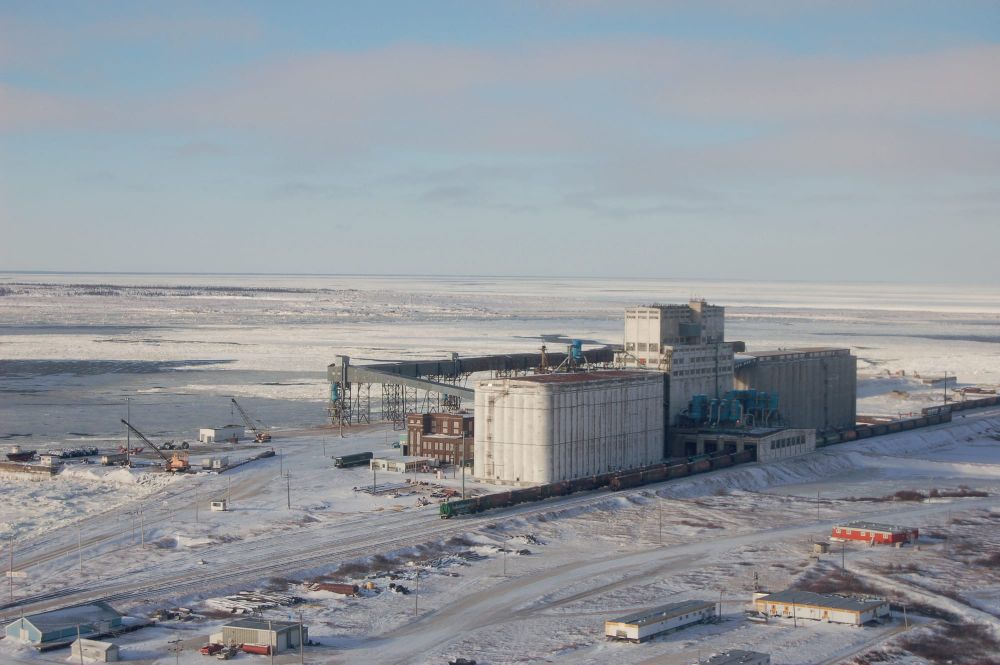
If Grays Bay shows how a project with northern roots can be swept up by national urgency, the Port of Churchill shows how that same urgency can inflate a modest northern asset into a national ambition. Churchill sits on the western shore of Hudson Bay, at the end of the 821-kilometre Hudson Bay Railway from The Pas, and it is home to Canada’s only deep-water port with direct access to Arctic shipping routes. Built in the early twentieth century, at the urging of Prairie grain farmers, the port has spent most of its existence trying to justify the hopes placed on it. For decades, its survival rested on federal policy rather than market demand.
When the Canadian Wheat Board directed grain through Churchill, wheat made up about 90 percent of its export traffic, but once the 2011 Marketing Freedom for Grain Farmers Act let shippers choose cheaper routes through the West Coast and the United States, its traffic collapsed. Its owner, OmniTRAX, suspended grain shipments in 2016, and a 2017 flood washed out the rail line, cutting the town off from the south. A consortium bought the port and railway for $117 million in 2018 with federal support, and in 2021 Arctic Gateway Group, now owned by a partnership of forty-one First Nations and northern communities, became sole owner. Activity has slowly returned. In 2024, a single ten-thousand-tonne shipment of zinc concentrate marked the port’s first mineral export in more than two decades; in 2026, a vessel carrying about thirty thousand tonnes of wheat sailed for Antwerp, the first grain shipment since 2020, with further cargoes of durum wheat and zinc to follow.
Modest progress has not tempered the ambitions now attached to the port. In September 2025, Ottawa referred the “Port of Churchill Plus” strategy to the Major Projects Office, envisioning an all-weather road, an upgraded rail line, a new energy corridor, and year-round icebreaking capacity.
A federal market-sounding study followed in February 2026 to court industry interest, and in August, Premier Wab Kinew and federal ministers announced that new studies had found year-round shipping feasible, citing climate change and modern vessel technology, and called on private investors to come forward. Kinew has also said that Prime Minister Mark Carney set an “aggressive” four-year timeline to get liquefied natural gas flowing through Churchill, which the premier interpreted as an ultimatum to build quickly or risk losing federal support. Ottawa has not confirmed that timeline, but the premier’s own words capture the mood. “The federal government has made it very clear,” Kinew said, “they want to build big things, and they want to build things fast.” That is the crisis mentality in its purest form. A port that has rarely operated without public money is being recast as a national export corridor because the trade war demands one, not because the conditions for success have changed.
Feasibility is not the same as viability. Year-round shipping would still depend on icebreakers and ice-capable vessels that do not yet exist, and no pipeline would supply an LNG terminal, nor is there a confirmed investor to build one. The rail line, built on thawing permafrost and prone to washouts, remains the port’s only land link south. Larger vessels would require dredging that could damage fish habitat and accelerate erosion, while increased traffic and underwater noise threaten the western Hudson Bay beluga population that Inuit and coastal communities depend on.
Emergency capacity lags far behind. When the cargo ship Thamesborg ran aground in September 2025, the Coast Guard icebreaker Sir Wilfrid Laurier took nine hours to reach it. Churchill residents, already struggling with housing, water treatment, and waste disposal, have asked for more discussion before their town is transformed. A four-year deadline leaves little room for the deliberate, community-driven review that Berger’s legacy demands. As with Grays Bay, the danger is not ambition itself, but ambition that outruns the evidence. Churchill is not a lost cause. The port works; it is shipping grain and minerals again, and modest growth is within reach. The problem is the scale of what governments now propose, and their neglect of the related needs, from search and rescue to housing and environmental monitoring, that any project of this size would bring. An all-weather road, an energy corridor, year-round icebreaking, and an LNG terminal measured in tens of billions of dollars would stake the port’s future on markets that have repeatedly passed it by.
A better vision would match investment to what Churchill can realistically sustain. It would make the port a reliable resupply hub for northern Manitoba, the Kivalliq region of Nunavut, and beyond, while supporting the grain, potash, and mineral shippers who already use it, and growing that trade at a pace the rail line, the bay, and the town can bear. Striking that balance between communities and commerce, rather than chasing a national export corridor on a four-year deadline, is what would give Churchill a future that outlasts the current crisis.
III. Build for the North
For more than eighty years, Canada has answered each new crisis in the North in much the same way. The Alaska Highway was rushed through in wartime, and the Canol pipeline abandoned within a year; the DEW Line was imposed on Inuit homelands and became largely obsolete within a decade; Diefenbaker’s roads to resources stalled once the political moment passed; and Nanisivik was announced as a bold statement of sovereignty before closing without ever becoming fully operational. In Coates’s terms, Canada has too often practiced symbolic sovereignty in the language of development, building monuments to its claims rather than the lasting infrastructure, services, and communities that give those claims substance.
The Berger Inquiry and the modern treaties that followed gave Northerners a formal voice, but as Nanisivik showed, they altered the cycle without breaking it. Today, the Building Canada Act threatens to restart that cycle with the force of law. Grays Bay and the Port of Churchill are not without merit, but both are being scaled to the moment rather than to the North. The Mackenzie Valley Highway and the Kivalliq Hydro-Fibre Link show that another path is possible, one in which projects grow out of northern needs and northern review rather than national alarm. None of this is an argument against building. Northerners need roads, ports, power, and connectivity, and they have waited far too long for them.
The question is not whether Canada should build, but how. Responsible development means bringing Inuit, First Nations, local governments, industry, and every affected community to the table, weighing economic, environmental, social, and security considerations together, and planning from the outset for search and rescue, environmental response, monitoring, housing, and maintenance. Speed matters, but building responsibly matters more, because a project built quickly for the wrong reasons will not endure, while one built carefully, with the needs and interests of the North in mind, will serve it for generations.
Jackson Walling is a Ph.D. Candidate at Trent University’s School for the Study of Canada. He is also an Emerging Leaders Co-Lead and Research Fellow at the North American and Arctic Defence and Security Network (NAADSN).
Aerial view of the Port of Churchill, 2012. Via Wikimedia Commons.