I picture Mel Watkins gazing out of his University of Toronto office window in 1962. Decades have passed since his mentor Harold Innis had published his theories on Canadian staples, and at this time in the midcentury Mel’s discipline of developmental economics was being reinvented by dependency theory.
Like many good things in Toronto, it came out of another part of the world, in this case, Latin America, and it sought to explain why developing countries so rich in resources (e.g., oil, sugar, gold) failed to evolve into wealthy economies. Theorists like Raúl Prebisch summed it up by saying that those same resources which made the country rich eventually brought their demise, as they invited exploitation from richer neighbours who manipulated the terms of trade with smaller powers to their own advantage. These deals encouraged weaker nations to export cheap unprocessed goods and refine them in rich economies. It’s a theory that is familiar to those studying trade today, when world leaders frequently reference unfair or disadvantageous trade deals. But at the time, this heterodox notion was tearing up established economic doctrine, and the departments that had abided by them.
But looking out his window towards College Street, Mel would have seen an exception. The pathways out of his building were paved and led to towering skyscrapers and diverse services. On the main drag, a few trucks might have been visible carrying the refined goods that dependency theorists claimed could barely subsist outside the imperial core. The oil, lumber, and wheat that should have attracted American intervention in Canada over the nineteenth century had birthed a powerful and diverse economy north of the border.
The result was his seminal paper “A Staple Theory of Development,” which sought to explain what at the time was Canada’s unique existence as a middle power on the border of a hegemonic one. Mel argued that while large powers would always try to exploit smaller ones, underdogs could fight back by diversifying their activity. Yes, an economy that primarily exported wheat would remain a simple one, but what if that wheat was processed? What if flour factories were built beside the wheat fields and cereal companies beside those? What if some of the local farmers took up higher-paying jobs in those factories? What if banks established themselves in neighbouring towns to manage the money flow, and what if those same banks provided start-up loans to local enterprise?
Watkins warned that if a country fails to develop beyond the export of raw materials, they’ll end up stuck in a resource trap, reliant on selling cheap simple products and importing expensive items like machinery and processed goods. But used strategically, staples could form a sturdy foundation for diversification, and found what is today the tenth-largest economy in the world. Canada has managed to develop beyond staple exports to build cars, planes, and satellite equipment, a feat with which today’s staple exporters like Peru and the Congo still struggle.
That same goal is now the Prime Minister’s. While some projects up for construction relate to electricity generation and transmission, a majority are focussed on harvesting Canada’s raw materials, including oil and natural gas, as well as the mining of copper, nickel, graphite, and tungsten—all critical minerals in the development of new technologies. These are to be supported by separate transport investments, such as the delivery of high-speed rail between Toronto and Quebec City, upgrades to ports, and the expansion of roads and rail to facilitate trade in the new materials.
Carney’s theory is a fair one: build up our capacity to extract and export staples in order to incentivize investment and decrease reliance on our testy neighbour south of the border. Dominic LeBlanc acts as internal minister for trade, sits at the heart of Carney’s economic strategy, and appears to have taken over Chrystie Freeland’s role in the Trudeau years that insiders referred to as “Minister of Everything.” “Canada is moving from reliance to resilience” LeBlanc explained last fall, “By developing our critical mineral deposits, our clean electricity production, and our LNG export capacity, we are unleashing Canada’s economic potential and securing long-term prosperity for all Canadians.” Resources lead to exports lead to growth.
But Watkins’ warning must be taken seriously. While resources can help improve annual GDP figures, there is no guarantee that growth will be felt across the country. Our long-term economic viability, and our economic future, hinges not on whether the mines and drills can be made, but whether today’s economy will be able to use their output to diversify Canada’s industries and further develop the country.
I. A Capacity to Transform
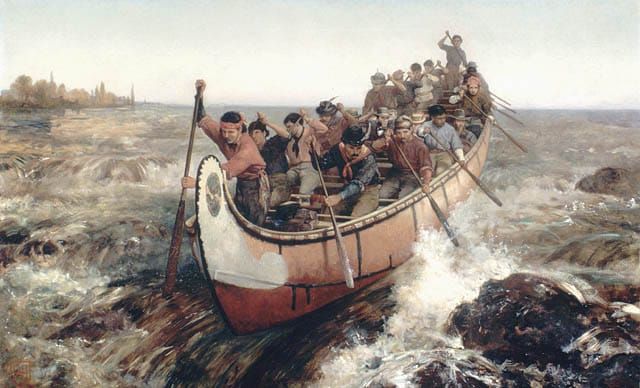
Mel based his theory on the work of Harold Innis. In 1923, before he became a monumental historian, economist, sociologist, and communications theorist, Innis wrote his PhD thesis on the Canadian Pacific Railway, noting its outsize impact on economic life across the country due to its effect on local economies. This line of inquiry formed the basis of his historical and economic work, which saw him trek across the country, canoeing across remote regions to research the fur trade and delve into records held by the Hudson’s Bay Company.
To his contemporaries Innis might have appeared as an eccentric and obsessive, but he was a tardy explorer and, in his own words, “a dirt empiricist,” following the paths trodden by early Canadian voyageurs and pioneers who moved up and down the country’s waterways to find, trade, and sell staples to European merchants. Using these experiences, and the records he encountered Innis would write numerous books on Canadian staples, including fur, cod, and timber, all of which he linked to Canada’s trajectory of economic development.
But Canada is not the same economy today. Whereas once we were a rural, resource-based, localized economy, today Carney faces a country with new services, based in more urban areas, that work in a globalised system. The Innisian instinct to look into the material fundamentals of an economy, its staples, remains as sound as ever, but the question Canadians face at the present is somewhat different: can staples theory create industries and markets that don’t currently exist?
The first test of Carney’s logic will be sectoral. The Major Projects Office (MPO) is designed to incentivise a reliable flow of private sector investment into infrastructure and critical resources, while at the same time acting as sources of growth in the Canadian economy. Consider just a few of their objectives: (1) diversify trade and reduce our dependence on the US; (2) build new supply chains; (3) support domestic capacity; (4) enhance national security; and (5) advance climate justice, indigenous economic development, and regional goals
Although it is focusing investment on major infrastructure projects like ports, rail, and mining, it is clear that these sectors alone are incapable of meeting the project’s wider goals. In fact, many will require projects to deliver on the above issues simultaneously, and this is likely to rely on spillovers into new sectors where we do not already excel. It’s what Watkins calls “spread effects.”
When government makes an investment, it doesn’t only look at the direct impacts, which might include wages paid, or infrastructure funded. When evaluating the success of major projects, the Department of Finance will review what it calls indirect benefits, which includes the broader web of industries that those projects supported. This might include housing and construction needed to support local projects, or steel industries required to build major infrastructure. At the same time, it will review induced benefits, which is essentially what happens with wages once paid to staff, and which regularly stimulate the food and retail sector.
Part of the government’s solution comes from analyzing value chains. This method acts somewhat like economic genealogy. It traces the value of certain products through multiple stages and across entire systems. For a mine to be successful, it requires not only extractive potential, but processing industries, logistics, finance, and tech sectors. These complementary sectors will need to be developed in parallel with major projects for either to work, and these will need to be evaluated throughout the project.
But measuring success cannot be done using traditional econometric tools. The MPO is deliberately designed to be broad and multidimensional. As a result, success can’t be measured in those sectors directly impacted by its spending. While past projects have relied on civil servants to diligently tally the benefits and costs of key investments, this becomes much more complicated when indirect and induced benefits become a key objective in the project.
As far back as 1930, Keynes, another intellectual north star for Watkins, warned that cost-benefit analysis was incapable of accurately analyzing a project with spillover effects. Even where it included indirect and induced spending, Keynes warned that traditional economic methods were incapable of accounting for the full range of benefits from major projects and as a result tended to stymie productive investments. “It should be obvious” he claimed, “that mere abstinence is not enough in itself to build cities or drain fens . . . as soon as thrift gets ahead of enterprise, it positively discourages the recovery of enterprise and sets up a vicious circle by its adverse effect on profits.” This deficiency has long been acknowledged in the footnotes of white papers, which accept the limitations of traditional economic analysis. Nevertheless, they have continued to apply them. The problem will not be in denouncing old forms of measurement but in generating new ones capable of analyzing positive effects outside those traditionally measured and over a longer span than is usually studied.
One method may be to look at the complexity of the Canadian economy. New methods of analysis have been developed at Harvard capable of measuring the complexity of economies, products, and major exports. By tracking our progress through these indexes, economists could find much more valuable information than they could normally obtain from GDP figures, and this would allow them to home in on measuring the spread effects of a policy.
Diversification is no longer a byproduct of economic growth but essential for its continuation, and it will determine what economist C.P. Kindleberger called “a capacity to transform.” It would get us away from the booms and busts that come with resource exports and allow us to shift with the times. Beyond economic output or added value, expanding the range of opportunities available in Canada’s economy must become a goal unto itself, requiring econometric methods beyond traditional ones in order to judge success. Certain criteria for the MPO, like “national interest,” appear intentionally broad and flexible, potentially to allow for greater flexibility when allocating funds.
Yet the critical question of how government stimulates the creation of economic sectors upstream and downstream of major projects remains essentially unanswered. The MPO has a mandate to, in its words “focus on resolving policy challenges, structuring financing, and reducing risks for projects, to fast-track decisions and movement to ensure projects remain competitive from development to operation.” (If you can figure out what that means, you got further than me.)
To buttress economic diversification, policies are needed that would help industries start and scale up. The good news is that these are already off the ground. The Canadian Institute for Advanced Research (CIFAR) provided funding for key AI advances when the discipline was still unpopular in the mainstream, proving the potential for lucrative public investment. The Canadian Natural Sciences and Engineering Research Council, (NSERC) provides small grants to a large range of ventures, already demonstrating the kind of strategy that will be needed to get a number of new industries off the ground. Procurement can also be focussed so that necessary industries have secure financing to get off the ground. An intelligent and selective immigration policy that targets critical skilled labour gaps may also play a role. These methods can provide nascent industries with the skilled staff they need to operate and the capital they need to scale.
This is difficult but not impossible. China and Indonesia both excel at using resources mined at home in integrated supply chains that build everything from cars to microchips to advanced machinery. They do so primarily in and around their major cities, which act as labour sources, knowledge pools, and export centers. Yet this is only possible when government steps in to make room for new business centers, while ensuring developers provide buildings for the services and homes that any labour will require.
When considering this strategy, we’re effectively talking about an active state coordinating multiple sectors to maximise returns. This is precisely what Watkins envisioned. Coordinating multiple sectors to come together with the appropriate linkages at the right time is a delicate maneuver in a stable economic climate. And today’s is anything but. Expanding the benefits of major projects to sectors beyond those that are currently active in the market will be a difficult task, but it will be essential to Carney’s success.
II. The Urban Question
“There was a time in this fair land when the railroad did not run.” So begins “Canadian Railroad Trilogy,” Gordon Lightfoot’s seven-minute ballad that describes how Canada’s economy was kickstarted by the national railway. The song stands as our closest approximation to a national epic and portrays Canadian history as having been shaped by its transport.
“For they looked in the future and what did they see?
They saw an iron road running from the sea to the sea,
Bringing the goods to a young growing land,
All up from the seaboards and into their hands
If the Government wants to get serious about economic growth, it will have to do more to link the MPO to transport provision. And that transport provision will have to be urban.
Canada is no longer the country of Sir John A. Macdonald. When his government administered the railroad as the new federation’s first major project, 90 percent of our population lived in rural areas, and mostly worked in agriculture, forestry, and mining—the very industries the railway would support. Today’s economy is more complex. Ours is a highly urbanized country with dense cities hosting jobs driven by services. With relatively few Canadians likely to be directly impacted by new mines and drill sites, how can new infrastructure turbocharge Canadian development? Carney’s success will hinge on the ability of major projects to make impacts beyond their immediate locale, in particular in the cities and towns where most Canadians now live. Watkins is useful here, warning that for staples development to succeed “Government must create conditions favourable to the flow of labour,” including mobility, to “develop a transport system adequate both for domestic and export requirements.”
Historically, the economic benefits that come from resource extraction tend to be spatially concentrated. Most of the money ends up stuck in the local area, where workers spend their wages and where any associated infrastructure, like roads, bridges, or energy, is focused. Profits may be accrued more widely through tax revenue and investment income, but these rarely end up directly filtering through to national urban economies. One study of Brazil found that any positive impacts from mining investment tend to stay within 50 kilometres of the given mine. After that, the correlation becomes statistically insignificant. Another surveyed mining projects around the globe finding that the positive spillovers for urban areas tend to emerge only where countries manage to develop industries upstream and downstream of the resource boom.
And that’s even more true today. Most of our population has moved now to cities. As of 2024, 83 percent of Canada’s population lived in urban centers, accounting for 61 percent of GDP. These cities account for most of Canada’s population growth over the last few years, in particular the downtowns, which grew by 10 percent between 2016 and 2021. In contrast, our rural population now makes up just 17 percent of the total. At the same time, rural regions are particularly unattractive to young adults, who represent a lower share of the population than their national average, limiting the available workforce and the viability of long-term projects.
That’s bad news for political consensus. Although rural communities punch above their weight when it comes to economic output, accounting for 23 percent of our GDP, this contribution is usually connected with major population centers, with 60 percent of rural production occurring relatively close to major markets. And it’s coming at a time when an increasing proportion of value is concentrated in cities, as the pivot away from manufacturing and agriculture toward services is clustering economic production in every denser urban areas.
Indeed, Canadian cities are clogged. Congestions and bottlenecks already plague Canada’s rail network, impeding the first-choice businesses have for long-haul shipping. Other sectors have not been spared. Recent reports by Export Development Canada have noted that “Congestion and poor maintenance in key export regions disrupt the movement of goods by air, rail, marine and roads” slowing the delivery of goods and increasing the costs of doing business. Highway congestion and infrastructure challenges are now being cited by businesses as a key impediment to transactions, all while we see more cars and trucks being used on the roads. This is to say nothing of the thousands of dollars drivers are forced to spend on their cars each year just to get to work, placing both a physical and monetary limits on the jobs they’re able to access. If cities are to benefit from the fruits of new extractive industries and integrate into national supply chains, more will have to be spent on transport infrastructure in and around Canadian cities.
In some areas, this is already being done. Montreal’s new REM trains are connecting suburbs with the core of the city, and future expansion will bring the airport into the network. GO Train expansion looks to do the same in the GTA, while also improving services in the city centre. Vancouver is getting expansions to the SkyTrain, while even Calgary and Edmonton, not historic friends of public transport, are seeing new LRT projects. But for the MPO to gain public buy-in, more successes will have to be accomplished at a faster pace than they have been historically.
The government’s commitment to delivery of a high-speed rail line is a good example. Connecting towns and midsize cities along the Montreal–Toronto corridor is sound economic policy, diversifying labour pools and decreasing traffic between each town. But Alto, as the line (and the crown corporation building it) is known, is not just about finances. Transport is one the most obvious demonstrations of whether a government is efficient. Is there a new rail line available for me? Can I buy a ticket? Alright job done. If not, faith in public works programmes tends to waver.
Cities are the engines of Canadian growth, but they have not always been. A stronger economic foundation for the country can be generated by the minerals and other resources on which Canadians stand. Yet with four in five Canadians living in cities, it is difficult to imagine Carney’s strategy sparking much success without paying more attention to the infrastructure our urban economies so desperately need.
III. Balancing the National and Global
Martin Wolf has written that 2025 was “the year that global trade definitely did not die.” He might also have said that trade’s death had been greatly exaggerated. Agitated warnings that Trump would destroy globalism have given way to more nuanced conversations about how trade is changing and how globalization might be reconfigured rather than relegated or abandoned—and Canada now sits at the center of the debate.
The MPO fits the times. It is export oriented, capital intensive, and invests with long payback horizons. Many of the projects like ports and energy investments will require global demand and market access to succeed. As such, the MPO is left extremely reliant on external trade conditions, and expanding the opportunities to collaborate with a wider range of countries will be necessary. It’s no coincidence that it was launched alongside the PM’s Trade Diversification Strategy, which aims to double Canada’s overseas exports across more global markets.
To some degree, Carney has already explained that his interest in diversifying Canada’s trading networks is based on security concerns should we continue to be reliant on the United States. “What it's doing” he explained at Davos, “is creating a dense web of connections across trade, investment, culture, on which we can draw for future challenges and opportunities . . . the middle powers must act together, because if we're not at the table, we're on the menu.” 70 percent of Canada’s exports currently go to the US. That’s a security concern given recent volatility, and like any good banker, Carney would warn against overexposing an investment portfolio to a single area.
But it’s also a blockage to economic industrial development. Canada has a small population in an open economy, too small in itself to absorb the large outputs from produced from its energy and critical mineral extraction. That limits our productive potential unless exports expand. Given our reliance on the US, Canada’s major industries have had to align themselves with what works for the American market. Often, that’s staple exports.
Take oil. The US already has massive oil storage and refineries, particularly in Oklahoma, Texas, the Gulf, and the Midwest. That’s meant its relatively unproductive for Canadians to refine at home, since it requires massive upfront costs, and we can make a relatively higher profit by selling crude oil and refining elsewhere. As we design our supply to fit American demand, firms optimize their output to align with US standards. Innovation becomes path dependent, and like a broken radio, continues to produce an economic market that suits American issues, but does not necessarily leave Canadians better off. New start-ups that fail to align are broken down, as they struggle to find demand for goods that are not attuned to US interests.
The same is true for other goods. By building links with a wider array of high-growth and complex markets, we can stimulate domestic investment in new sectors while attracting further investment from abroad. As trading partners shift, so too do the terms of trade and our comparative advantages. Whereas we might have been unable to attract private sector investment for refinement when the US was the endpoint, there is no reason that will hold true in more diversified global value chains.
This is what economist Paul Krugman labels the “love of variety” wherein a country gains when they can produce a wider range of goods to meet varying tastes and specifications. The US market demands energy, cars, and standard staples. But non-US markets in the EU and Asia may demand more and different things: specialized machinery, batteries, processed resources, and other forms of niche manufacturing. They may have specific regulations that require precise compliance and which can stimulate new sectors across Canada. Innovation can better flourish when there are a greater variety of market niches that need to be filled.
This also has the potential to benefit a wider range of regions, given that they will require a greater variety of goods and services. Canadians are increasingly concerned that rural areas have been neglected by economic policymakers. These fears are valid but not new. In fact, Mel Watkins himself was criticized by later economists like James Sacouman and John Lutz who argued that Canada had its own core-hinterland relationships, with the Maritimes and the West suffering from dependency on Central Canada. Carney’s goal to develop extraction, manufacturing, and agricultural industries is useful given these sectors tend to concentrate in rural areas. The promise of engaging with more countries is therefore not that they offer more opportunities than the US but that they offer more diversified ones.
Some of this is already happening. While many American auto manufacturers drag their feet over the pivot to electric vehicles, Stellantis is currently discussing options for assembling EVs in Canada using Chinese parts, while bringing an idled plant in Brampton back online. More needs to be done to ensure a sufficient number of jobs emerge out of the Brampton deal, but the new talks are instructive in how complementarities can be discovered when accessing more markets.
Note that integration into global value chains does not mean neglecting the domestic market. Watkins warned against the tendency for Canada’s leaders to develop “an inhibiting ‘export mentality’ resulting in an overconcentration of resources in the export sector and a reluctance to promote domestic development.” While exports should rise, this should not require deprioritizing the domestic market or giving foreign demand greater weight than its actual economic potential. Doing so is exactly what brought us an overreliance on the US market. As Watkins put it, “when export earnings are high, the country is able to finance development but lacks the incentive to do so; when the earnings are low, the incentive exists but the means are lacking.”
Discovering complementary trading relationships is a job best left to specialists who understand what it means to build a product from extraction to completion (rather than a Substack economist). It takes time and expertise. Harold Innis knew this well and felt anyone making economic or historical claims about the benefits of certain products had to understand them at a visceral level. It’s why he spent years writing dense books on fur, wheat, cod, and other staples. If the government wants to maximize the opportunities that come from its resources, it will need teams capable of understanding the unique needs for every project.
Although Carney’s endorsement of this venture marks a radical departure from the laissez-faire trade policies of Canadian governments since 1988, it marks a return to the system of guided economies seeking to find or develop comparative advantages that mutually benefitted each other. Less free trade and more, well, trade.
IV. Escaping the Elephant
So how can success be measured? To be fair, a great deal will have to do with increasing the diversity and complexity of the economy, as above. But the other big number to watch is the share of Canadian exports going to the US. The current number is 70 percent, which is a greater concentration than any other country in the OECD barring Mexico. Even worse, the centrality of the US has barely budged since 1995, despite tantalizing offers to expand trade with other as evidenced by the subsequent spate of FTAs Canada has signed with countries and multilateral organizations all over the world.
But actually weaning Canadians from overdependence on the American market is easier said than done. John Diefenbaker, Pierre Elliot Trudeau, and Jean Chretien all made sincere efforts to decrease America’s role in our exports. Trudeau (Sr.) famously told Nixon that “Living next to you is in some ways like sleeping with an elephant. No matter how friendly and even-tempered the beast, if I can call it that, one is affected by every twitch and grunt.” The challenge was always acknowledged but it seemed to be of a secondary order of importance in the days when the US was generally “friendly and even-tempered”; we certainly cannot say the same nowadays.
While Carney’s strategy may seem new, it is an old one that’s been inconsistently applied throughout our history. Watkins made clear that although Canada’s greatest growth spurts have been driven by staples development, it has not always been so. He sites the periods from 1900 to 1913, 1920 to 1929, and 1946 to 1956—periods of growing complexity with varying degrees of protection—as the main points when investment rates and manufacturing rose. This can happen again.
Eventually, Watkins said, the end goal of staples development should be such that the term no longer applies. “Entrepreneurial confidence and expanding opportunities of domestic markets will allow domestic entrepreneurs to usurp markets from foreign suppliers. Secondary manufacturing sectors serving domestic markets and possibly even foreign markets can emerge. Staple exports will fall and manufactured exports will rise.”
Reaching this point will not be easy. As Watkins explained, it will “require institutions and values consistent with transformation.” “Institutionalism” and “transformation” usually don’t pair well together. But they are the necessary ingredients of development, and precisely what this government promised.
Gideon Salutin is Chief Economist at the Social Market Foundation, Britain’s leading cross-party think tank. Here he leads research on economic growth policy and distribution, and advises policymakers on his findings and recommendations. His work builds on his experience growing up in Canada, where he worked for the Max Bell School of Public Policy, the International Development Research Centre, and le Centre International pour La Prevention de la Criminalité. He has appeared on the BBC, LBC, and Times Radio, and has been published in the Guardian, the Times, the FT, the Toronto Star, and National Observer among others.