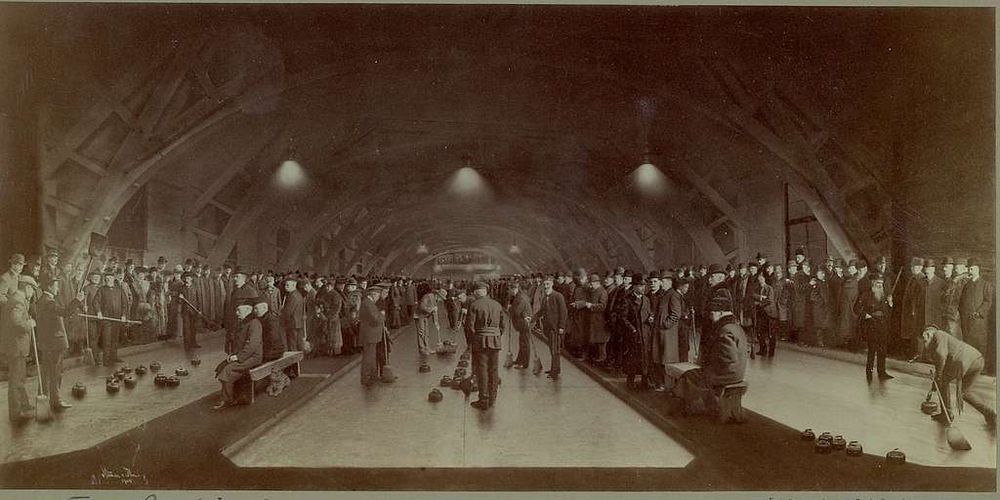
At the end of a curling game, no matter how the game went, one can expect the players to cross the sheet of ice and shake hands with the people they were just trying to beat. This happens in bitter losses, in blowouts, in games decided by a bad break on the last shot, and between teams that plainly do not like each other. Someone usually says, “good curling.” Even before the handshake, however, another form of etiquette has usually already been at work because curlers are expected to call fouls on themselves. If you nick a stone with your broom on the way past, you say so, out loud, unprompted, even if nobody else noticed. There is no referee standing over the ice to catch you. Curling belongs to a short list of competitive sports—golf is usually the other one people think of—where players are still trusted to call the violation on themselves and in the moment. As the winter draws near, roughly 2.3 million Canadians will be throwing stones, sweeping ice, shaking hands, and spending time together in the warmth of curling clubs and centres across Canada.
I have spent more than twenty years inside curling clubs and talking with curlers across this country, and it continues to fascinate me. Curlers play a peculiar game on ice, in slippery shoes, with heavy rocks, painted houses, and technologically advanced brooms. Further, an entire sporting culture has organized itself, for more than two centuries (Scottish settlers founded the Royal Montreal Curling Club in 1807, still North America’s oldest continuously operating sports club) around a rather demanding code of manners. There are fewer of these clubs around today, and the ones that remain are still holding to that same self-officiating standard. They have also functioned, for a large part of that history, as something like the country’s rec rooms. They are “third places,” in the sociological term, and they ask the people inside them what a host asks of their guests: behave—because everyone here can see you and you’ll be back.
Vera Pezer’s The Stone Age: A Social History of Curling on the Prairies (2003) describes how this culture came to exist: fur traders on frozen rivers, the Scottish and English settlers who carried the game inland, two World Wars and a Depression, and the postwar clubs that eventually produced Olympic teams. Pezer writes: “The game of curling is a unique component of the social history of the Prairies. From its sparse, random beginnings more than 150 years ago, to its present sophisticated level, curling defines the character and spirit of the Prairies and its people. Its requirements of self-discipline, persistence, patience, and co-operation parallel the qualities of early settlers, and it has been linked with almost every aspect of prairie life — political, religious and commercial.” Pezer’s is an excellent account, written by a four-time national champion who went on to a second career studying the psychology of the game and its players. My own years of research suggest a complementary perspective, one that shifts attention from the history of the game and the character of its players to the places where curling is played and the social worlds that have taken shape around them.
I. Clubs, Bonspiels, and Rituals
Fieldwork has taken different shapes at different times. One project put me in six curling clubs across Manitoba, Saskatchewan, and Alberta, over six bonspiel (typically a multiday, multiteam competition) weekends. Three of those towns—Cedar, Ash, and Maple are the names I gave them—show how differently, and how similarly, curling plays out from one warm space to the next.
Cedar, Manitoba, had 656 people in 2001; for one long weekend each year, by all accounts, virtually the whole community turns up at the curling club. The year I visited, the bonspiel was the club’s hundredth, and the two neighbouring rinks joined their ice to turn a three-sheet club into a nine-sheet facility for the weekend, hosting more than seventy teams. Volunteers from the local hospital and museum ran the food and the bar and split the proceeds with the club. The fire department hosted a Saturday breakfast at the fire hall. Aside from the icemaker, every part of the weekend was made possible by volunteer labour: organizing, cooking, staffing, and cleaning up after.
Ash, Saskatchewan, population 1,758, holds a mixed bonspiel every April where families who don’t often get to play together enter teams just to be part of it, and friend groups fill out the field. “Curling families” in a town like this become local legends. One family I met was well known enough that naming the father and the family name was, on its own, enough to identify a particular shot everyone remembered. To raise money, the club sold naming rights to its tables, usually to honour a member who has died; the name and the stories that go with it stay on the table for years afterward.
Maple, Alberta, population 1,762, runs its men’s bonspiel out of a four-sheet rink attached to the local hockey arena, with a long bar and windows running the length of the ice. The Saturday banquet is a roast beef dinner, and the raffle table that year held everything from T-shirts and poker sets to hockey tickets and a beer company mirror the size of a door. An unwritten expectation among the small clubs in the area, the organizer told me, is that everyone sends teams to everyone else’s bonspiel, as long as the dates don’t conflict.
In other communities without dedicated curling spaces, people create what curlers call “arena clubs.” Here, the ice used for hockey is put into service. The changeover between the two sports is its own kind of volunteer choreography.
In one club where I spent time in Newfoundland and Labrador, after the late Sunday-night hockey game, a small crew stayed behind. What followed was a specific, carefully learned process: the Zamboni runs over the ice to remove the hockey cuts from the surface, four concentric circles are drawn to mark the houses (scoring area) and lines are measured out, and then the hacks (starting blocks for a curler to throw the stone) are frozen down. Pebbling the ice involves spraying the sheet with fine droplets of water, so that a stone travels across a field of frozen beads instead of flat ice. Without that texture, a thrown stone would drag to a stop partway down the sheet; the pebble is what lets it glide the rest of the way and curl at all. The next day is filled with an afternoon seniors’ league, a junior practice after school, and two evening leagues running back-to-back. Curlers mill around, drink coffee or beer, and compare shots. Then the same volunteers who built the ice stay late to remove the hacks, put the stones and the brooms away, and hand the surface back to the Zamboni, so the rink can be hockey again. This curling club lasts about a day, once a week.
In most places, what curlers mostly call the lounge is doing at least as much work as the ice. Even the game typically faces it: whichever end of the sheet sits nearest the lounge, half the ends in every game are played toward it. Curlers call that direction “coming home,” so the game spends half its time pointed at the room everyone ends up in, win or lose. In practice it might mean a kitchen too, sometimes a pro shop, or a second bar down a back stairwell. A stream of chairs usually lines the windows overlooking the sheets, worn in the way any well-used seat gets worn, cushions gone slightly concave in the places generations of curlers have set themselves down to watch a game they were not playing in. Off to one side, there is often a couch or two, sometimes a stack of board games, doing duty as an unofficial kids’ area. In many cases, young children are handed off to whoever’s arms happen to be free, and few treat this as an imposition. Some curlers have a name for what those kids become on league nights: “curling orphans” is used affectionately, on account of how many hours they spend at the club when their parent is out on the ice.
The tables tell another version of the same story. Most are round, with seats for eight, built for the ritual that follows a game. “Broomstacking,” as many curlers call it, is a term that goes back to the centuries-old Scottish practice of standing brooms together by the hearth after a match on a frozen loch or river, while the game got talked through. Today, the two teams who were just playing each other walk off the ice together and sit down at the same table, the winners typically buying the first round, and everyone trading compliments and complaints about the shot that decided things. What goes in the glass has changed more than the ritual itself: rye or whisky through most of curling’s early history, then mostly beer for much of the twentieth century, and in the clubs I have spent time in lately, a much wider range of options, including coffee, pop, and water.
The walls, filled in over the decades, include photos of teams and club presidents, and there is a trophy case, and a wall of fame reserved for the rarest feat in the game, the eight-ender (when one team scores on all eight rocks), which happens infrequently enough that clubs frame the image and hang it up for bragging rights.
Someone in every club can probably tell you about a repair the members made themselves, a jerry-rigged hack here, a hand-patched wall there, or a leak in the men’s bathroom that got solved one afternoon between games. In one club I spent a great deal of time in, an elderly life member told the story of the year a handful of regulars decided they wanted a second bar in the downstairs lounge and simply built one: cut a hole in an unused closet wall, framed it, ran the taps, and kept a bar going there for years afterward. “We used to spend time in the club no matter if we were curling or not,” he said. “If it was broken, we’d fix it.”
The games inside the game are as ritualized as the curling itself. I have watched two members run a bit for an entire bonspiel weekend, selling raffle tickets off a hand-drawn sign, “one for two dollars, three for five, or an arm’s length for ten,” with the arm’s length measured out, laughing, right there at the table. I have watched men in their seventies and eighties work through hand after hand of hearts in the lounge, a card table give way to darts or a low-stakes poker game, and grandmothers teach a handful of nine-year-olds how to play cribbage.
Competition prizes tend toward the practical and even a bit eccentric. You could see various cuts of meat, cheese wheels, maple syrup, wrench sets, flashlights, air fryers, and so on, enough that more than one curler has told me, with a kind of prideful affection, that half the tools in their garage arrived that way. The kitchen turns out coffee and, more than once, a pot of hamburger soup, and the clubs may send smokers outside now, but the smell of the cigarettes that used to be lit at that same bar has never entirely left the paint and the carpet.
The game is not always the reason someone is present. One man, whose wife had left him a few years before, told me he had joined the club mostly because he needed somewhere to be. “I don't think I’d be here if it weren't for this club and the guys I curl with,” he said. “Just a place to go. A reason to get out of the house.” He mentioned, almost as an afterthought, that his curling had gotten better too. Down the lounge from him on the same afternoon, three generations of one family were having lunch together (grandparents, a daughter and son-in-law, their granddaughter), and the older woman was playing with a delivery aid that lets curlers with bad knees keep throwing rocks, often well past the point their bodies would otherwise have made them stop. On a Saturday, the same kitchen that fed all of them might belong to a dozen teenagers from a track club fundraising with a lunch sale, because the building doubles as whatever the town needs it to be at the time.
Most of this runs on volunteer labour. Small clubs especially depend on members to staff the bar, cook the food, organize the fundraising, and, in all but a small number of cases, look after the ice. The one paid position, if a club can afford it at all, is usually the icemaker. Curlers describe this to me as a source of real pride, one of the things that separates a small club from a bigger, better-funded urban facility.
II. Rules and Reputations
What holds these clubs together goes beyond the category of third place described above. They share a code: an unwritten agreement about how the people inside should treat each other and be treated in return. World Curling, the sport’s governing body, now counting more than seventy member federations, calls it, formally, the spirit of curling, and prints it at the front of the official rulebook, above the rules themselves:
Curling is a game of skill and of tradition. A shot well executed is a delight to see and it is also a fine thing to observe the time-honoured traditions of curling being applied in the true spirit of the game. Curlers play to win, but never to humble their opponents. A true curler never attempts to distract opponents, nor to prevent them from playing their best, and would prefer to lose rather than to win unfairly.
Curlers never knowingly break a rule of the game, nor disrespect any of its traditions. Should they become aware that this has been done inadvertently, they will be the first to divulge the breach.
While the main object of the game of curling is to determine the relative skill of the players, the spirit of curling demands good sportsmanship, kindly feeling and honourable conduct.
This spirit should influence both the interpretation and the application of the rules of the game and also the conduct of all participants on and off the ice.
Curling’s rulebook does something interesting and probably unusual. Rather than a list of what’s prohibited, the rulebook opens by describing what a decent person does and trusts the players to be that person without anyone watching. Readers who followed the last Olympics will already have their own name for what happens when that code is tested on the largest stage curling has; that’s a story for another piece.
This all relies on self-officiating, and it is worth reflecting on how strange that is. A curler who nicks a stone with a broom on the way past is expected to announce it immediately and unprompted, even in a high-stakes game, and even when the only ones who would ever have known are the player and the ice itself. There is no official assigned to catch infractions. The players are the referees, for themselves, against their own interest, in the middle of trying to win.
Ask people inside the sport why this holds, and two explanations tend to come up. The practical one: for most of curling’s history in small-town Canada, there simply weren’t officials, so clubs built a code that didn’t need any. The other is closer to why a host asks decent behaviour of guests: in curling, small town or big city, the people on the other team tend to be people you’ll see again, at the next bonspiel, behind the bar on a volunteer shift, at the rink the following week, so there is nowhere to hide a bad habit. Somewhere between those two explanations is a real question about what kind of people build a sporting culture around the assumption that everyone will police themselves—and keep believing it works.
The code is most visible in what happens when someone breaks it in public. In November 2018, at a bonspiel in Red Deer, Alberta, a team that included the Olympic gold medalist Ryan Fry was disqualified for behaviour that damaged other teams’ equipment. Fry apologized publicly, paid a fine, donated to the local junior program, and stepped away from his regular lineup for several events. His own teammates, who hadn’t been there, still felt the need to publicly distance themselves from what happened. Stories like this make news because they are so rare.
A public apology and a fine can’t fully restore standing, which is why Fry’s own teammates, who had done nothing wrong, still felt the need for distance. Reputation in a self-officiating sport works like a shared account: a club’s trust in its own code gets built up over years by people honouring it and a public breach draws down more of that balance than the one infraction likely accounts for. And these mechanics apply at any scale. A code that holds easily inside a small club, where the next person you call out is the same person you see next week, gets tested differently in front of a large television audience and with social media sharing the events widely and instantly.
Historically, not everyone has been welcome in the sport. Curling’s spread across this country followed the same settlement patterns that pushed Indigenous nations off the land it was played on, and the clubs that opened along the rail lines and in the new prairie towns were an import of Scottish and English custom onto land that already had people and rules of its own. For most of the sport’s history since, the tight, self-policing, everyone-knows-everyone quality that makes the honour system work also kept these warm spaces open for a fairly narrow slice of the country: overwhelmingly white, organized around a specific version of small-town belonging with little room for immigrants, for people of colour, for anyone whose Friday nights belonged to a different tradition. Years ago, I saw a version of the same pattern studying who was and was not showing up to curling clubs in Toronto: curling there was and is far more plentiful than in Cedar, Ash, or Maple, yet its membership still looks almost nothing like the city surrounding it.
A newer generation of players, coaches, and administrators, including researchers and leaders I have worked with, are looking specifically for the colonial assumptions embedded in curling’s own stories about itself. Together, we have spent the past several years prying that room open further, such as through efforts at greater inclusion, outreach to wheelchair curlers, and a symposium built around changing who the sport pictures when it pictures a curler. Indeed, those defending the storied honour system need to think more about who gets to be an insider in the first place.
III. Good Curling
There are fewer of these clubs than there used to be. The decline of curling clubs is a concrete case of something researchers have been naming under headings like social atomization and the loneliness epidemic: the slow disappearance of the ordinary, unglamorous places where people used to accumulate contact with each other just by habit. Curling did that work without advertising it as wellness or civic repair. It did it by asking people to show up to the same place on the same night, for years, whether or not they felt like it, and by giving them a warm lounge to sit in once the game ended. The importance of that kind of infrastructure is only visible once it’s gone, which is roughly where a number of the towns in this essay now sit, and where plenty of communities with no connection to curling at all are heading too.
Someone in their twenties or thirties who has never set foot in a curling club may still recognize what’s missing from that description. Much of daily life now runs through channels designed to be efficient rather than habitual: a social media feed that is different every time you open it, a group chat that can go quiet for a month without anyone noticing, a city organized around errands rather than a standing commitment to the same room full of the same people. With that decline goes social company as a structural fact built into a place and a schedule, rather than something a person has to choose and keep choosing on their own. Curling clubs, at their most ordinary, solved that problem for more than a century by taking the choice out of people’s hands: show up Tuesday because the team needs and expects you. A reader who has never thrown a rock can still recognize the shape of what that solved, because the shape of what’s missing has become so familiar.
But sitting inside the clubs that remain, twenty years on, what has stayed with me most is that every game, win or lose, ends the same way, with the ubiquitous phrase: “good curling.” Plenty of sports end with a handshake. Few of them hand the players a script, and fewer still get people to say the words and sound like they mean them, to someone they were just trying to beat. I have come to think that small, strange courtesy says something real about this country’s idea of itself: enough people have agreed, for more than two centuries, to keep saying it, and to keep acting like the words asked something of them.
It was the sociologist Ray Oldenburg who coined the term third place, describing it as distinct from home and work, built on nothing more structured than repetition and company. Decades later, Eric Klinenberg gave the same idea more heft, calling places like this social infrastructure, making clear that a country’s social fabric gets built, physically, warm room by warm room, through the plain fact of people showing up to the same spot on a schedule, year after year, and stacking their brooms by the hearth to gather when the game is over. Curling clubs have been doing that work for more than a century. They have not done it for everyone equally, and the previous section is a record of that. But what they are doing is definitely worth sustaining.
Heather Mair is a professor of Recreation and Leisure Studies at the University of Waterloo, where she chairs the department. She has spent two decades researching curling and community development in Canada.
Photo: Wm. Notman & Son, Montreal Curling Club, 1905, McCord Stewart Museum.