Capitalism has been in some kind of crisis for as long as most people alive can recall. An anomalous interlude of prosperity and peace, the End of History, was first punctured by the 2008 financial crash, which should have been a moment of revelation, perhaps even of revolution. The old world was dying and a new one needed to be born. Instead, what transpired was a decade of quantitative easing, asset inflation, and not only the survival but the spectacular enrichment of those who had caused the catastrophe.
Then came populism, the pandemic, the collapse in global supply chains, recurring bouts of inflation and tariff wars, and the slow realization that the digital platforms absorbing ever-greater portions of our attention and capital were not, as their founders had promised, engines of liberation but rather something more feudal: algorithmic lords extracting rent from a captive market. There seemed to be endless upheaval but little sign of a new settlement or consensus.
The spectres just keep multiplying, and the system keeps not quite dying, mutating instead into what Greek economist Yanis Varoufakis has called technofeudalism, arguably “the far, far uglier social reality that has superseded capitalism,” built on “the great algorithmic network hiding in the cloud” behind our contemporary technologies of convenience “to guide our behaviour in ways superbly lucrative for its owners.”
Canadians are acutely haunted by the same mutating spectres that press down on advanced societies nearly everywhere: housing scarcity, stagnating wages, declining communities, the retreat of productivity, the spread of “enshittification,”[i] and the concentration of wealth in a narrowing class of asset and platform oligarchs. But Canada faces these converging forces in tandem with something most Western democracies do not face: a direct and explicit threat to the existence of the country itself. Our body politic is not merely sick; it’s being told, from outside, that it was never really a body at all. The political pressure is, to many, terrifyingly novel—Canadians have never faced such flagrantly threatening rhetoric from a U.S. administration, but the technological and cultural corrosion brought about by American firms, algorithms, and applications is, of course, older than the unfolding crisis; the longstanding fact of digital domination both prefigures and enables the madness of 2026.
It is in this context—of prolonged disruption without resolution, of a Canadian anxiety that is both economic and existential—that David Cronenberg’s 2012 film Cosmopolis deserves a second, harder look. Based on Don DeLillo's prophetic 2003 novel, published five years before the financial crisis and eight years before Occupy Wall Street went global, the film has aged from prophecy into reality. The film shoots New York through Toronto, observing the American financial nightmare through a Canadian lens. Cronenberg is sometimes reductively described as a body horror filmmaker, but Cosmopolis is something else: a definitive work of body politic horror, a diagnosis of a civilization whose heart and brain are failing, filmed in this country by one of our greatest artists, fourteen years before we were ready to understand what he was showing us. That Cosmopolis was made more than a decade ago is proof of Marshall McLuhan’s adage: “The job of the artist is to upset all the senses and thus provide new vision and new powers of adjusting to and relating to new situations.”
Indeed, even for those who might not have lined up to see the picture when it came out, Cosmopolis is a worthy, if difficult, object of study for Canadians in 2026: a useful artistic prism for engaging with our current social impasse and perhaps finding a way out.
I. A Besieged City
Cronenberg’s film hews closely to its source. In an interview, the director said his most significant change was to use the Chinese yuan instead of the novel’s Japanese yen, the better to accurately represent 2012 market contexts. Cronenberg muses, “I don’t know if DeLillo has stock accounts, but he should: he has a remarkably perceptive vision of what is going on and how things are going to turn out . . . The film is contemporary, while the book was prophetic.”
Like the novel, the film follows twenty-eight-year-old billionaire asset manager Eric Packer (Robert Pattinson) as he floats in his luxurious, armored, cork-lined stretch limo through an embattled New York City. His fittingly narcissistic objective is to get a haircut. Packer has fallen unconsciously into the role of a sort of fallen, amoral Odysseus. The grimy streets of Manhattan (really, University Avenue and its adjacent blocks) serve as his River Styx leading to his personal Hades of market collapse and violent class revolt.[ii]
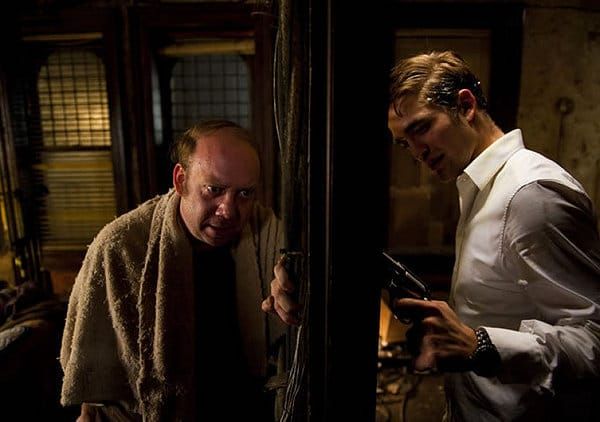
As the film progresses, Packer disregards his consultants’ warnings and loses millions of dollars betting against the yuan. En route to his destination barber shop, he receives a private medical exam (in which he discovers that his prostate is asymmetrical), converses with employees and colleagues, and has soulless sexual encounters with multiple women, notably excluding his trust fund poet wife, Elise Shifrin (Sarah Gadon). The climax brings Packer into the dank hideout of Benno Levin (Paul Giamatti), an ex-employee and radical conspiracist deranged by post-postmodern disillusionment and suppression. Whereas DeLillo’s novel contains interlude excerpts from Levin’s Confessions, our would-be assassin’s manifesto of sorts, the film almost entirely withholds Levin’s presence until he attacks Packer in the final third.
Much scholarship has been written on the role of neoliberalism in DeLillo’s oeuvre, including Cosmopolis.[iii] Of specific interest here is how Cronenberg’s work of body politic horror speaks uniquely (if quietly) to a contemporary Canadian context, in which—much like Nola’s psychoplasmic sessions birth murderous mutant children in Cronenberg’s The Brood (1979)—neoliberalism has brought forth the terrible spawn of technofeudalism.
Cronenberg’s Cosmopolis invokes this gestating form of social organization, simultaneously a predecessor and a successor to capitalism, with an onscreen billboard flashing the omen: A specter is haunting the world / The specter of capitalism. This play on the opening line of Marx and Engels’ Communist Manifesto speaks to the film’s thesis: capitalism is an undead entity, increasingly spectral in its cyber manifestations, lurching toward a dark, reactionary future that resembles the very feudal despotism it was supposed to have transcended. The novel and film both instantly underline this unsettling notion with an epigraph from Zbigniew Herbert’s poem, “Report from the Besieged City”: “a rat becomes the unit of currency.” Throughout the film, protestors wield and throw dead rats; some wear monstrous rat costumes.
It’s difficult not to connect such imagery to the Gothic horror tradition that haunts much of Cronenberg’s early work; Gothic literature often uncharitably metonymizes the rat as a symbol of death, disease, and decay—a stand-in for medieval rot.[iv] The capitalism of Cosmopolis is dying or already dead, food for rats, its new form all the more monstrous. As Varoufakis notes in Technofeudalism, this ghoulish new system, founded on the evolution of cyber capital, “decoupled from the mundane world of physical capital, legitimised by the ideology of neoliberalism, fuelled by a new virtue called ‘greed’, shrouded in the complexity of . . . computers” sees financiers “reinvent[ing] themselves – not without some justification – as masters of the universe.”
Preceding Cronenberg’s apocalyptic body horror revival Crimes of the Future (2022) by ten years, Cosmopolis duly concerns itself with the former’s titular subject: the always worsening crimes of the future as committed by these self-appointed masters of the universe. Cosmopolis locates such crimes in its observations of the present, via the constantly increasing corruption and concentrated sociopolitical power of the uber-rich. Body politic horror, indeed. Look no further than Eric’s conversation with his personal Chief of Theory, Vija Kinsky (Samantha Morton, who 2026 audiences might remember as the witch Circe from The Odyssey; in both roles, she explains the tensions between forms and essences to a wandering protagonist).
As Kinsky and Packer glide through a street teeming with class rioters, the former observes: “It’s cyber capital that creates the future . . . Time is a corporate asset now. It belongs to the free market system. The present is harder to find. It is being sucked out of the world to make way for the future of uncontrolled markets and huge investment potential.” As if anticipating the transparent oligarchical consolidation of power manufactured by tech billionaires in the 2024 U.S. presidential election,[v] Kinsky surveys the outraged citizens outside the air-conditioned cocoon of Packer’s limo and notes, “This is a protest against the future.” The future is here, and Kinsky’s predictions have ossified into reality; as if anticipating the increasingly ubiquitous algorithmicizing of reality and subjecthood, she muses that “people will be absorbed in streams of information,” and that computers are “melting into the texture of everyday life.” Speaking to the film’s pervading interest in the corrosion of language and collective truth, she adds, “even the word computer sounds backward and dumb.”
II. Broligarchy North
In 2026, the United States blatantly showcases the consequences of technofeudalism through its openly oligarchical, Silicon Valley-saturated regime, where the likes of Elon Musk and Peter Thiel hold outsize influence. Canada’s dominant oligarchs—in the form of grocery store cartels and natural resource tycoons—are somewhat more “analogue” and retrograde, but technofeudalist currents are nonetheless visible in our public discourse.
Consider Canadian Shopify CEO Tobi Lütke’s recent endorsement of former TD Bank executive Eric Thor’s X post, which proposed an electoral system of “weighted voting proportional to the amount of income tax you pay.” Lütke responded “Good system” to Thor’s specific musings about the possibilities of his proposal: “no income tax paid - 0 vote, $1-100k - 1 vote, $100-200k 2 votes and so on... cap it at 5 votes for $500k+.” Lütke has also recently taken to X to dismiss public pushback against data centre construction as “nonsensical,” despite rising concerns surrounding regulation, environmental damage, and job loss within an already precarious economic context. Notably, according to a recent Angus Reid poll, 74% of Canadians “doubt any government is truly equipped to keep pace” with AI technology and “68% would oppose a large AI data centre being built within a few blocks of their home, with rural and urban Canadians equally resistant.” Taken together, Lütke’s positions speak to a flagrantly technofeudalist worldview, wherein cyber-capitalist wealth takes precedence over democratic principles and environmental wellbeing.
Lütke is the same species as Cosmopolis’s Packer, who tells his twenty-two-year-old Systems Analyst (Philip Nozuka) that “there’s only one thing in the world worth pursuing, both professionally and intellectually: the interaction between technology and capital.” This monomaniacal worldview drives Packer’s beliefs surrounding the concept of public ownership, as demonstrated when he tells his art consultant, Didi Fancher (Juliette Binoche), that he wants to purchase the Houston Rothko Chapel and re-integrate it into his private New York apartment. When Didi rebuts that “the Rothko chapel belongs to the world,” Packer blankly and unironically responds, “It’s mine if I buy it.”
Violence seethes on the outskirts of Packer’s hermetically sealed and air-conditioned reality, ultimately boiling over into a climax of gunplay. Torval (Kevin Durand), Packer’s stoic Chief of Security, notifies his boss of a threat on the American President’s life. Later, an outraged citizen repeatedly stabs the Managing Director of the International Monetary Fund on live television. This violence creeps inexorably closer into Packer’s orbit. When the billionaire arrives in the low-income neighborhood of his preferred barbershop (and his father’s preferred barbershop before him), he coldly murders Torval with his own voice-activated firearm. Packer views his bodyguard the same way he views everything and everyone else: as a disposable asset.
This abrupt act precedes Packer’s first significant encounter with working-class Americans; his limo driver, Ibrahim (Abdul Ayoola), joins him in the barbershop. While cutting Packer’s hair, barber Anthony (George Touliatos) exchanges past cab-driving stories with Ibrahim. Anthony remembers driving twelve hours a night after helping his father in the barbershop during the day. Both he and Ibrahim recall eating meals at the wheel, stopping only to urinate. “I could not afford to stop driving,” Ibrahim reflects. The film coyly emphasizes the radically different realities occupied by Anthony and Ibrahim versus Packer; several scenes prior, Packer urinated into a retractable basin in the comfortable privacy of his limo.
The film’s climax introduces Benno Levin, aka Richard Sheets, a former Packer employee driven to madness by the inevitably schizophrenic existence engendered by technofeudalism. When Benno fires at Packer from his unit in a decrepit building, Packer rushes inside to apprehend him, pistol drawn. Cosmopolis reaches its conclusion as the men sit down to talk. Benno once worked in currency analysis for Packer’s company, specializing in the Thai baht. “I began to hate my work and you and all the numbers on my screen and every minute of my life,” he tells Packer.
The two debate Levin’s reasons for wanting to murder his former employer. As if to remind himself of his own physical reality, Packer—proclaiming that “violence needs a burden, it needs a purpose”—shoots himself in the hand. Ironically, earlier in the film Packer and Kinsky mocked a self-immolating protestor for being “unoriginal” in his manner of self-sacrifice. Packer’s outburst might be original, but it is meaningless. His unexplained act of self-harm does, however, situate the film in its final Cronenbergian focus: the body. Levin and Packer are linked by asymmetrical prostates, and Levin accordingly delivers a riposte to the posthuman logic of technofeudalist capitalism:
You should have listened to your prostate. You tried to predict movements in the yuan by drawing on patterns from nature. Yes, of course, the mathematical properties of tree rings, sunflower seeds, the limbs of galactic spirals. I learned this with the baht. I loved the cross-harmonies between nature and data. You taught me this. You made this form of analysis horribly and sadistically precise. But you forgot something along the way. . . . The importance of the lopsided, the thing that’s skewed a little. You were looking for balance, beautiful balance, equal parts, equal sides. I know this. I know you. But you should have been tracking the yuan in its tics and quirks. . . . That’s where the answer was: in your body, in your prostate.
Benno’s motivation, too, stems from his body; he admits that a fungus living between his toes instructed him to kill Packer before he begins detailing Packer’s very own crimes of the future: “For your apartment and what you paid for it. For your daily medical checkups. This alone. Medical checkups every day. For the limousine that displaces the air that people need to breathe in Bangladesh. This alone.” The film ends on what seems an inevitably tenuous note, with Levin standing behind Packer, gun levelled at the back of his head and lamenting, “I wanted you to heal me. I wanted you to save me.”
Packer represents the rotten heart and mind of the decaying body politic, which has become spectrally detached from the very real human suffering that allows technofeudalism to exist. In 2026, technofeudalists all too easily forget the unassuming human consciousness they spent years mining for data to train their job-stealing and ecologically destructive AI technologies. We cannot look to the sickness to heal us, let alone save us. It’s probably time we find a real cure.
III. Roots of Resistance
There is something of Benno in all of us, particularly in the younger generations who have grown up in the stratified, simulacral reality Cosmopolis diagnoses. The difference between Benno’s febrile desperation and our collective exhaustion is largely one of degree. Benno reached the end of his sanity and picked up a gun. Most of us, mercifully, cannot go that far. What we can say is that Benno’s rage, however deranged, is at least rationally directed: at the specific human being whose choices produced the conditions of his degradation. In an age of algorithmic abstraction, there is a refreshing, if grim, clarity in that. But Canada is not (or not yet) Cronenberg and DeLillo’s Cosmopolis. Cronenberg filmed New York through Toronto, and the gap between the two cities—and the two countries—is still real, and it matters.
The United States has already travelled much further down the road Packer drives: its democratic institutions have been visibly warped, its campaign finance system effectively licenses oligarchy, and its current administration makes Kinsky’s predictions about a cannibalized present and vulgarized future all too literal. Canada has not gone as far, and the distance that remains between us is not just geographic but constitutional, cultural, and ethical. Our public health care system, imperfect and strained as it is, embodies a principle that Packer’s world has entirely abandoned: that some things belong to everyone, that the Rothko Chapel—or, in our case, the boreal forest, the freshwater system, the public broadcaster, the universal health card—is not for sale. There still exists a fragile resistance to the logic of technofeudalism, which requires above all that every domain of life be converted into something between a postmodern market and a premodern fief.
Canada is a bounded body politic, a corporeal reality, however battered, which is itself a source of vitality. The fluid, borderless, deracinating forces of capital and technology emanating from the south have no interest in bodies, in prostates, in asymmetries, in the lopsided and the local, for in the eyes of the Silicon Republic, all shall be dissolved into the posthuman stew of the singularity.
This is why the question of technology, which Lütke and his fellow travellers have effectively monopolized as a subject, must be reclaimed rather than abdicated. The problem with the broligarchs is not that they bear the dazzling gifts of innovation: it is the specific theology of technology they have disseminated, which treats the displacement of human beings as the highest aspiration of progress rather than a regrettable externality, i.e., the Muskian-Thielite dream of rendering citizens obsolete through digital transcendence, only expressed in a somewhat more restrained Canadian idiom. Against this, Canadians still have the right to insist—as Benno did (with rather more violence than is advisable)—that the answer to the question of “To whom should technology answer?” must be us.
[i] Cory Doctorow coined this term to describe the strategic bait-and-switch design of major online platforms, whereby corporations lure in the competition’s consumer bases with unsustainably “generous” business models; once the competition has been eradicated, those same corporations gradually implement changes to appease their shareholders while also undoing the features that made their products reliable, let alone desirable, for consumers.
[ii] Other critics have identified a link to Greek mythology in Cosmopolis. In her review of Cronenberg’s film for the Stanford Daily, Misa Shikuma describes the film as “an eerily dystopian retelling of James Joyce’s Ulysses.” Jan Wildt’s San Diego Union-Tribune review of DeLillo’s novel names it “a concise Ulysses for the new century.” Benno Levin makes his own Greek mythological reference when he refers to Packer as “Icarus falling.”
[iii] Consider, for example, “‘Money is Talking to Itself’: Finance Capitalism in the Fiction of Don DeLillo from Players to Cosmopolis,” by Nick Heffernan (Critical Engagements: A Journal of Criticism and Theory, 2007); “The Contemporary American Novel as World Literature: The Neoliberal Antihero in Don DeLillo’s Cosmopolis,” by Martina Sciolino (Texas Studies in Literature and Language, 2015); “The Obsolescence of Politics in the Age of ‘Absolute capitalism’: Cosmopolis by Don DeLillo and Resistere non serve a niente by Walter Siti,” by Sylvie Servoise (Acta Philologica, 2022); and “‘Reduced to Near Nothingness’: Don DeLillo’s Ethico-Political Project in Cosmopolis,” by Daniel Dufournaud (Journal of Modern Literature, 2024).
[iv] See, for example, Bram Stoker’s “The Burial of the Rats” (1896), H. P. Lovecraft’s “The Rats in the Walls” (1923), Stephen King’s “Graveyard Shift” (1970), and James Herbert’s The Rats (1974).
[v] Georgios Samaras, “Under New Stewardship: Affective–Algorithmic Dynamics of Conspiracy Memes on X during the 2024 US Election,” Visual Studies, 2026.
Mike Thorn is a fiction writer and Gothic scholar based in Fredericton, NB. He is the author of Shelter for the Damned, Darkest Hours, and Peel Back and See. His essays and articles have been published in American Gothic Studies, The Weird: A Companion, American Twilight: The Cinema of Tobe Hooper, In Review Online, The Film Stage, and elsewhere. He is a SSHRC Postdoctoral Research Fellow at Dalhousie University, and he holds his PhD in English (Creative Writing) from the University of New Brunswick. He co-hosts the writing-themed Craftwork podcast with his wife, writer Miriam Richer.
Image: Robert Pattinson and Paul Giamatti in Cosmopolis (2012), dir. David Cronenberg. Used under fair dealing for the purposes of criticism and review.